
Level:
Correct: 0
Incorrect: 0
Marks: 0/0
Exam Practice
Course:
Topics:
Edexcel GCSE Physics (Paper 1) Smart practice A mixed round aimed at your weak spots
Unit 1
Key concepts of physics
Unit 2
Motion and forces
Unit 3
Conservation of energy
Unit 4
Waves
Unit 5
Light and the electromagnetic spectrum
Unit 6
Radioactivity
Unit 7
Astronomy
Avg
score:
–
Topics
done:
0/40

Dissipation, insulation and efficiency

Practise 18 exam-style questions on Dissipation, insulation and efficiency for Edexcel GCSE Physics (Paper 1). Write your answer as you would in the exam and get it marked in seconds against the mark scheme, point by point, with the Study Helper on hand if you get stuck.

  • 18 questions
  • 1–6 marks each
  • Instant marking
  • No sign-up needed
18 questions, marked as you go

Sample questions with model answers

Here are 4 of the questions in this topic, each with a model answer, an explanation of why it earns the marks and the mark scheme an examiner would use.

Question 1

1 mark

The wheel of Ali's wheelbarrow squeaks and its axle gets warm when the wheelbarrow is pushed. Ali puts oil on the axle.

How does the oil reduce the unwanted energy transfer at the axle?

Choose your answer.

  • A it reduces air resistance
  • B it insulates the axle
  • C it adds energy to the wheel
  • D it reduces friction

Model answer

D - it reduces friction.

Explanation

Lubrication puts a layer of oil between the moving surfaces, which reduces friction, so less energy is wasted heating the axle. A common confusion is between lubrication (which reduces friction) and thermal insulation (which reduces the rate at which a hot object transfers energy to its surroundings).

Mark scheme
  1. 1 mark

    D / it reduces friction (1)

    The only correct answer is D: lubrication with oil reduces the friction between the axle and the wheel, so less energy is dissipated by heating the axle and the surroundings (and less by sound). A is not correct because oil on the axle has no effect on the air resistance acting on the wheelbarrow. B is not correct because thermal insulation would only slow the transfer of energy from the warm axle to the air; it would not reduce the friction that causes the heating. C is not correct because the oil is not a fuel and does not add energy to the wheel. Accept the letter or the option. If more than one option is given, do not award the mark.
Question 2

2 marks

The hot-water cylinder in a house is covered with a thick jacket of foam.

Explain how the foam jacket reduces the unwanted energy transfer from the hot water.

Model answer

The foam has a low thermal conductivity because it contains trapped air, and the jacket is thick. So the rate at which energy is transferred from the hot water to the surroundings is reduced, and the water stays hot for longer.

Explanation

Thermal insulation works by reducing the rate of energy transfer by heating; a material with a low thermal conductivity, used in a thick layer, gives the lowest rate. Insulation slows the transfer but does not stop it completely, so answers saying it 'stops all the heat escaping' are not accepted.

Mark scheme
  1. 1 mark

    foam has a low thermal conductivity / is a (good) thermal insulator / contains trapped air (1)

    Any two from the three points; max 2. Accept 'foam is a poor conductor of heat'.

  2. 1 mark

    the jacket is thick, which reduces the rate of energy transfer further (1)

    Accept 'the thicker the jacket, the slower the energy transfer'.

  3. 1 mark

    so the rate of energy transfer (by heating) from the hot water to the surroundings is reduced / the water cools more slowly (1)

    Accept 'less energy is needed to keep the water hot'. Do not accept 'it stops all heat escaping' or 'it keeps the cold out'.

Question 3

3 marks

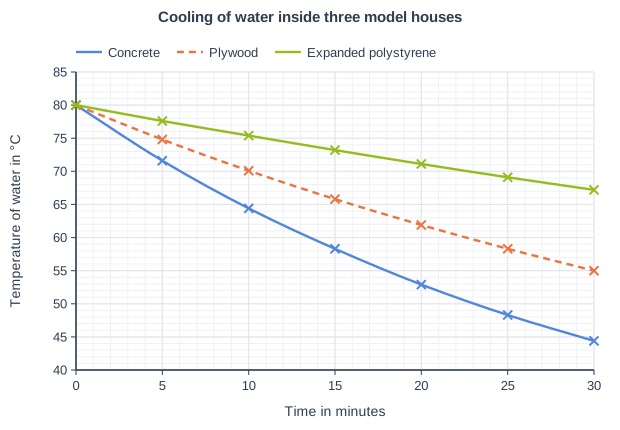
Zara makes three model houses of the same size. Their walls are the same thickness, but each house has walls made of a different material: concrete, plywood or expanded polystyrene.

She puts a beaker containing 200 cm³ of water at 80 °C inside each model house and closes it. She measures the temperature of the water with a digital thermometer every 5 minutes for 30 minutes.

The graph shows her results.

Use the graph to explain which material has the lowest thermal conductivity.

Cooling of water inside three model houses. Line graph of temperature of water in °C (y-axis, 40 to 85) against time in minutes (x-axis, 0 to 30). "Concrete" is a smooth curve through (0, 80), (5, 71.6), (10, 64.4), (15, 58.3), (20, 52.9), (25, 48.3), (30, 44.4). "Plywood" (dashed) is a smooth curve through (0, 80), (5, 74.8), (10, 70.1), (15, 65.8), (20, 61.9), (25, 58.3), (30, 55). "Expanded polystyrene" is a smooth curve through (0, 80), (5, 77.6), (10, 75.4), (15, 73.2), (20, 71.1), (25, 69.1), (30, 67.2).

Model answer

Expanded polystyrene has the lowest thermal conductivity. The water in the polystyrene house cooled the most slowly: it fell from 80 °C to 67.2 °C in 30 minutes, a fall of about 13 °C, compared with falls of 25 °C in the plywood house and about 36 °C in the concrete house. A material with a lower thermal conductivity transfers energy through the walls at a lower rate, so the water inside cools more slowly.

Explanation

The walls are the same thickness, so the difference in the rate of cooling is caused by the thermal conductivity of the material. The lowest thermal conductivity gives the slowest energy transfer, so the shallowest cooling curve. Use the graph by comparing values for all three houses at the same time, not by quoting one value.

Mark scheme
  1. 1 mark

    expanded polystyrene (1)

    Accept polystyrene.

  2. 1 mark

    the water in the polystyrene house cooled the least / most slowly, e.g. from 80 °C to 67.2 °C in 30 minutes, compared with 55.0 °C for plywood and 44.4 °C for concrete (1)

    Dependent on MP1. Accept values read from the graph within 1 °C, e.g. a fall of about 13 °C compared with about 25 °C (plywood) and about 36 °C (concrete), or a correct comparison at another time. Accept 'its line is the least steep'. Quoted values alone without a comparison are not enough.

  3. 1 mark

    a lower thermal conductivity means energy is transferred through the walls at a lower rate (so the water cools more slowly) (1)

    Accept heat for energy. Do not accept 'polystyrene keeps the cold out'.

Question 4

4 marks

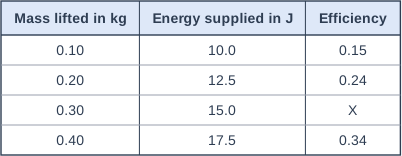
Priya investigates the efficiency of a small electric motor used to lift loads. The motor lifts different masses through a height of 1.5 m. A joulemeter measures the energy supplied to the motor for each lift.

The table shows her results.

Calculate the efficiency X.

Describe how the efficiency of the motor changes as the mass lifted increases, and suggest a reason for this change.

(g = 10 N/kg)

Table with columns "Mass lifted in kg", "Energy supplied in J", "Efficiency". Mass lifted in kg: 0.10; Energy supplied in J: 10.0; Efficiency: 0.15 | Mass lifted in kg: 0.20; Energy supplied in J: 12.5; Efficiency: 0.24 | Mass lifted in kg: 0.30; Energy supplied in J: 15.0; Efficiency: X | Mass lifted in kg: 0.40; Energy supplied in J: 17.5; Efficiency: 0.34.

Model answer

useful energy = ΔGPE = 0.30 × 10 × 1.5 = 4.5 J
X = 4.5 ÷ 15.0 = 0.30
The efficiency increases as the mass lifted increases.
Some of the energy wasted, such as the energy used to overcome friction in the motor and heat it, is about the same whatever the load. So as the load increases, the useful energy increases more than the wasted energy and a greater fraction of the energy supplied is useful.

Explanation

The useful energy is the gain in gravitational potential energy, 0.30 × 10 × 1.5 = 4.5 J, so X = 4.5 ÷ 15.0 = 0.30. The efficiency rises from 0.15 to 0.34 because the wasted energy (supplied minus useful) rises only from 8.5 J to 11.5 J while the useful energy quadruples. Describing the trend needs a statement, not just a list of values.

Mark scheme
  1. 1 mark

    (useful energy = ΔGPE =) 0.30 × 10 × 1.5 = 4.5 (J) (1)

    0.30 with or without working scores MP1 and MP2.

  2. 1 mark

    (X = 4.5 ÷ 15.0 =) 0.30 (1)

    Accept 0.3 or 30%. Allow ecf from the student's useful energy. 15.0 ÷ 4.5 = 3.3 (inverted) scores MP1 only. Leaving out g (useful energy 0.45 J, X = 0.03) scores MP2 only, by ecf.

  3. 1 mark

    the efficiency increases as the mass lifted increases (1)

    Accept 'the heavier the load, the more efficient the motor'. Ignore 'increases by smaller amounts each time' (true, but not required). Quoted values alone are not enough; the trend must be stated.

  4. 1 mark

    suggestion: (some of) the wasted energy, e.g. heating the motor / overcoming friction in the motor, is about the same whatever the load / the useful energy increases by more than the wasted energy, so a greater fraction of the energy supplied is useful (1)

    Accept data: e.g. from 0.10 kg to 0.40 kg the useful energy rises from 1.5 J to 6.0 J while the wasted energy rises only from 8.5 J to 11.5 J. Do not accept 'the motor works harder', 'heavier loads have more energy' or 'more energy is supplied' with no idea of the fraction that is useful.

Ready to try the rest? Every answer you write is marked against the mark scheme, so you can see exactly where the marks are.

Study Helper Hints first, answers after you try

Stuck on this one? Ask for a hint and I’ll point you in the right direction, without giving the answer away. Once you’ve checked your answer, I’ll show you how the marks are awarded.