
Level:
Correct: 0
Incorrect: 0
Marks: 0/0
Exam Practice
Course:
Topics:
Edexcel GCSE Physics (Paper 1) Smart practice A mixed round aimed at your weak spots
Unit 1
Key concepts of physics
Unit 2
Motion and forces
Unit 3
Conservation of energy
Unit 4
Waves
Unit 5
Light and the electromagnetic spectrum
Unit 6
Radioactivity
Unit 7
Astronomy
Avg
score:
–
Topics
done:
0/40

Core practical: force, mass and acceleration

Practise 15 exam-style questions on Core practical: force, mass and acceleration for Edexcel GCSE Physics (Paper 1). Write your answer as you would in the exam and get it marked in seconds against the mark scheme, point by point, with the Study Helper on hand if you get stuck.

  • 15 questions
  • 1–6 marks each
  • Instant marking
  • No sign-up needed
15 questions, marked as you go

Sample questions with model answers

Here are 4 of the questions in this topic, each with a model answer, an explanation of why it earns the marks and the mark scheme an examiner would use.

Question 1

1 mark

In the force, mass and acceleration core practical, a trolley on a runway is pulled by a string that passes over a pulley at the edge of the bench to a hanger of slotted masses. As the trolley moves along the runway, the hanging masses fall towards the floor.

Give one precaution the student should take to reduce the risk of injury in this practical.

Model answer

Put a box with some padding on the floor under the hanging masses so that they land in it, and keep feet clear of the area underneath them.

Explanation

The main hazards in this practical are slotted masses falling onto feet and the trolley running off the end of the bench. A padded box or sand tray under the masses, keeping clear of the area below them, or a stop at the end of the runway all reduce these risks. General answers such as 'wear goggles' do not deal with these hazards.

Mark scheme
  1. 1 mark

    place a box / tray (of sand) / cushion / soft material under the hanging masses (to catch them) (1)

    Any one from this point and the three that follow; max 1. Ignore 'wear goggles', 'wear a lab coat' or 'be careful' on their own: they do not reduce the risk from the falling masses or the moving trolley.

  2. 1 mark

    keep feet / legs / people away from the area under the hanging masses / stand clear of the falling masses (1)

    accept 'do not stand under the masses'.

  3. 1 mark

    fix a stop / buffer / block at the end of the runway so the trolley cannot hit the pulley or fall off the bench (1)

    accept 'catch the trolley before it reaches the end of the runway / the pulley'.

  4. 1 mark

    use small (enough) hanging masses so the trolley does not move too fast (1)

    accept any other valid precaution linked to the falling masses or the moving trolley, e.g. clamp the runway and pulley firmly to the bench.
Question 2

2 marks

Erin measures the speed of an accelerating trolley using one light gate and an interrupt card on the trolley. She divides the length of the card by the time the card takes to pass through the light gate.

Her teacher says that the shorter the card, the closer Erin's value will be to the speed of the trolley at the moment the card reaches the light gate.

Explain why.

Model answer

The trolley is accelerating, so its speed increases while the card is passing through the gate. Length ÷ time gives the average speed over that time, not the speed when the card reaches the gate. A shorter card passes through in less time, so the speed changes less and the average is closer to the speed at that moment.

Explanation

A light gate with a card measures an average speed over the time the card blocks the beam. For an accelerating trolley this average is higher than the speed when the card first reaches the gate, and the error is smaller when the card, and so the time, is shorter. Reaction time is not relevant because the gate starts and stops the timing automatically.

Mark scheme
  1. 1 mark

    the trolley is speeding up / its speed is increasing while the card passes through the gate (1)

    An explanation linking two of the three points; max 2.

  2. 1 mark

    (card length ÷ time) gives the average speed while the card is in the gate (not the speed at one instant) (1)

    accept 'it gives the mean speed over the length of the card'.

  3. 1 mark

    a shorter card passes through in less time, so the speed changes less during the measurement (1)

    accept 'a shorter card measures the speed over a shorter distance / time, so it is closer to an instantaneous speed'. Ignore 'a shorter card is more accurate' with no reason, and ignore references to reaction time (the light gate times automatically).

Question 3

3 marks

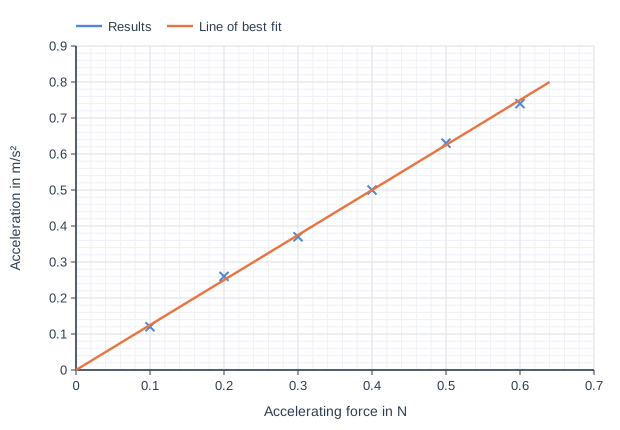
Ben investigates how the acceleration of a trolley depends on the accelerating force. He keeps the total mass being accelerated constant and compensates for friction.

The graph shows his results and his line of best fit.

Use the line of best fit to determine the total mass being accelerated.

Line graph of acceleration in m/s² (y-axis, 0 to 0.9) against Accelerating force in N (x-axis, 0 to 0.7). "Results" is shown as plotted points only (no line), at (0.1, 0.12), (0.2, 0.26), (0.3, 0.37), (0.4, 0.5), (0.5, 0.63), (0.6, 0.74). "Line of best fit" joins the points (0, 0), (0.64, 0.8).

Model answer

From the line, when F = 0.40 N, a = 0.50 m/s².
F = m × a, so m = F ÷ a = 0.40 ÷ 0.50 = 0.80 kg

Explanation

For a constant mass, F = m × a, so the mass equals force ÷ acceleration for any point on the line (or 1 ÷ the gradient). Using values from the line of best fit averages out the scatter in the individual results. Dividing acceleration by force gives 1.25, which is the gradient, not the mass.

Mark scheme
  1. 1 mark

    a correct pair of values read from the line, e.g. F = 0.40 (N) and a = 0.50 (m/s²) (1)

    allow any correct pair read from the line, e.g. 0.64 N and 0.80 m/s² or 0.60 N and 0.75 m/s², or gradient = 1.25 (accept 1.22 to 1.28). A plotted point may be used only if it lies on the line, e.g. (0.40 N, 0.50 m/s²); do not award this mark for a point off the line, e.g. (0.20 N, 0.26 m/s²), because the question asks for the line of best fit.

  2. 1 mark

    mass = force ÷ acceleration, e.g. 0.40 ÷ 0.50 (1)

    allow mass = 1 ÷ gradient, or F = m × a with values substituted. allow ecf from an incorrect reading.

  3. 1 mark

    0.80 (kg) (1)

    accept 0.78 to 0.82 (kg). An answer of 0.80 (kg) with no working scores 3 marks. Acceleration ÷ force (1.25) is an inverted ratio: it scores the first mark only.

Question 4

5 marks

Sam carries out the force, mass and acceleration core practical. He raises one end of the runway slightly to compensate for friction.

His trolley has a mass of 0.76 kg. The hanger and slotted masses on the string have a total mass of 40 g.

Two light gates record that the speed of the trolley is 0.18 m/s at the first gate and 0.72 m/s at the second gate. The trolley takes 1.20 s to travel from the first gate to the second gate.

Calculate the acceleration of the trolley from the light gate readings, and the acceleration Sam should expect if friction is fully compensated. Suggest a reason for the difference between the two values.

(gravitational field strength = 10 N/kg)

Model answer

Measured acceleration = (v − u) ÷ t = (0.72 − 0.18) ÷ 1.20 = 0.54 ÷ 1.20 = 0.45 m/s²
Accelerating force = weight of hanging masses = 0.040 kg × 10 N/kg = 0.40 N
Total mass being accelerated = 0.76 + 0.040 = 0.80 kg
Expected acceleration = F ÷ m = 0.40 ÷ 0.80 = 0.50 m/s²
The measured acceleration (0.45 m/s²) is less than expected (0.50 m/s²). The runway was probably not raised enough, so some friction is not compensated and the resultant force on the trolley and masses is less than 0.40 N.

Explanation

The measured value comes from a = (v − u) ÷ t, using the time between the gates. The expected value comes from F = m × a, where F is the weight of the hanging masses (40 g = 0.040 kg) and m is the total mass, including the hanging masses, because they accelerate too. Common errors are dividing the final speed by the time (0.60 m/s²) and dividing by the trolley mass alone (0.53 m/s²).

Mark scheme
  1. 1 mark

    (measured acceleration =) (0.72 − 0.18) ÷ 1.20 = 0.45 (m/s²) (1)

    Award full marks for the correct values without working: 0.45 m/s² scores this mark and 0.50 m/s² scores the next three marks. 0.72 ÷ 1.20 = 0.60 (initial speed ignored) is a wrong method and does not score this mark.

  2. 1 mark

    (accelerating force = weight of hanging masses =) 0.040 × 10 = 0.40 (N) (1)

    the mass must be converted to kg for this mark (40 × 10 = 400 does not score it).

  3. 1 mark

    (total mass being accelerated =) 0.76 + 0.040 = 0.80 (kg) (1)

    Using the trolley mass alone (0.76 kg) does not score this mark: the hanging masses are accelerated too.

  4. 1 mark

    (expected acceleration =) 0.40 ÷ 0.80 = 0.50 (m/s²) (1)

    allow ecf from an incorrect force or total mass, e.g. 0.40 ÷ 0.76 = 0.53 (m/s²) scores this mark but not the previous one.

  5. 1 mark

    friction is not fully compensated / the runway has not been raised enough, so the resultant force is less than the weight of the hanging masses (1)

    accept other valid sources of a resistive force, e.g. friction in the pulley or air resistance. Ignore 'human error', 'reaction time' (the light gates time automatically) or 'the light gates are inaccurate' with no explanation. Do not accept 'the runway was raised too much' (that would make the acceleration larger).

Ready to try the rest? Every answer you write is marked against the mark scheme, so you can see exactly where the marks are.

Study Helper Hints first, answers after you try

Stuck on this one? Ask for a hint and I’ll point you in the right direction, without giving the answer away. Once you’ve checked your answer, I’ll show you how the marks are awarded.