
Level:
Correct: 0
Incorrect: 0
Marks: 0/0
Exam Practice
Course:
Topics:
Edexcel GCSE Physics (Paper 1) Smart practice A mixed round aimed at your weak spots
Unit 1
Key concepts of physics
Unit 2
Motion and forces
Unit 3
Conservation of energy
Unit 4
Waves
Unit 5
Light and the electromagnetic spectrum
Unit 6
Radioactivity
Unit 7
Astronomy
Avg
score:
–
Topics
done:
0/40

The electromagnetic spectrum

Practise 15 exam-style questions on The electromagnetic spectrum for Edexcel GCSE Physics (Paper 1). Write your answer as you would in the exam and get it marked in seconds against the mark scheme, point by point, with the Study Helper on hand if you get stuck.

  • 15 questions
  • 1–6 marks each
  • Instant marking
  • No sign-up needed
15 questions, marked as you go

Sample questions with model answers

Here are 4 of the questions in this topic, each with a model answer, an explanation of why it earns the marks and the mark scheme an examiner would use.

Question 1

1 mark

White light is made up of the colours of the visible spectrum.

Which colour of light has a wavelength between the wavelength of green light and the wavelength of violet light?

Choose your answer.

  • A red
  • B blue
  • C yellow
  • D orange

Model answer

B - blue.

Explanation

The visible spectrum runs red, orange, yellow, green, blue, indigo, violet, from the longest wavelength (lowest frequency) to the shortest wavelength (highest frequency). Blue (and indigo) lie between green and violet.

Mark scheme
  1. 1 mark

    B / blue (1)

    The only correct answer is B: in order of decreasing wavelength the colours are red, orange, yellow, green, blue, indigo, violet, so blue lies between green and violet. A is not correct because red has the longest wavelength of visible light; C is not correct because yellow lies between orange and green; D is not correct because orange lies between red and yellow. Accept the letter or the option. If more than one option is given, do not award the mark.
Question 2

2 marks

The electromagnetic spectrum is described as continuous, although it is divided into groups such as microwaves and infrared.

Describe what is meant by saying that the electromagnetic spectrum is continuous.

Model answer

There are no gaps in the spectrum: every wavelength (and frequency) from the longest radio waves to the shortest gamma rays can exist. The groups merge into each other, so there is no sharp boundary where, for example, microwaves end and infrared begins - the groups are just convenient names for ranges of wavelength.

Explanation

Continuous means unbroken: the wavelength changes smoothly along the spectrum. The groups are named ranges chosen for convenience, and neighbouring groups overlap at their edges. A common error is to describe the order of the groups instead of what 'continuous' means.

Mark scheme
  1. 1 mark

    there are no gaps / every wavelength (or frequency) between radio waves and gamma rays is possible (1)

    accept the wavelength changes smoothly from one end to the other. ignore 'it goes on forever'.

  2. 1 mark

    the groups merge into each other / there are no sharp boundaries between the groups (1)

    accept the boundaries between groups are not exact / are chosen by people / neighbouring groups overlap. do not accept 'all the groups have the same wavelength'.

Question 3

3 marks

Satellite television signals are microwaves with a wavelength of 2.5 cm. Green light has a wavelength of 5.0 × 10⁻⁷ m.

Both travel at 3.0 × 10⁸ m/s in air.

Calculate how many times greater the frequency of green light is than the frequency of the microwaves.

Model answer

Wavelength of microwaves = 2.5 cm = 0.025 m
Frequency of microwaves = v ÷ λ = 3.0 × 10⁸ ÷ 0.025 = 1.2 × 10¹⁰ Hz
Frequency of green light = 3.0 × 10⁸ ÷ 5.0 × 10⁻⁷ = 6.0 × 10¹⁴ Hz
Ratio = 6.0 × 10¹⁴ ÷ 1.2 × 10¹⁰ = 50 000
The frequency of green light is 5.0 × 10⁴ times greater.

Explanation

Because both waves travel at the same speed, frequency is inversely proportional to wavelength, so the ratio of frequencies is the wavelength of the microwaves divided by the wavelength of the green light (both in metres). The most common errors are forgetting to convert 2.5 cm to metres, which gives an answer 100 times too big, and dividing the wrong way round.

Mark scheme
  1. 1 mark

    (wavelength of microwaves =) 2.5 cm = 0.025 m (1)

    accept the wavelengths in any one consistent unit, e.g. green light = 5.0 × 10⁻⁵ cm.

  2. 1 mark

    f = v ÷ λ for both: microwaves 1.2 × 10¹⁰ Hz and green light 6.0 × 10¹⁴ Hz / the frequency ratio is the inverse of the wavelength ratio, 0.025 ÷ 5.0 × 10⁻⁷ (1)

    accept the idea that the speed is the same, so frequency is inversely proportional to wavelength. allow ecf from an incorrect unit conversion.

  3. 1 mark

    50 000 / 5.0 × 10⁴ (1)

    An answer of 50 000 / 5.0 × 10⁴ with no working scores 3 marks. 5.0 × 10⁶ (cm not converted) or another power of ten error scores 2 marks. an inverted ratio (2.0 × 10⁻⁵) is a wrong method and scores only the conversion mark if it is seen.

Question 4

4 marks

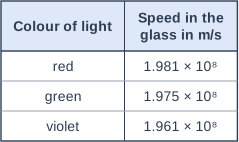
White light enters a glass prism. The table shows the speed of red, green and violet light in this glass. In air, all colours of light travel at 3.00 × 10⁸ m/s.

Explain why the prism splits white light into a spectrum, with violet light refracted more than red light.

Table with columns "Colour of light", "Speed in the glass in m/s". Colour of light: red; Speed in the glass in m/s: 1.981 × 10⁸ | Colour of light: green; Speed in the glass in m/s: 1.975 × 10⁸ | Colour of light: violet; Speed in the glass in m/s: 1.961 × 10⁸.

Model answer

All the colours slow down when they enter the glass from air, so they are all refracted. But different colours travel at different speeds in the glass: red light at 1.981 × 10⁸ m/s, green at 1.975 × 10⁸ m/s and violet at 1.961 × 10⁸ m/s. Violet light slows down the most, so it is refracted the most, and red light slows down the least, so it is refracted the least. So each colour leaves the prism in a slightly different direction and the white light spreads out into a spectrum.

Explanation

The amount of refraction depends on the change in speed, so colours that slow down more are bent more. In glass, violet light is slowest and is refracted most; red is fastest and is refracted least, which separates the colours. Answers that say violet bends more because it has more energy miss the speed idea that explains refraction.

Mark scheme
  1. 1 mark

    all colours slow down as they enter the glass, so they are all refracted (1)

    An explanation linking. accept light travels more slowly in glass than in air, so it changes direction (bends towards the normal).

  2. 1 mark

    different colours travel at different speeds in the glass (1)

    accept quoted speeds, e.g. red 1.981 × 10⁸ m/s and violet 1.961 × 10⁸ m/s.

  3. 1 mark

    violet light slows down the most / has the lowest speed in the glass (and red the least) (1)

    accept violet has the biggest change in speed.

  4. 1 mark

    so violet light is refracted (bent) the most and red light the least, so the colours spread out / separate (1)

    accept the bigger the change in speed, the more the light is refracted. do not accept 'violet is refracted most because it has the most energy' without the speed idea. ignore 'violet has the shortest wavelength' unless linked to speed.

Ready to try the rest? Every answer you write is marked against the mark scheme, so you can see exactly where the marks are.

Study Helper Hints first, answers after you try

Stuck on this one? Ask for a hint and I’ll point you in the right direction, without giving the answer away. Once you’ve checked your answer, I’ll show you how the marks are awarded.