
Level:
Correct: 0
Incorrect: 0
Marks: 0/0
Exam Practice
Course:
Topics:
Edexcel GCSE Physics (Paper 1) Smart practice A mixed round aimed at your weak spots
Unit 1
Key concepts of physics
Unit 2
Motion and forces
Unit 3
Conservation of energy
Unit 4
Waves
Unit 5
Light and the electromagnetic spectrum
Unit 6
Radioactivity
Unit 7
Astronomy
Avg
score:
–
Topics
done:
0/40

Radiation in medicine and nuclear power

Practise 17 exam-style questions on Radiation in medicine and nuclear power for Edexcel GCSE Physics (Paper 1). Write your answer as you would in the exam and get it marked in seconds against the mark scheme, point by point, with the Study Helper on hand if you get stuck.

  • 17 questions
  • 1–6 marks each
  • Instant marking
  • No sign-up needed
17 questions, marked as you go

Sample questions with model answers

Here are 4 of the questions in this topic, each with a model answer, an explanation of why it earns the marks and the mark scheme an examiner would use.

Question 1

1 mark

In a PET scan, the patient is injected with a tracer containing an isotope with a short half-life, such as fluorine-18.

What is the main advantage of the short half-life for the patient?

Choose your answer.

  • A the patient's dose is kept low
  • B the tracer can be made far away
  • C the tracer can be kept for months
  • D the positrons are more penetrating

Model answer

A - the patient's dose is kept low.

Explanation

A tracer with a short half-life gives out enough radiation for the scan and then loses its activity quickly, so the patient is exposed for only a short time. The disadvantage of a short half-life is that the isotope must be made close to where it is used. The half-life has no effect on the type or penetration of the radiation.

Mark scheme
  1. 1 mark

    A / the patient's dose is kept low (1)

    The only correct answer is A: the isotope decays quickly, so it gives out radiation inside the patient for only a short time and the total dose the patient receives is small. B is not correct because a short half-life means the isotope must be made near the hospital, as it decays during a long journey; C is not correct because an isotope with a short half-life decays quickly, so it cannot be stored; D is not correct because the half-life does not affect how penetrating the radiation is. Accept the letter or the option. If more than one option is given, do not award the mark.
Question 2

2 marks

Nuclear power stations do not release carbon dioxide when they generate electricity. However, when everything needed to run a nuclear power station over its whole life is taken into account, some carbon dioxide is released.

Suggest two reasons why.

Model answer

Energy, much of it from fossil fuels, is used to mine the uranium ore and to process it into fuel, which releases carbon dioxide. Building the power station also releases carbon dioxide, because large amounts of steel and concrete have to be made.

Explanation

Nuclear fission itself releases no carbon dioxide, but mining and processing the fuel, building and later taking apart the power station, and dealing with its waste all use energy and materials whose production releases carbon dioxide. Even so, over its whole life a nuclear power station releases only a few per cent of the carbon dioxide released by a gas-fired one for each unit of electricity.

Mark scheme
  1. 1 mark

    mining the uranium ore (1)

    Any two from the six points; max 2. 1 mark for each different activity; the activity releases carbon dioxide because energy from fossil fuels is used. Ignore 'the reactor burns uranium'. Do not accept 'nuclear fission releases carbon dioxide' or 'the steam from the cooling towers is carbon dioxide'.

  2. 1 mark

    processing / enriching the uranium / making the fuel (1)

    Accept 'the uranium has to be purified, which uses energy'.

  3. 1 mark

    building the power station / making the steel and concrete for it (1)

    Accept 'making cement releases carbon dioxide'.

  4. 1 mark

    transporting the fuel / ore / waste (by road, rail or sea) (1)

    Accept 'lorries and ships carrying the uranium burn fossil fuels'.

  5. 1 mark

    taking apart / decommissioning the power station at the end of its life (1)

  6. 1 mark

    treating / storing / disposing of the radioactive waste (1)

    Accept 'building a store for the waste deep underground'.

Question 3

3 marks

Fluorine-18 for PET scans is made in a cyclotron at a regional centre and then driven to hospitals. Fluorine-18 has a half-life of 110 minutes.

A hospital needs fluorine-18 with an activity of 400 MBq when it arrives. The journey from the cyclotron to this hospital takes 220 minutes.

Calculate the minimum activity the fluorine-18 must have when it leaves the cyclotron.

Model answer

Number of half-lives during the journey = 220 ÷ 110 = 2
The activity halves twice on the way, so the activity at the cyclotron must be 2 × 2 = 4 times the activity needed.
Activity at the cyclotron = 400 × 4 = 1600 MBq

Explanation

The journey lasts two half-lives, so only a quarter of the activity made at the cyclotron is left on arrival; the cyclotron must therefore make four times the activity the hospital needs. A common error is to halve 400 MBq instead of doubling it: the activity is higher at the start of the journey, not lower. The longer the journey, the more must be made - which is why PET isotopes are produced as near as possible to where they are used.

Mark scheme
  1. 1 mark

    (number of half-lives =) 220 ÷ 110 = 2 (1)

    An answer of 1600 MBq with no working scores 3 marks. Accept working that doubles back from 400 MBq: 400 → 800 → 1600.

  2. 1 mark

    (activity at the cyclotron =) 400 × 2 × 2 / 400 × 4 (1)

    800 MBq (doubling only once) scores MP1 only if two half-lives are stated. 100 MBq (halving instead of doubling) scores MP1 only.

  3. 1 mark

    1600 (MBq) (1)

    Accept 1.6 × 10⁹ Bq or 1.6 GBq.

Question 4

4 marks

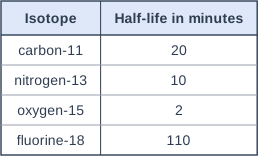
The table shows four positron-emitting isotopes used in PET scans, and their half-lives. All four are made in cyclotrons.

Hospital H does not have a cyclotron. The nearest cyclotron is 110 minutes' drive away.

Use the data to explain why fluorine-18 is the only one of these isotopes that Hospital H can use, and why a hospital with its own cyclotron can use all four.

Table with columns "Isotope", "Half-life in minutes". Isotope: carbon-11; Half-life in minutes: 20 | Isotope: nitrogen-13; Half-life in minutes: 10 | Isotope: oxygen-15; Half-life in minutes: 2 | Isotope: fluorine-18; Half-life in minutes: 110.

Model answer

The journey takes 110 minutes. Fluorine-18 has a half-life of 110 minutes, so it decays for only one half-life on the way and half of its activity is left when it arrives. Carbon-11 would decay for 110 ÷ 20 = 5.5 half-lives, so only about 2% of it would be left, and nitrogen-13 (11 half-lives) and oxygen-15 (55 half-lives) would have almost completely decayed. So the cyclotron would have to make an impossibly large activity of these isotopes for any to be left. A hospital with its own cyclotron can inject the isotope within minutes of making it, before much of it has decayed, so it can use all four.

Explanation

Divide the journey time by each half-life to find how many half-lives pass: 1 for fluorine-18, 5.5 for carbon-11, 11 for nitrogen-13 and 55 for oxygen-15. Only fluorine-18 has enough activity left to be useful, which is why the isotopes used in PET must be made close to where they are used, and the shortest-lived ones in the same building. Answers that just say 'the others have shorter half-lives' without using the data cannot gain full marks.

Mark scheme
  1. 1 mark

    fluorine-18 decays for only one half-life on the journey, so half of its activity is left when it arrives (1)

    Any four from the five points; max 4. Max 3 if the half-lives are not used numerically (e.g. as a number of half-lives or a fraction left). Max 3 if nothing is said about a hospital with its own cyclotron (MP5).

  2. 1 mark

    carbon-11 decays for 5.5 half-lives, so only about 2% (1/45) of its activity is left (1)

    Accept 'more than 5 half-lives, so less than 1/32 is left'.

  3. 1 mark

    nitrogen-13 (11 half-lives) and oxygen-15 (55 half-lives) would have (almost) completely decayed before arriving (1)

    Accept either isotope with its number of half-lives, e.g. 'oxygen-15 goes through 55 half-lives, so none would be left'.

  4. 1 mark

    so for isotopes other than fluorine-18 the activity made at the cyclotron would have to be impossibly large / almost nothing would be left to use (1)

    Accept 'carbon-11 would need about 45 times the activity the hospital needs to be made'.

  5. 1 mark

    a hospital with its own cyclotron can use an isotope within minutes of making it, before much of it has decayed (1)

    Accept 'there is no journey, so even oxygen-15, with a 2-minute half-life, can be used before it decays'.

Ready to try the rest? Every answer you write is marked against the mark scheme, so you can see exactly where the marks are.

Study Helper Hints first, answers after you try

Stuck on this one? Ask for a hint and I’ll point you in the right direction, without giving the answer away. Once you’ve checked your answer, I’ll show you how the marks are awarded.