
Level:
Correct: 0
Incorrect: 0
Marks: 0/0
Exam Practice
Course:
Topics:
Edexcel GCSE Physics (Paper 1) Smart practice A mixed round aimed at your weak spots
Unit 1
Key concepts of physics
Unit 2
Motion and forces
Unit 3
Conservation of energy
Unit 4
Waves
Unit 5
Light and the electromagnetic spectrum
Unit 6
Radioactivity
Unit 7
Astronomy
Avg
score:
–
Topics
done:
0/40

Scalars and vectors

Practise 13 exam-style questions on Scalars and vectors for Edexcel GCSE Physics (Paper 1). Write your answer as you would in the exam and get it marked in seconds against the mark scheme, point by point, with the Study Helper on hand if you get stuck.

  • 13 questions
  • 1–6 marks each
  • Instant marking
  • No sign-up needed
13 questions, marked as you go

Sample questions with model answers

Here are 4 of the questions in this topic, each with a model answer, an explanation of why it earns the marks and the mark scheme an examiner would use.

Question 1

1 mark

A student writes four values in her notes on motion. Each value has a unit, and three of them also have a direction.

Which value is a velocity?

Choose your answer.

  • A 25 m/s
  • B 25 m/s north
  • C 25 m north
  • D 25 m/s² north

Model answer

B 25 m/s north

Explanation

A velocity has a size, measured in m/s, and a direction. A speed on its own (25 m/s) is a scalar; giving its direction makes it a velocity. Check the unit as well as the direction: a quantity in m with a direction is a displacement, and one in m/s² is an acceleration.

Mark scheme
  1. 1 mark

    B / 25 m/s north (1)

    The only correct answer is B: velocity is speed in a stated direction, so it needs a unit of speed (m/s) and a direction. A is not correct because it has no direction, so it is a speed (a scalar); C is not correct because a distance in metres with a direction is a displacement; D is not correct because m/s² is the unit of acceleration. Accept the letter or the option. If more than one option is given, do not award the mark.
Question 2

2 marks

The speedometer in a car shows a reading of 48 km/h.

Explain why this reading is the speed of the car and not its velocity.

Model answer

Velocity is speed in a stated direction, so it is a vector with both a size and a direction. The speedometer only shows the size of the car's speed (48 km/h) and gives no information about the direction the car is travelling in, so its reading is a speed, which is a scalar.

Explanation

To be a velocity, a value needs a direction as well as a size, e.g. 48 km/h due west. A speedometer reads the same whichever way the car is going, so it shows speed only. Saying the unit makes it a speed is wrong, because speed and velocity have the same units.

Mark scheme
  1. 1 mark

    velocity is speed in a (stated) direction / velocity is a vector, with size and direction (1)

    An explanation linking MP1 and MP2.

  2. 1 mark

    the speedometer gives only the size of the speed / does not show the direction the car is moving in (1)

    accept 'the reading has no direction' / 'it is only a number and a unit'; ignore references to the speed changing; do not accept 'because speed is measured in km/h' (a velocity can have the same unit).

Question 3

3 marks

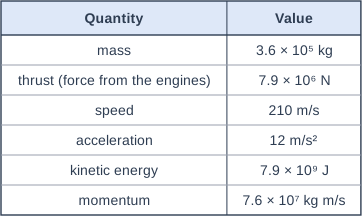
The table gives some information about a rocket at one moment during its launch.

For each quantity in the table, state whether it is a scalar quantity or a vector quantity.

Table with columns "Quantity", "Value". Quantity: mass; Value: 3.6 × 10⁵ kg | Quantity: thrust (force from the engines); Value: 7.9 × 10⁶ N | Quantity: speed; Value: 210 m/s | Quantity: acceleration; Value: 12 m/s² | Quantity: kinetic energy; Value: 7.9 × 10⁹ J | Quantity: momentum; Value: 7.6 × 10⁷ kg m/s.

Model answer

mass: scalar
thrust: vector
speed: scalar
acceleration: vector
kinetic energy: scalar
momentum: vector

Explanation

Force (including thrust), acceleration and momentum have a direction as well as a size, so they are vectors; mass, speed and energy have a size only, so they are scalars. The table does not give any directions, but the rocket's thrust, acceleration and momentum all act upwards. Energy is often wrongly called a vector because the rocket is moving in a direction.

Mark scheme
  1. 3 marks

    mass - scalar; thrust - vector; speed - scalar; acceleration - vector; kinetic energy - scalar; momentum - vector (3)

    all six correct scores 3 marks; four or five correct scores 2 marks; two or three correct scores 1 mark; none or one correct scores 0. A quantity given as both scalar and vector counts as wrong. The table gives no directions: the answers depend on the type of quantity, not on whether a direction is written.

Question 4

4 marks

A funicular railway has a carriage that is pulled by a cable along a straight track up a steep hillside. The carriage travels 1.2 km from the bottom station to the top station, stops, and then returns along the same track to the bottom station. The whole round trip, including the stop, takes 10 minutes.

Ben says: 'The carriage's average speed for the round trip was zero, because it finished where it started.'

Evaluate Ben's statement.

Model answer

The carriage finishes where it started, so its displacement for the round trip is zero, and its average velocity (a vector, which depends on displacement) is zero. Ben's reasoning would be right for velocity.
But speed is a scalar, worked out from the total distance travelled, whatever the direction. The carriage travelled 1200 m + 1200 m = 2400 m in 10 × 60 = 600 s.
average speed = 2400 ÷ 600 = 4.0 m/s
So Ben's statement is wrong: the carriage's average speed was 4.0 m/s, not zero; only its average velocity was zero.

Explanation

Average speed = total distance ÷ total time, and distance (a scalar) keeps adding up whichever way the carriage moves; the total time includes the stop. Displacement and velocity are vectors, so a return trip gives zero displacement and zero average velocity. Using only one direction of the trip (1.2 km), or forgetting to change 10 minutes to 600 s for an answer in m/s, are common errors.

Mark scheme
  1. 1 mark

    the carriage's displacement (for the round trip) is zero / it ends where it started (1)

    An answer including a judgement supported by evidence. MP1-MP4 can be awarded in any order.

  2. 1 mark

    so it is its average velocity that is zero / Ben's reasoning only applies to a vector such as displacement or velocity, not to speed (1)

    accept 'Ben has confused speed with velocity' if linked to displacement or direction.

  3. 1 mark

    speed is a scalar, (calculated) from the total distance travelled, 2400 m / 2.4 km (1)

    accept 2 × 1.2 km used as the distance.

  4. 1 mark

    (average speed =) 2400 ÷ 600 = 4.0 m/s, so Ben is wrong (1)

    accept 4 m/s, 240 m/min, 0.24 km/min or 14.4 km/h; a correct value of 4.0 m/s with no working scores MP3 and MP4 (award full marks for the calculation without working); do not award MP4 for 2.0 m/s (1200 ÷ 600, one direction only) or 240 m/s (the time left in minutes).

Ready to try the rest? Every answer you write is marked against the mark scheme, so you can see exactly where the marks are.

Study Helper Hints first, answers after you try

Stuck on this one? Ask for a hint and I’ll point you in the right direction, without giving the answer away. Once you’ve checked your answer, I’ll show you how the marks are awarded.