
Level:
Correct: 0
Incorrect: 0
Marks: 0/0
Exam Practice
Course:
Topics:
Edexcel GCSE Physics (Paper 1) Smart practice A mixed round aimed at your weak spots
Unit 1
Key concepts of physics
Unit 2
Motion and forces
Unit 3
Conservation of energy
Unit 4
Waves
Unit 5
Light and the electromagnetic spectrum
Unit 6
Radioactivity
Unit 7
Astronomy
Avg
score:
–
Topics
done:
0/40

Nuclear fission and nuclear reactors

Practise 15 exam-style questions on Nuclear fission and nuclear reactors for Edexcel GCSE Physics (Paper 1). Write your answer as you would in the exam and get it marked in seconds against the mark scheme, point by point, with the Study Helper on hand if you get stuck.

  • 15 questions
  • 1–6 marks each
  • Instant marking
  • No sign-up needed
15 questions, marked as you go

Sample questions with model answers

Here are 4 of the questions in this topic, each with a model answer, an explanation of why it earns the marks and the mark scheme an examiner would use.

Question 1

1 mark

Fuel rods are taken out of a nuclear reactor after several years of use. The used fuel is far more radioactive than the fuel was before it went into the reactor.

Which of these is the main reason?

Choose your answer.

  • A heat makes the uranium decay faster
  • B it now contains more uranium-235
  • C it contains the products of fission
  • D gamma rays made the fuel radioactive

Model answer

C - it contains the products of fission.

Explanation

Every fission produces two daughter nuclei, and these products of fission are radioactive. They build up in the fuel while the reactor works, so used fuel is highly radioactive and must be handled and stored with great care. Heating does not change the rate of radioactive decay, and irradiating a material with gamma rays does not make it radioactive - both are common misconceptions.

Mark scheme
  1. 1 mark

    C / it contains the products of fission (1)

    The only correct answer is C: the daughter nuclei (fission products) formed when uranium-235 nuclei split are radioactive, and they build up in the fuel while the reactor is working. A is not correct because the rate of radioactive decay does not depend on temperature. B is not correct because uranium-235 is used up while the reactor is working, so the used fuel contains less uranium-235, not more. D is not correct because being irradiated by gamma rays does not make a material radioactive. Accept the letter or the option. If more than one option is given, do not award the mark.
Question 2

2 marks

In a nuclear power station, the reactor transfers 1600 MJ of thermal energy to the coolant each second. The power station has an efficiency of 38%.

Calculate the electrical energy that the power station transfers to the National Grid each second.

Model answer

efficiency = useful energy output ÷ total energy input
useful (electrical) energy output = efficiency × total energy input
= 0.38 × 1600
= 608 MJ each second

Explanation

Rearrange efficiency = useful energy output ÷ total energy input to give useful energy output = efficiency × input, using 38% as 0.38. The other 992 MJ each second is wasted, mostly as thermal energy carried away by the cooling water in the condenser. A common error is to divide 1600 by 0.38, which gives an output bigger than the input.

Mark scheme
  1. 1 mark

    substitution and rearrangement: (useful energy output =) 0.38 × 1600 / 38 ÷ 100 × 1600 (1)

    An answer of 608 MJ with no working scores 2 marks. Allow 610 MJ. 60 800 MJ (38 × 1600, not divided by 100) is a power-of-ten error and scores 1 mark. Do not credit 1600 ÷ 0.38 (4200 MJ): this is a wrong rearrangement and scores 0.

  2. 1 mark

    608 (MJ) (1)

    Accept 6.08 × 10⁸ J.

Question 3

3 marks

In a pressurised water reactor (PWR), ordinary water is used as both the moderator and the coolant. The water is kept at a very high pressure so that it does not boil in the reactor core.

If some of the water in the core did turn into steam, the rate of fission in the core would decrease. Engineers see this as a safety feature. (Source: World Nuclear Association)

Explain why the rate of fission would decrease.

Model answer

Steam is much less dense than liquid water, so there would be far fewer water molecules in the core to act as the moderator. Fewer neutrons would collide with the nuclei in the water and be slowed down. Fast neutrons are much less likely to be absorbed by uranium-235 nuclei and cause fission, so the number of fissions each second would fall.

Explanation

The moderator's job is to slow down neutrons, because slow neutrons are much more likely to cause uranium-235 nuclei to split. Steam contains far fewer molecules than the same volume of water, so it is a poor moderator, the neutrons stay fast and the chain reaction slows. This is a safety feature because overheating the water automatically reduces the rate of fission.

Mark scheme
  1. 1 mark

    steam is much less dense than water / there would be far fewer water molecules in the core / there would be less moderator (1)

    An explanation linking the three points.

  2. 1 mark

    so fewer neutrons would be slowed down / the neutrons would stay fast (1)

    Accept 'fewer collisions between neutrons and (hydrogen) nuclei in the water'. Do not accept 'fewer neutrons absorbed by the water' (that would not reduce the rate of fission).

  3. 1 mark

    fast neutrons are less likely to be absorbed by uranium-235 nuclei / to cause fission, so there are fewer fissions (1)

    Accept 'slow neutrons are needed to cause fission (of uranium-235), so the chain reaction slows down'.

Question 4

4 marks

When a nuclear reactor is shut down, all the control rods are lowered fully into the core and the chain reaction stops. However, the fuel continues to release thermal energy.

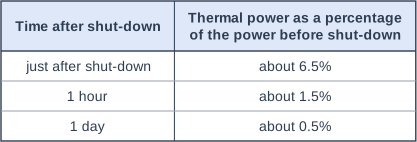
The table shows the thermal power of the fuel after shut-down, as a percentage of the thermal power of the reactor before it was shut down. The values are approximate, for a reactor that has been working steadily for a long time. (Data: World Nuclear Association and published reactor data)

Before it was shut down, the thermal power of the reactor was 3000 MW.

Calculate the thermal power of the fuel 1 hour after shut-down.

Explain why the fuel continues to release thermal energy after the chain reaction has stopped, and why the coolant must continue to flow through the core.

Table with columns "Time after shut-down", "Thermal power as a percentage of the power before shut-down". Time after shut-down: just after shut-down; Thermal power as a percentage of the power before shut-down: about 6.5% | Time after shut-down: 1 hour; Thermal power as a percentage of the power before shut-down: about 1.5% | Time after shut-down: 1 day; Thermal power as a percentage of the power before shut-down: about 0.5%.

Model answer

Thermal power after 1 hour = 1.5% of 3000 MW = 0.015 × 3000 = 45 MW
The daughter nuclei produced by fission are radioactive. Even after the chain reaction has stopped they continue to decay, and each decay releases energy, which heats the fuel. The coolant must keep flowing to carry this thermal energy away; otherwise the temperature of the fuel would keep rising and the fuel could overheat and melt.

Explanation

Read the percentage for 1 hour (about 1.5%) and take 1.5% of 3000 MW to get 45 MW. The products of fission are radioactive, so their decay keeps releasing energy after the chain reaction stops; the power falls as they decay, but it is still large, so cooling must continue. A common error is to think that fission carries on slowly after shut-down.

Mark scheme
  1. 1 mark

    (thermal power =) 1.5 ÷ 100 × 3000 / 0.015 × 3000 (1)

    An answer of 45 MW with no working scores MP1 and MP2. Using 6.5% (195 MW) or 0.5% (15 MW) does not score MP1 or MP2. An otherwise correct answer with a power-of-ten error (e.g. 4500 MW from 1.5 × 3000) scores 1 mark.

  2. 1 mark

    45 (MW) (1)

    Accept 4.5 × 10⁷ W.

  3. 1 mark

    the daughter nuclei / fission products (in the fuel) are radioactive and (continue to) decay, releasing energy (1)

    Accept 'the products of fission are radioactive, and radioactive decay releases energy'. Do not accept 'some fission continues', 'the chain reaction slows down gradually' or 'the fuel is still hot' alone.

  4. 1 mark

    the coolant must carry this thermal energy away, otherwise the temperature of the fuel would rise and it could overheat / melt (1)

    Accept 'to stop the core overheating or melting'. Ignore 'to keep it cool' alone.

Ready to try the rest? Every answer you write is marked against the mark scheme, so you can see exactly where the marks are.

Study Helper Hints first, answers after you try

Stuck on this one? Ask for a hint and I’ll point you in the right direction, without giving the answer away. Once you’ve checked your answer, I’ll show you how the marks are awarded.