
Level:
Correct: 0
Incorrect: 0
Marks: 0/0
Exam Practice
Course:
Topics:
Edexcel GCSE Physics (Paper 1) Smart practice A mixed round aimed at your weak spots
Unit 1
Key concepts of physics
Unit 2
Motion and forces
Unit 3
Conservation of energy
Unit 4
Waves
Unit 5
Light and the electromagnetic spectrum
Unit 6
Radioactivity
Unit 7
Astronomy
Avg
score:
–
Topics
done:
0/40

Gravity, the Solar System and orbits

Practise 17 exam-style questions on Gravity, the Solar System and orbits for Edexcel GCSE Physics (Paper 1). Write your answer as you would in the exam and get it marked in seconds against the mark scheme, point by point, with the Study Helper on hand if you get stuck.

  • 17 questions
  • 1–6 marks each
  • Instant marking
  • No sign-up needed
17 questions, marked as you go

Sample questions with model answers

Here are 4 of the questions in this topic, each with a model answer, an explanation of why it earns the marks and the mark scheme an examiner would use.

Question 1

1 mark

A communications satellite is in a geostationary orbit, so it stays above the same point on the Earth's equator.

Which statement about this satellite's orbit is correct?

Choose your answer.

  • A it orbits once in about 24 hours
  • B it is in a very low orbit
  • C it moves faster than the ISS
  • D it orbits from east to west

Model answer

A - it orbits once in about 24 hours.

Explanation

A geostationary satellite orbits above the equator, in the same direction as the Earth spins, and takes about 24 hours (ESA gives 23 hours 56 minutes) to go round once, so it stays above the same point on the Earth. This needs a high orbit, about 36 000 km above the surface, where the satellite moves at only about 3 km/s.

Mark scheme
  1. 1 mark

    A / it orbits once in about 24 hours (1)

    The only correct answer is A: to stay above the same point, the satellite must go round once in the time it takes the Earth to spin once, about 24 hours. B is not correct because a geostationary orbit is very high, about 36 000 km above the equator; C is not correct because the satellite's orbit has a much larger radius than that of the International Space Station (about 400 km up), so for a stable orbit it moves more slowly (about 3 km/s compared with about 7.7 km/s); D is not correct because it orbits from west to east, the same direction as the Earth spins. Accept the letter or the option. If more than one option is given, do not award the mark.
Question 2

2 marks

Pluto was discovered in 1930 and was called the ninth planet for many years. In 2005, astronomers discovered Eris, a body about the same size as Pluto, orbiting the Sun beyond Neptune. In 2006, astronomers agreed a new definition of a planet, and Pluto was reclassified as a dwarf planet.

Suggest why the discovery of Eris led astronomers to change their ideas about Pluto.

Model answer

Eris is about the same size as Pluto, so if Pluto counted as a planet, Eris would have to be a planet too - and more objects like them were likely to be found beyond Neptune. Astronomers therefore agreed a new definition of a planet and a new group, the dwarf planets, for these smaller bodies, which include Pluto and Eris.

Explanation

Scientific ideas change when new evidence is found. NASA describes how the discovery of Eris started a debate that led the International Astronomical Union, in 2006, to define what a planet is and to create the group of dwarf planets, which includes Pluto and Eris. Good answers link the change to Eris being similar in size to Pluto.

Mark scheme
  1. 1 mark

    if Pluto was a planet, Eris (which is about the same size) would also have to be called a planet (1)

    Any two from the three points; max 2. Do not accept answers that only repeat the question, e.g. 'Eris was discovered so Pluto became a dwarf planet' or 'a new definition of a planet was needed / a new group, dwarf planets, was made', unless linked to one of these reasons.

  2. 1 mark

    more objects like Pluto and Eris were likely to be found beyond Neptune / Pluto was one of many similar small bodies (1)

    Accept 'there could have been many more planets'.

  3. 1 mark

    Pluto is much smaller than the other eight planets / Pluto shares its region of space (orbit) with many other objects (1)

    Accept 'Pluto has not cleared its orbit of other objects'. Ignore 'Pluto is too far from the Sun'.

Question 3

3 marks

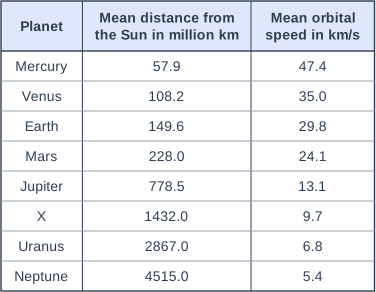
The table shows NASA data for the eight planets of our Solar System, in order of their distance from the Sun. The name of one planet has been replaced by X.

Name planet X.

Describe the relationship between the mean distance of a planet from the Sun and its mean orbital speed.

Table with columns "Planet", "Mean distance from the Sun in million km", "Mean orbital speed in km/s". Planet: Mercury; Mean distance from the Sun in million km: 57.9; Mean orbital speed in km/s: 47.4 | Planet: Venus; Mean distance from the Sun in million km: 108.2; Mean orbital speed in km/s: 35.0 | Planet: Earth; Mean distance from the Sun in million km: 149.6; Mean orbital speed in km/s: 29.8 | Planet: Mars; Mean distance from the Sun in million km: 228.0; Mean orbital speed in km/s: 24.1 | Planet: Jupiter; Mean distance from the Sun in million km: 778.5; Mean orbital speed in km/s: 13.1 | Planet: X; Mean distance from the Sun in million km: 1432.0; Mean orbital speed in km/s: 9.7 | Planet: Uranus; Mean distance from the Sun in million km: 2867.0; Mean orbital speed in km/s: 6.8 | Planet: Neptune; Mean distance from the Sun in million km: 4515.0; Mean orbital speed in km/s: 5.4.

Model answer

X is Saturn.
The further a planet is from the Sun, the lower its orbital speed. The relationship is not inversely proportional: for example, Uranus is about twice as far from the Sun as Saturn, but its speed (6.8 km/s) is about 0.7 times Saturn's speed (9.7 km/s), not half of it. The speed falls steeply at first and then more gradually as the distance increases.

Explanation

In order from the Sun the planets are Mercury, Venus, Earth, Mars, Jupiter, Saturn, Uranus and Neptune, so X is Saturn. The data show that planets further out move more slowly in their orbits, because the Sun's gravitational pull is weaker further away. Many students say 'inversely proportional', but doubling the distance does not halve the speed, so the relationship is an inverse one that is not proportional.

Mark scheme
  1. 1 mark

    Saturn (1)

    Accept phonetic spellings. Do not accept any other planet.

  2. 1 mark

    the greater the distance (from the Sun), the smaller the orbital speed (1)

    Accept ORA, e.g. 'planets closer to the Sun move faster'. Accept 'negative correlation' or 'inverse relationship'. 'Inversely proportional' scores this mark but not the next.

  3. 1 mark

    the speed does not decrease in proportion to the distance / the relationship is not inversely proportional, e.g. from Saturn to Uranus the distance (about) doubles but the speed only falls from 9.7 to 6.8 km/s (1)

    Accept 'non-linear' or 'the speed falls steeply at first and then more gradually (a curve)', or any correct use of data showing that doubling the distance does not halve the speed (e.g. Mercury to Venus: distance × 1.9, speed × 0.74). Do not accept 'inversely proportional' or 'when the distance doubles, the speed halves'.

Question 4

4 marks

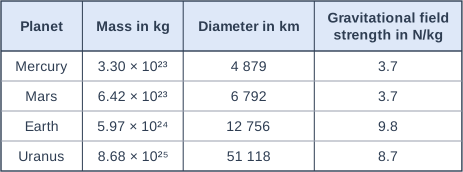
The table shows NASA data for four planets. Uranus has no solid surface, so its gravitational field strength is given at the level in its atmosphere where the pressure is the same as atmospheric pressure at the Earth's surface. For the other three planets it is given at the surface.

A student says: 'The greater the mass of a planet, the greater the gravitational field strength at its surface.'

Use the data in the table to evaluate the student's statement.

Table with columns "Planet", "Mass in kg", "Diameter in km", "Gravitational field strength in N/kg". Planet: Mercury; Mass in kg: 3.30 × 10²³; Diameter in km: 4 879; Gravitational field strength in N/kg: 3.7 | Planet: Mars; Mass in kg: 6.42 × 10²³; Diameter in km: 6 792; Gravitational field strength in N/kg: 3.7 | Planet: Earth; Mass in kg: 5.97 × 10²⁴; Diameter in km: 12 756; Gravitational field strength in N/kg: 9.8 | Planet: Uranus; Mass in kg: 8.68 × 10²⁵; Diameter in km: 51 118; Gravitational field strength in N/kg: 8.7.

Model answer

The data partly support the statement: the Earth has a much greater mass than Mercury or Mars, and a greater gravitational field strength (9.8 N/kg compared with 3.7 N/kg). However, Mars has about twice the mass of Mercury but the same gravitational field strength, 3.7 N/kg, and Uranus has about 15 times the mass of the Earth but a smaller gravitational field strength, 8.7 N/kg. This is because g also depends on the size of a planet: Mars is larger than Mercury, and Uranus has about four times the Earth's diameter, so their surfaces are further from their centres, which makes g smaller. So the student's statement is not correct in general - the gravitational field strength depends on both the mass and the radius of the planet.

Explanation

To evaluate, use the data both for and against the statement and then make a judgement. Mercury and Mars have the same g with different masses, and Uranus has a much bigger mass than the Earth but a smaller g, because Mars and Uranus have larger diameters. The gravitational field strength at the surface of a planet increases with its mass but decreases with its radius.

Mark scheme
  1. 1 mark

    the Earth has a much greater mass than Mercury or Mars and a greater gravitational field strength (9.8 N/kg compared with 3.7 N/kg), which supports the statement (1)

    Any four from the five points; max 4. Max 3 if there is no judgement (marking point 5). Data must be used correctly for marking points 1-3; accept any correct comparison from the table that supports the statement for this point.

  2. 1 mark

    Mars has (about) twice the mass of Mercury but the same gravitational field strength (3.7 N/kg) (1)

    Accept 'Mars is more massive than Mercury but g is the same'.

  3. 1 mark

    Uranus has (about) 15 times the mass of the Earth but a smaller gravitational field strength (8.7 N/kg compared with 9.8 N/kg) (1)

    Accept 'Uranus has a much bigger mass than the Earth but a lower g'. Accept 14 to 15 times.

  4. 1 mark

    the gravitational field strength also depends on the size of the planet: for a planet of larger diameter / radius (for its mass), g at the surface is smaller (because the surface is further from the centre) (1)

    Accept 'Mars and Uranus have larger diameters (than Mercury and the Earth), which reduces g'. Do not accept 'larger planets have a larger g'. Ignore references to density, atmosphere or distance from the Sun.

  5. 1 mark

    judgement: the statement is not (always) correct / is only true for planets of similar size / g depends on both mass and radius (1)

    The judgement must be consistent with the evidence given. Do not accept 'the statement is correct' with no qualification.

Ready to try the rest? Every answer you write is marked against the mark scheme, so you can see exactly where the marks are.

Study Helper Hints first, answers after you try

Stuck on this one? Ask for a hint and I’ll point you in the right direction, without giving the answer away. Once you’ve checked your answer, I’ll show you how the marks are awarded.