Level:
Correct: 0
Incorrect: 0
Marks: 0/0
Exam Practice
Course:
Topics:
Edexcel GCSE Physics (Paper 1) Smart practice A mixed round aimed at your weak spots
Unit 1
Key concepts of physics
Unit 2
Motion and forces
Unit 3
Conservation of energy
Unit 4
Waves
Unit 5
Light and the electromagnetic spectrum
Unit 6
Radioactivity
Unit 7
Astronomy
Avg
score:
–
Topics
done:
0/40

Reflection, refraction, TIR and colour

Practise 15 exam-style questions on Reflection, refraction, TIR and colour for Edexcel GCSE Physics (Paper 1). Write your answer as you would in the exam and get it marked in seconds against the mark scheme, point by point, with the Study Helper on hand if you get stuck.

  • 15 questions
  • 1–6 marks each
  • Instant marking
  • No sign-up needed
15 questions, marked as you go

Sample questions with model answers

Here are 4 of the questions in this topic, each with a model answer, an explanation of why it earns the marks and the mark scheme an examiner would use.

Question 1

1 mark

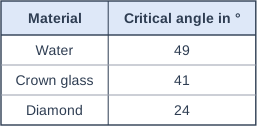
The table shows the critical angle for three materials.

In each material, a ray of light meets a boundary with air. The angle of incidence is 45° each time.

In which materials is the light totally internally reflected?

Choose your answer.

  • A crown glass and diamond
  • B water only
  • C diamond only
  • D all three materials
Table with columns "Material", "Critical angle in °". Material: Water; Critical angle in °: 49 | Material: Crown glass; Critical angle in °: 41 | Material: Diamond; Critical angle in °: 24.

Model answer

A - crown glass and diamond.

Explanation

Total internal reflection needs light to travel towards a material in which it is faster (here air) at an angle of incidence greater than the critical angle. Compare 45° with each critical angle: it is bigger than 41° and 24°, but smaller than 49°. Choosing water only is a common slip from thinking that a bigger critical angle makes total internal reflection more likely.

Mark scheme
  1. 1 mark

    A / crown glass and diamond (1)

    The only correct answer is A: total internal reflection happens when the angle of incidence is greater than the critical angle, and 45° is greater than 41° (crown glass) and 24° (diamond) but less than 49° (water). B is not correct because in water 45° is less than the critical angle of 49°, so the light is refracted out into the air - water is the only one of the three where total internal reflection does not happen; C is not correct because 45° is also greater than the critical angle of crown glass; D is not correct because 45° is less than the critical angle of water. Accept the letter or the option. If more than one option is given, do not award the mark.
Question 2

2 marks

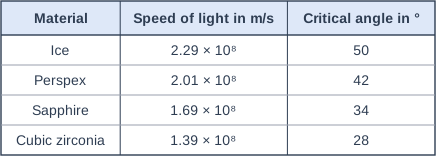
The table shows the speed of light in four transparent materials and the critical angle of each material.

Describe the relationship between the speed of light in a material and its critical angle. Use data from the table in your answer.

Table with columns "Material", "Speed of light in m/s", "Critical angle in °". Material: Ice; Speed of light in m/s: 2.29 × 10⁸; Critical angle in °: 50 | Material: Perspex; Speed of light in m/s: 2.01 × 10⁸; Critical angle in °: 42 | Material: Sapphire; Speed of light in m/s: 1.69 × 10⁸; Critical angle in °: 34 | Material: Cubic zirconia; Speed of light in m/s: 1.39 × 10⁸; Critical angle in °: 28.

Model answer

The lower the speed of light in the material, the smaller its critical angle. For example, light travels at 2.29 × 10⁸ m/s in ice, which has a critical angle of 50°, but at only 1.39 × 10⁸ m/s in cubic zirconia, which has a critical angle of 28°.

Explanation

The slower light travels in a material, the more it is refracted when it leaves, so the angle of refraction reaches 90° at a smaller angle of incidence. The critical angle falls as the speed falls, but not in proportion. Answers need to quote both quantities for at least two materials to use the data.

Mark scheme
  1. 1 mark

    the lower the speed of light in the material, the smaller the critical angle (1)

    Max 1 if no data from the table are used. accept ORA / a positive correlation. do not accept 'directly proportional' or 'inversely proportional'.

  2. 1 mark

    correct use of data, e.g. ice: 2.29 × 10⁸ m/s and 50° compared with cubic zirconia: 1.39 × 10⁸ m/s and 28° (1)

    accept any two (or more) materials compared correctly with their speeds and critical angles.

Question 3

3 marks

Asha swims under the calm surface of a swimming pool and looks up. Directly above her, she sees the sky through a bright circle. Outside this circle, the underside of the water surface looks like a mirror, and she sees a clear image of the floor of the pool in it.

The critical angle for water is 49°.

Explain why the water surface outside the circle looks like a mirror.

Model answer

Light from the floor of the pool reaches the water surface outside the circle at an angle of incidence greater than the critical angle of 49°. This light cannot be refracted out into the air, so it is totally internally reflected back down into the water and reaches Asha's eyes. Because the surface is calm, it is smooth and flat, so the reflection is specular, like a mirror, and she sees a clear image of the pool floor.

Explanation

Inside the circle the angle of incidence is less than 49°, so light from the sky can be refracted in through the surface. Outside it, light from below meets the surface at more than 49° and is totally internally reflected, and a smooth surface gives specular reflection, so a clear mirror image forms. Choppy water would scatter the light and spoil the image.

Mark scheme
  1. 1 mark

    light from the pool floor meets the (water) surface at an angle of incidence greater than the critical angle / greater than 49° (1)

    An explanation linking. accept light reaching the surface far from the point above Asha hits it at a large angle.

  2. 1 mark

    so it is totally internally reflected (back down to Asha's eyes) (1)

    accept TIR. 'reflected' without 'total internal' does not score.

  3. 1 mark

    the calm surface is smooth / flat, so the reflection is specular (the rays are not scattered) and a clear image forms (1)

    accept regular reflection / the reflected rays keep their arrangement. ignore 'the water is clear'.

Question 4

4 marks

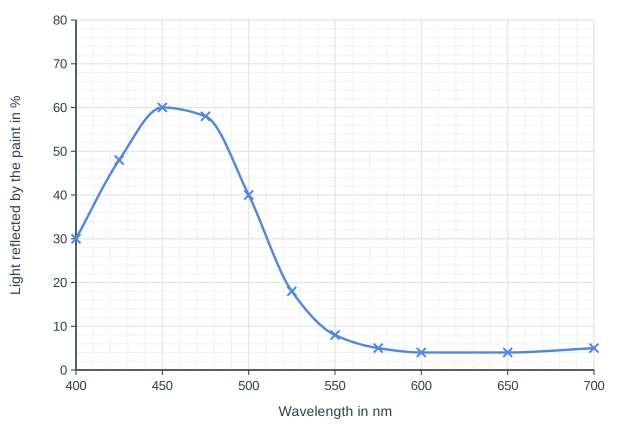
A scientist measures the percentage of light of each wavelength that is reflected by the paint on a car. The graph shows the results.

In daylight (white light) the car looks blue. At night, under an old type of street lamp that gives out yellow light with a wavelength of 589 nm only, the car looks almost black.

Use the graph to explain both observations.

Line graph of light reflected by the paint in % (y-axis, 0 to 80) against wavelength in nm (x-axis, 400 to 700). The line is a smooth curve through (400, 30), (425, 48), (450, 60), (475, 58), (500, 40), (525, 18), (550, 8), (575, 5), (600, 4), (650, 4), (700, 5).

Model answer

In daylight the paint reflects mainly short, blue wavelengths: about 60% of the light at 450 nm is reflected. It absorbs most of the other colours - less than 10% of the light from 550 nm to 700 nm is reflected - so the light reflected into our eyes is mainly blue and the car looks blue. The street lamp gives out only 589 nm light, and the graph shows that the paint reflects only about 4% of light of this wavelength. So it absorbs about 96% of the yellow light and reflects very little, and the car looks almost black.

Explanation

The colour of a surface depends on which wavelengths it reflects and which it absorbs, and on which wavelengths are in the light falling on it. In white light the blue part is reflected; under light of one yellow wavelength there is no blue to reflect, and the paint absorbs most of the yellow, so the car looks almost black. Answers lose marks for not quoting values from the graph.

Mark scheme
  1. 1 mark

    in white light the paint reflects mainly short / blue wavelengths, e.g. about 60% at 450 nm (1)

    Max 3 if no data from the graph are used. An explanation linking. accept any correct reading between 425 nm and 500 nm, or 'it reflects most light at about 450 to 475 nm'.

  2. 1 mark

    and absorbs most of the other wavelengths / colours, e.g. it reflects less than 10% from 550 nm to 700 nm (1)

    accept it absorbs most of the green, yellow and red light.

  3. 1 mark

    at 589 nm the paint reflects only about 4 to 5% of the light (1)

    accept any value from 3% to 6%. accept 'very little'.

  4. 1 mark

    so it absorbs (about 95% of) the yellow light, very little light is reflected, and it looks (almost) black (1)

    accept there is no blue light in the lamp's light for the paint to reflect. ignore 'the street lamp is dim'.

Ready to try the rest? Every answer you write is marked against the mark scheme, so you can see exactly where the marks are.

Study Helper Hints first, answers after you try

Stuck on this one? Ask for a hint and I’ll point you in the right direction, without giving the answer away. Once you’ve checked your answer, I’ll show you how the marks are awarded.