
Level:
Correct: 0
Incorrect: 0
Marks: 0/0
Exam Practice
Course:
Topics:
Edexcel GCSE Physics (Paper 1) Smart practice A mixed round aimed at your weak spots
Unit 1
Key concepts of physics
Unit 2
Motion and forces
Unit 3
Conservation of energy
Unit 4
Waves
Unit 5
Light and the electromagnetic spectrum
Unit 6
Radioactivity
Unit 7
Astronomy
Avg
score:
–
Topics
done:
0/40

Electromagnetic waves and the refraction core practical

Practise 15 exam-style questions on Electromagnetic waves and the refraction core practical for Edexcel GCSE Physics (Paper 1). Write your answer as you would in the exam and get it marked in seconds against the mark scheme, point by point, with the Study Helper on hand if you get stuck.

  • 15 questions
  • 1–6 marks each
  • Instant marking
  • No sign-up needed
15 questions, marked as you go

Sample questions with model answers

Here are 4 of the questions in this topic, each with a model answer, an explanation of why it earns the marks and the mark scheme an examiner would use.

Question 1

1 mark

In which example is energy transferred from a source to an observer by an electromagnetic wave?

Choose your answer.

  • A sound from a speaker to an ear
  • B heat through a metal spoon
  • C infrared from a toaster to bread
  • D ripples from a stone to a duck

Model answer

C - infrared from a toaster to bread.

Explanation

Every electromagnetic wave transfers energy from the source that emits it to whatever absorbs it (the observer). Sound and water waves also transfer energy, but they are not electromagnetic waves, and conduction is not a wave at all.

Mark scheme
  1. 1 mark

    C / infrared from a toaster to bread (1)

    The only correct answer is C: infrared is an electromagnetic wave, emitted by the hot toaster element and absorbed by the bread, which warms up. A is not correct because sound is a longitudinal mechanical wave, not an electromagnetic wave; B is not correct because energy moves through a spoon by conduction (particles vibrating), not by a wave; D is not correct because ripples are water waves, not electromagnetic waves. Accept the letter or the option. If more than one option is given, do not award the mark.
Question 2

2 marks

A student uses a ray box, a rectangular glass block and a protractor to investigate refraction. She works in a darkened room.

Suggest one hazard in this investigation and how the risk from it can be reduced.

Model answer

The lamp inside the ray box gets very hot and could burn the student's fingers. She should not touch the lamp or its cover, switch the ray box off when it is not being used and let it cool before moving it.

Explanation

The precaution must match the hazard: a hot lamp is managed by not touching it and letting it cool, while the darkness is managed by keeping the floor clear. Vague answers such as 'be careful' do not reduce a named risk, so they do not score.

Mark scheme
  1. 1 mark

    (hazard:) the lamp in the ray box gets hot and could burn the skin (1)

    Hazard: any one from this point and the next two; max 1. Precaution: any one from the last three points, linked to the hazard given; max 1. Total max 2. accept any other valid hazard with a linked precaution, e.g. staring into the bright beam - do not look directly into the ray box. ignore 'the light is dangerous' or 'glass could break' with no harm to the student stated.

  2. 1 mark

    (hazard:) the room is dark, so someone could trip over bags or stools (1)

  3. 1 mark

    (hazard:) the glass block could have sharp or chipped edges that cut the skin (1)

    accept a dropped block could break and the pieces cut someone.

  4. 1 mark

    (precaution:) do not touch the lamp or its cover / hold the ray box by its base / switch it off when not in use and let it cool before moving it (1)

    Must match the hot-lamp hazard. do not accept 'wear goggles' as a precaution for a hot lamp.

  5. 1 mark

    (precaution:) keep bags and stools under the benches / keep the floor clear (1)

    Must match the tripping hazard. accept keep a low light on so the floor can be seen.

  6. 1 mark

    (precaution:) check the block for chips or sharp edges before use / keep the block away from the edge of the bench so it cannot fall (1)

    Must match the sharp-edge (or broken glass) hazard. do not accept 'be careful' on its own as a precaution for any hazard.

Question 3

3 marks

A garden light has a solar cell on top. During the day, light from the Sun is used to charge a battery inside the garden light. At night, the battery lights an LED.

Explain how the garden light shows that electromagnetic waves transfer energy from a source to an observer.

Model answer

The Sun is the source: it emits light, which is an electromagnetic wave. The light travels through space and the air to the solar cell on the garden light, which acts as the observer. The solar cell absorbs the light, so energy is transferred from the Sun to the solar cell and then stored in the battery's chemical energy store, which later lights the LED.

Explanation

To explain energy transfer by an electromagnetic wave, name the source that emits the wave, the wave travelling, and the observer that absorbs it and gains energy. Answers often miss the absorption step, which is where the energy is transferred.

Mark scheme
  1. 1 mark

    the Sun is the source: it emits light / electromagnetic waves (1)

    An explanation linking. accept the Sun gives out visible light and infrared.

  2. 1 mark

    the light travels (through space and the air) to the solar cell (which is the observer) (1)

    accept the light reaches the solar cell / garden light.

  3. 1 mark

    the solar cell absorbs the light, so energy is transferred to it / to the battery (chemical store) (1)

    accept the energy from the light charges the battery / is used to light the LED later. do not accept 'the Sun's heat charges the battery' without absorption of the radiation. ignore 'solar energy' unless the transfer is described.

Question 4

4 marks

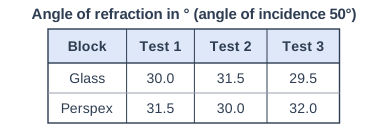
Two students use the same ray box to compare a glass block and a perspex block. They shine the ray at each block with an angle of incidence of 50° and measure the angle of refraction three times. The table shows their results.

One student says: 'The results show that glass refracts light more than perspex does.'

Evaluate this statement using the results.

Angle of refraction in ° (angle of incidence 50°). Table with columns "Block", "Test 1", "Test 2", "Test 3". Block: Glass; Test 1: 30.0; Test 2: 31.5; Test 3: 29.5 | Block: Perspex; Test 1: 31.5; Test 2: 30.0; Test 3: 32.0.

Model answer

Mean angle of refraction for glass = (30.0 + 31.5 + 29.5) ÷ 3 = 30.3°.
Mean angle of refraction for perspex = (31.5 + 30.0 + 32.0) ÷ 3 = 31.2°.
The mean angle of refraction is smaller for glass, so on average the glass bent the light more, which agrees with the statement. However, the difference between the means is only about 0.8°, which is smaller than the spread of the repeat readings (2° for each block), and the ranges overlap. So the difference could be caused by measurement error, and the results are not precise enough to support the statement.

Explanation

When the difference between two means is smaller than the spread of the repeat readings, the results cannot show that there is a real difference. Good answers calculate both means, compare the difference with the range of the repeats and then make a supported judgement. Simply agreeing because 30.3° is less than 31.2° ignores the uncertainty.

Mark scheme
  1. 1 mark

    mean angle of refraction for glass = 30.3° (1)

    Any four from the five points; max 4. accept 30 / 30.3 / 30.33 (values that round to 30.3, or 30 to 2 significant figures). answers of 30.3° (glass) and 31.2° (perspex) with no working score marking points 1 and 2.

  2. 1 mark

    mean angle of refraction for perspex = 31.2° (1)

    accept 31 / 31.2 / 31.17 (values that round to 31.2, or 31 to 2 significant figures).

  3. 1 mark

    the mean angle of refraction is smaller for glass, so on average the glass bent the light more (which agrees with the statement) (1)

    accept glass changes the direction of the ray more on average.

  4. 1 mark

    the difference between the means (about 0.8° / 1°) is smaller than the spread of the repeat readings (2°) / the ranges of the readings overlap (1)

    accept the readings for glass (29.5° to 31.5°) and perspex (30.0° to 32.0°) overlap. accept the difference is within the uncertainty of the measurements.

  5. 1 mark

    so the results are not precise enough to support the statement / the difference could be due to measurement (random) error (1)

    Dependent on the previous mark point. accept a suggestion that more precise measurements or more repeats are needed before a conclusion can be made. do not accept 'the results prove the statement'.

Ready to try the rest? Every answer you write is marked against the mark scheme, so you can see exactly where the marks are.

Study Helper Hints first, answers after you try

Stuck on this one? Ask for a hint and I’ll point you in the right direction, without giving the answer away. Once you’ve checked your answer, I’ll show you how the marks are awarded.