
Level:
Correct: 0
Incorrect: 0
Marks: 0/0
Exam Practice
Subject:
Topics:
AQA GCSE Geography (Paper 2) Smart practice A mixed round aimed at your weak spots
Avg
score:
–
Topics
done:
0/23

Water: increasing supply and sustainable water

Practise 34 exam-style questions on Water: increasing supply and sustainable water for AQA GCSE Geography (Paper 2). Write your answer as you would in the exam and get it marked in seconds against the mark scheme, point by point, with an AI tutor on hand if you get stuck.

  • 34 questions
  • 1–12 marks each
  • Instant marking
  • No sign-up needed
20 questions, marked as you go

Sample questions with model answers

Here are 4 of the questions in this topic, each with a model answer, an explanation of why it earns the marks and the mark scheme an examiner would use.

Question 1

1 mark

Which one of the following is an example of a large-scale water transfer scheme?

A Johads in the Wakel River basin, India
B The Lesotho Highland Water Project
C Sand dams in Kenya
D Grey water recycling in a sustainable home

Give the letter of the correct answer.

Model answer

B

Explanation

The Lesotho Highland Water Project stores water behind large dams in Lesotho and transfers it through tunnels and rivers to the Gauteng region of South Africa. Johads and sand dams are small, local schemes, and grey water recycling is a water conservation measure.

Mark scheme
  1. 1 mark

    B (the Lesotho Highland Water Project)

    Accept the letter or the option written out; do not accept more than one answer.
Question 2

2 marks

Explain how fitting water meters in homes can help to conserve water.

Model answer

With a water meter, a household pays for the amount of water it actually uses. This gives people a reason to save water, for example by taking shorter showers, fixing dripping taps and only running full loads in the washing machine.

Explanation

Without a meter, many households pay a fixed charge however much water they use, so there is no reward for saving water. Metering links cost to use, which encourages conservation.

Mark scheme
  1. 1 mark

    With a meter, households pay for the amount of water they actually use (instead of a fixed charge)

    1 mark for the point, 1 for its development.

  2. 1 mark

    so they have a financial incentive to use less, e.g. taking shorter showers, fixing leaks or using a water butt / meters also help to detect leaks

    Development of the previous point.

Question 3

4 marks

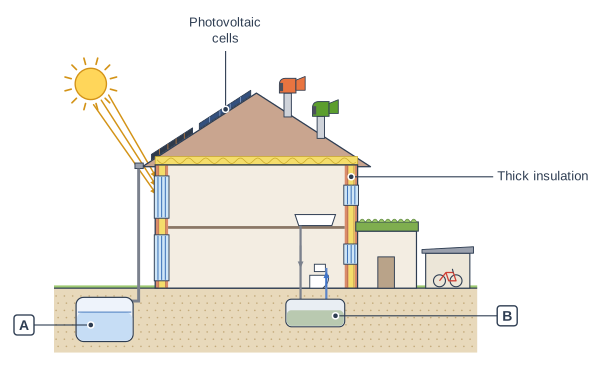
Figure 1 is a cross-section of a sustainable home.

Identify features A and B, and explain how each feature helps to conserve water.

Cross-section of a sustainable home (BedZED style). A cross-section of a two-storey house, with a yellow Sun at the top left whose rays shine into the upstairs window in the left-hand wall. The left-hand roof slope has dark blue panels on its upper part and black panels with copper lines on its lower part. Two brightly coloured hooded vents with fins stand on the right-hand roof slope. The walls are drawn with a brick outer layer and a thick yellow layer inside, and there is a thick yellow layer above the top ceiling. The left-hand wall has large windows on both floors, each drawn with three panes of glass. A gutter and downpipe at the left-hand edge of the roof lead to an underground tank of water in the garden. A pipe runs down from a bath upstairs to a tank under the house, and another pipe runs up from that tank to the toilet downstairs. A single-storey extension on the right has a flat roof covered with plants, and beyond it is a small shed with a bicycle inside. Label A points to the underground tank in the garden, fed by the downpipe from the roof gutter; label B points to the tank under the house, with a pipe down from the bath upstairs and a pipe up to the toilet; the label "Photovoltaic cells" points to the dark blue panels on the upper part of the left-hand roof slope; the label "Thick insulation" points to the thick yellow layer inside the right-hand wall (and above the top ceiling).

Model answer

A is a rainwater harvesting tank. Rain falling on the roof runs down the gutter into the tank and is stored, so it can be used to flush toilets and water the garden instead of using mains water.

B is a grey water recycling tank. Used water from the bath is collected in the tank and then pumped back up to flush the toilet, so clean drinking water is not wasted on flushing.

Explanation

Both features reduce the amount of treated mains water a home uses by supplying water for jobs that do not need drinking-quality water. Each explanation must say what the water is reused for and that this saves mains water.

Mark scheme
  1. 1 mark

    A: rainwater harvesting tank / rainwater storage tank

    Accept 'tank collecting rainwater from the roof'.

  2. 1 mark

    Rain from the roof is collected and stored, then used for flushing toilets, watering the garden or washing machines, so less mains (treated) water is used

    Explanation of A.

  3. 1 mark

    B: grey water recycling tank

    Accept 'grey water tank' or 'tank storing used bath water'.

  4. 1 mark

    Used water from the bath or sinks is collected and reused to flush the toilet, so drinking-quality mains water is not used for flushing

    Explanation of B.

Question 4

6 marks

Discuss the advantages and disadvantages of building dams and reservoirs to increase water supply.

Model answer

Dams and reservoirs have important advantages. They store water when it is plentiful, during wet seasons, so that it can be used in dry seasons and droughts, giving cities, industry and farmers a reliable supply. Many dams also generate hydro-electric power, a renewable source of energy, and they can hold back floodwater to protect towns downstream. Reservoirs such as Kielder Water in Northumberland, the UK's largest reservoir by capacity, also provide recreation and tourism.

However, there are serious disadvantages. Reservoirs flood large areas of land, forcing people to leave their homes and destroying farmland, habitats and cultural sites; the Three Gorges Dam in China displaced over a million people. Dams are very expensive to build. They trap sediment, so reservoirs gradually silt up and store less water, and less fertile silt reaches farmland and deltas downstream. Reduced flows below the dam can damage river ecosystems and fisheries. In hot climates, reservoirs lose large amounts of water through evaporation, as at Lake Nasser behind the Aswan High Dam. Dams on rivers that cross borders can also cause tension, as the Grand Ethiopian Renaissance Dam has between Ethiopia and Egypt.

In conclusion, dams and reservoirs can provide a large and reliable water supply as well as energy and flood control, but their social and environmental costs are high. They are most worthwhile where the need for water is great and the scheme is carefully planned, and they should be combined with water conservation so that fewer new dams are needed.

Explanation

'Discuss' needs both sides, developed with examples, and a conclusion. Strong answers cover social, economic and environmental effects, and use named dams to support their points.

Mark scheme
  1. 6 marks

    Levels of response (6 marks).
    Level 3 (5-6 marks): detailed, well-balanced discussion of the advantages and disadvantages of dams and reservoirs (social, economic, environmental), with well-developed points and examples; reaches a clear, substantiated conclusion.
    Level 2 (3-4 marks): clear discussion with some development; may be unbalanced; a conclusion may be stated but is not well supported.
    Level 1 (1-2 marks): basic, simple statements of advantages and/or disadvantages; little development; no conclusion.
    0 marks: nothing worthy of credit.

    Indicative content (not a checklist; credit other valid points): advantages - store water from wet periods for use in dry seasons and droughts, giving a reliable supply for cities, industry and irrigation; hydro-electric power, a renewable source of energy; flood control by holding back floodwater; recreation and tourism (e.g. Kielder Water, the UK's largest reservoir by capacity); can supply water transfers (e.g. Katse Dam); disadvantages - flood large areas, so people are displaced (e.g. the Three Gorges Dam in China displaced over a million people) and farmland, habitats and cultural sites are lost; very expensive; trap sediment, so reservoirs silt up and lose capacity, and less fertile silt reaches farmland and deltas downstream; reduced flow downstream damages river ecosystems and fisheries; large evaporation losses from reservoirs in hot climates (e.g. Lake Nasser); rotting vegetation in new reservoirs releases greenhouse gases; can cause tension between countries sharing a river (e.g. the Grand Ethiopian Renaissance Dam); risk of dam failure; conclusion - valuable but large social and environmental costs, so best where carefully planned and combined with conservation.

Ready to try the rest? Every answer you write is marked against the mark scheme, so you can see exactly where the marks are.

AI Tutor Hints first, answers after you try

Hi! Stuck? Ask me for a hint and I’ll help you work it out. Once you’ve checked your answer I can explain exactly where the marks are.