The UK: rural change, infrastructure, the north-south divide and global links
Practise 35 exam-style questions on The UK: rural change, infrastructure, the north-south divide and global links for AQA GCSE Geography (Paper 2). Write your answer as you would in the exam and get it marked in seconds against the mark scheme, point by point, with an AI tutor on hand if you get stuck.
35 questions
1–12 marks each
Instant marking
No sign-up needed
20 questions, marked as you go
Sample questions with model answers
Here are 4 of the questions in this topic, each with a model answer, an explanation of why it earns the marks and the mark scheme an examiner would use.
Question 1
1 mark
In which year did the UK formally leave the European Union?
A 1973 B 2016 C 2020 D 2023
Give the letter of your answer.
Model answer
C
Explanation
The UK left the EU on 31 January 2020, and the transition period ended on 31 December 2020. 1973 is when the UK joined the European Economic Community, and 2016 is the year of the referendum in which the UK voted to leave.
Mark scheme
1 mark
C (2020)
Accept the letter or the year written out; do not accept more than one answer.
Question 2
2 marks
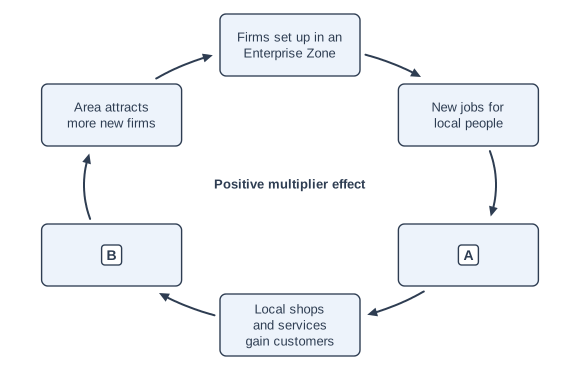
Figure 1 shows how new firms setting up in an Enterprise Zone can lead to further economic growth.
Suggest what should go in box A and box B.
Model answer
A: The workers have more money to spend in the local area. B: More taxes are collected and spent on better roads, services and training.
Explanation
The diagram shows the positive multiplier effect: each step leads to the next, so the growth keeps building. Box A must link jobs to spending, and box B must link busier businesses to something that makes the area more attractive to new firms, such as better infrastructure paid for by taxes.
Mark scheme
1 mark
A: workers have more money to spend / higher incomes in the local area
Accept similar, e.g. 'people spend wages in the area', 'less unemployment so more spending'.
1 mark
B: more taxes are collected (by the council or government), which are spent on better services and infrastructure (e.g. roads, schools, training)
Accept 'better infrastructure and services' or 'more tax revenue'. Do not accept a repeat of box A.
Question 3
4 marks
Using a named example, explain the social changes that have taken place in a rural area with a growing population.
Model answer
South Cambridgeshire, the rural district around Cambridge, has grown quickly because of counter-urbanisation. Many people working in Cambridge's high-tech industries want to live in the countryside, so demand for housing is high. This has pushed house prices well above the national average, so young people who grew up in the villages often cannot afford to buy a home and have to move away.
Large new settlements have been built to house the growing population, such as Cambourne, which is now home to about 10 000 people, and the new town of Northstowe. These have changed the character of the area from small farming villages to commuter settlements. The extra people put pressure on primary schools and GP surgeries, and the roads into Cambridge, such as the A14, became very congested at peak times.
Explanation
The question asks for social changes (people, housing, services, communities), so economic changes such as jobs should only be used if they are linked to social effects. Level 2 answers explain why each change happens, e.g. high demand from commuters → higher house prices → young locals priced out. Naming places like Cambourne or Northstowe gives the place-specific detail examiners look for.
Mark scheme
4 marks
Levels of response (4 marks). Level 2 (3-4 marks): clear explanation of social changes in a rural area of population growth, with linked points showing why each change has happened; some place-specific detail about a named area. Level 1 (1-2 marks): basic explanation; simple statements of change that are not developed, or may describe economic rather than social changes; generic, with little or no place-specific detail. 0 marks: nothing worthy of credit.
Indicative content (not a checklist; credit other valid points): counter-urbanisation brings in commuters, young professionals and families; house prices rise because of high demand, so young local people cannot afford to buy and may have to move away; new housing estates and settlements change the character of villages (in South Cambridgeshire, Cambourne has been built since the late 1990s and is now home to about 10 000 people; Northstowe new town near Longstanton had its first residents in 2017); pressure on services such as primary schools and GP surgeries; some village services (shops, pubs, buses) still close because commuters shop and socialise in the city; villages can become quiet 'dormitory' settlements in the daytime; traffic congestion on roads into the city (e.g. A14, A10); possible tension between newcomers and long-standing residents; new community facilities in new settlements (schools, sports centres, supermarket in Cambourne). Credit any appropriate named example.
Question 4
6 marks
Explain the economic and political importance of the Commonwealth to the UK.
Model answer
The Commonwealth is a voluntary association of 56 countries with about 2.5 billion people, roughly a third of the world's population. Economically, it is important because many members, such as India, Nigeria and Malaysia, have large, young and fast-growing populations, which are growing markets for UK goods and services. Commonwealth countries share the English language and often have similar legal and business systems, which makes trading and investing easier. Investment flows both ways: for example, the Indian company Tata owns Jaguar Land Rover, a major UK car manufacturer. Since leaving the EU, the UK has made trade deals with Commonwealth members such as Australia and New Zealand.
Politically, the Commonwealth gives the UK a voice in a large international organisation that spans every continent. Leaders meet every two years to discuss issues such as climate change, trade and human rights, and the British monarch is Head of the Commonwealth. Events such as the Commonwealth Games, held in Birmingham in 2022, strengthen cultural ties and the UK's influence. However, the Commonwealth is not a trading bloc, so it does not offer tariff-free trade, and the UK's trade with it is much smaller than its trade with the EU.
Explanation
Strong answers explain why each link matters (e.g. shared language → lower costs of doing business → more trade) and cover both economic and political importance. Accurate details such as 56 members, 2.5 billion people and the Birmingham 2022 Games add credibility. Recognising that the Commonwealth is not a free trade area shows a sophisticated understanding.
Mark scheme
6 marks
Levels of response (6 marks). Level 3 (5-6 marks): detailed, well-developed explanation of both the economic and political importance of the Commonwealth to the UK, with clear links; accurate specific detail; may recognise limits to its importance. Level 2 (3-4 marks): clear explanation of some ways the Commonwealth is important, with some linked points; may be unbalanced between economic and political; some specific detail. Level 1 (1-2 marks): basic statements with little explanation; generic or partly inaccurate. 0 marks: nothing worthy of credit.
Indicative content (not a checklist; credit other valid points): 56 countries with about 2.5 billion people (about a third of the world's population), many of them young and fast-growing economies (e.g. India, Nigeria, Bangladesh, Malaysia); shared language (English), similar legal and business systems and historical links make trade and investment easier and cheaper; new trade deals after Brexit with Commonwealth members (e.g. Australia, New Zealand; CPTPP membership alongside Canada, Australia, Malaysia, Singapore, New Zealand, Brunei); UK aid and development programmes in Commonwealth countries; investment by UK firms and from Commonwealth countries into the UK (e.g. Indian-owned firms such as Tata, which owns Jaguar Land Rover); migration links and diaspora communities; education - many Commonwealth students at UK universities; political - a voice in a large international organisation, meetings of Commonwealth heads of government every two years (CHOGM), shared values of democracy, human rights and the rule of law; soft power and cultural influence, e.g. the Commonwealth Games (Birmingham 2022); the British monarch is Head of the Commonwealth; limits - not a trading bloc, so no tariff-free trade; trade with the Commonwealth is much smaller than with the EU; some members criticise the UK's colonial past.
Ready to try the rest? Every answer you write is marked against the mark scheme, so you can see exactly where the marks are.
Ctrl + Enter to check
AI TutorHints first, answers after you try
Hi! Stuck? Ask me for a hint and I’ll help you work it out. Once you’ve checked your answer I can explain exactly where the marks are.