Practise 36 exam-style questions on Global urbanisation and megacities for AQA GCSE Geography (Paper 2). Write your answer as you would in the exam and get it marked in seconds against the mark scheme, point by point, with an AI tutor on hand if you get stuck.
36 questions
1–12 marks each
Instant marking
No sign-up needed
20 questions, marked as you go
Sample questions with model answers
Here are 4 of the questions in this topic, each with a model answer, an explanation of why it earns the marks and the mark scheme an examiner would use.
Question 1
1 mark
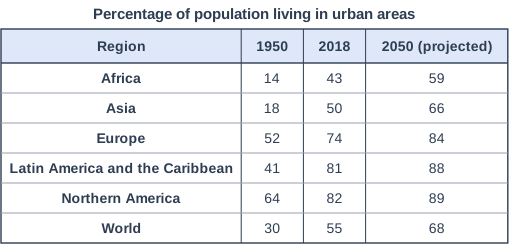
Figure 1 shows the percentage of the population living in urban areas in five world regions and in the world as a whole.
Identify the region with the largest increase in the percentage of its population living in urban areas between 1950 and 2018.
Model answer
Latin America and the Caribbean, which increased from 41% to 81%, an increase of 40 percentage points.
Explanation
Subtract the 1950 figure from the 2018 figure for each region: Africa 29, Asia 32, Europe 22, Latin America and the Caribbean 40 and Northern America 18. Africa and Asia are urbanising quickly now, but Latin America urbanised very rapidly in the second half of the twentieth century and is now as urban as many HICs.
Mark scheme
1 mark
Latin America and the Caribbean (an increase of 40 percentage points, from 41% to 81%)
Accept 'Latin America' or 'South America'. Do not accept 'World' or any other region. The figure alone (40) is not enough: the region must be named.
Question 2
2 marks
Give two reasons why death rates are often lower in cities in NEEs than in the surrounding rural areas.
Model answer
Cities have more hospitals, clinics and doctors, so illnesses can be treated. Also, many city residents have clean water and sanitation, which reduces the spread of diseases such as cholera.
Explanation
Low death rates in cities, together with high birth rates, explain why natural increase is so high in cities in LICs and NEEs. The young age structure of cities is a useful extra point: if most people are young adults, few people die each year. Do not just write 'better services' without saying which ones.
Mark scheme
1 mark
Better access to hospitals, clinics and doctors / healthcare
max 2; 1 mark for each valid reason.
1 mark
Clean (piped) water and sanitation reduce diseases such as cholera and diarrhoea
1 mark
Vaccination and health programmes are easier to deliver to large numbers of people
1 mark
Higher incomes and a more reliable food supply mean better diets
1 mark
Cities have a young population because most migrants are young adults, so there are fewer elderly people to die
1 mark
Better education, so people know more about hygiene and health
Question 3
4 marks
Suggest why the rate of urbanisation in many NEEs, such as China, has been very rapid in recent decades.
Model answer
NEEs such as China have industrialised very quickly, and most new factories have been built in cities, especially on the coast. These factories, many of them run by TNCs attracted by cheap labour and government incentives such as China's Special Economic Zones, need millions of workers. Factory wages are much higher than what people can earn from farming, so huge numbers of young people have moved from the countryside to the cities. At the same time, mechanisation has reduced the number of farm jobs, pushing people out of rural areas. As a result, China's urban population grew from about 20% in 1980 to over 60% by 2020.
Explanation
NEEs urbanise quickly because economic development and urbanisation go together: new jobs in manufacturing and services are concentrated in cities. Level 2 needs linked reasons (for example TNC investment → factory jobs → migration), not just a list. Using a specific example such as Shenzhen or the rise in China's urban percentage strengthens the answer.
Mark scheme
4 marks
Levels of response (4 marks). Level 2 (3-4 marks): clear suggestions with linked (developed) reasons why urbanisation has been rapid in NEEs, e.g. industrialisation creating city jobs that attract rural migrants; may use an example such as China effectively; accurate terminology. Level 1 (1-2 marks): basic suggestions; simple, unlinked statements, e.g. 'there are more jobs in cities'. 0 marks: nothing worthy of credit.
Indicative content (not a checklist; credit other valid points): rapid industrialisation: factories (many owned by TNCs) in cities need large numbers of workers; government policies to attract foreign investment, e.g. China's Special Economic Zones from 1980 (Shenzhen grew from a small town into a city of more than 10 million); wages in city factories are much higher than incomes from farming; mechanisation and farm reforms reduced the need for rural labour; investment in roads, railways and housing makes migration easier; young migrants have children in the city (natural increase); globalisation and growing exports; China's urban population rose from about 20% in 1980 to over 60% by 2020; similar processes in India, Nigeria and Brazil.
Question 4
6 marks
Explain why the number of megacities in the world has increased since 1950.
Model answer
In 1950 there were only two megacities, New York and Tokyo, but by 2018 there were 33. The main reason is rapid urbanisation in LICs and NEEs. The world's population grew from about 2.5 billion in 1950 to about 8 billion by 2022, and much of this growth happened in countries with very large populations such as China, India and Nigeria, so their biggest cities could pass 10 million.
Millions of people have migrated from rural areas to these cities, pushed by poverty, drought and the mechanisation of farming, and pulled by the hope of jobs and better services. Cities such as Lagos and Dhaka receive thousands of new migrants every week. Because the migrants are mostly young adults, natural increase is also high, so these cities grow even faster.
Globalisation and industrialisation have also concentrated economic activity in a few large cities. TNCs build factories and offices in cities such as Shanghai and Guangzhou, where there is cheap labour and good port access, creating jobs that attract more migrants. In many countries one primate city, such as Lagos or Mexico City, receives most of the investment, so it grows much larger than other cities. As these cities spread outwards and merge with nearby towns, more urban areas pass the 10 million mark.
Explanation
Level 3 links the growth of megacities to processes covered in this topic: migration, natural increase, population growth and industrialisation in LICs and NEEs. Using figures such as 2 megacities in 1950 and 33 in 2018 shows the scale of change. A list of reasons without explaining how each makes cities grow stays in Level 1 or 2.
Mark scheme
6 marks
Levels of response (6 marks). Level 3 (5-6 marks): detailed, well-developed explanation of several reasons for the growth in the number of megacities, with clear links to urbanisation in LICs and NEEs; may use accurate examples; accurate terminology. Level 2 (3-4 marks): clear explanation of some reasons with some development. Level 1 (1-2 marks): basic explanation; simple, unlinked statements, e.g. 'more people live in cities'. 0 marks: nothing worthy of credit.
Indicative content (not a checklist; credit other valid points): in 1950 there were only two megacities (New York and Tokyo), about 10 in 1990 and 33 in 2018, with about 43 projected by 2030; rapid urbanisation in LICs and NEEs: rural-urban migration on a huge scale (push and pull factors); high natural increase in cities with young populations; world population growth from about 2.5 billion in 1950 to about 8 billion in 2022, so countries with very large populations (China, India, Nigeria) can have cities of over 10 million; industrialisation and globalisation: TNCs locate factories and offices in cities with cheap labour (e.g. Shanghai, Guangzhou); primate cities attract most investment and government spending (e.g. Lagos, Dhaka, Mexico City); improved transport and infrastructure allow cities to grow very large; cities spread outwards and merge with surrounding towns; examples of new megacities such as Lagos, Kinshasa, Dhaka, Karachi.
Ready to try the rest? Every answer you write is marked against the mark scheme, so you can see exactly where the marks are.
Ctrl + Enter to check
AI TutorHints first, answers after you try
Hi! Stuck? Ask me for a hint and I’ll help you work it out. Once you’ve checked your answer I can explain exactly where the marks are.