Level:
Correct: 0
Incorrect: 0
Marks: 0/0
Exam Practice
Subject:
Topics:
AQA GCSE Geography (Paper 2) Smart practice A mixed round aimed at your weak spots
Avg
score:
–
Topics
done:
0/23

Reducing the development gap

Practise 34 exam-style questions on Reducing the development gap for AQA GCSE Geography (Paper 2). Write your answer as you would in the exam and get it marked in seconds against the mark scheme, point by point, with an AI tutor on hand if you get stuck.

  • 34 questions
  • 1–12 marks each
  • Instant marking
  • No sign-up needed
20 questions, marked as you go

Sample questions with model answers

Here are 4 of the questions in this topic, each with a model answer, an explanation of why it earns the marks and the mark scheme an examiner would use.

Question 1

1 mark

Define the term tied aid.

Model answer

Tied aid is aid given with conditions attached, for example that the receiving country must use the money to buy goods or services from the donor country.

Explanation

Tied aid often benefits the donor as well as, or more than, the receiver, because the money is spent on the donor's own companies and products. This is one reason why aid does not always reduce the development gap.

Mark scheme
  1. 1 mark

    Aid given with conditions attached, e.g. the receiving country must spend it on goods or services from the donor country

    The idea of conditions is needed. Accept 'aid that has strings attached'.

Question 2

2 marks

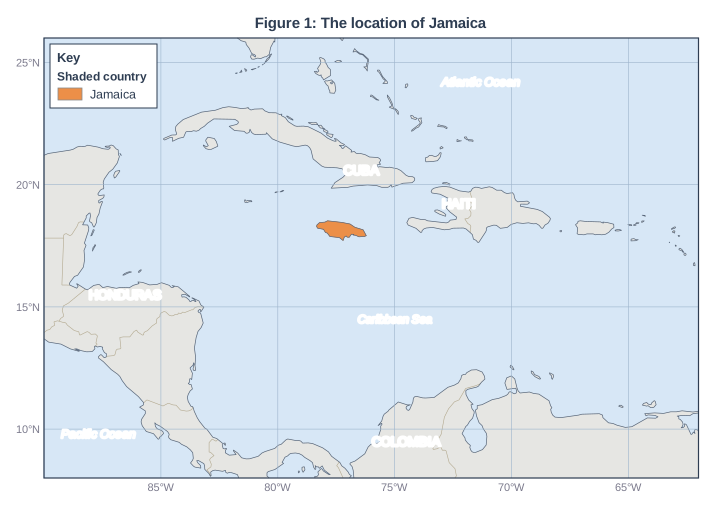
Figure 1 shows the location of Jamaica, an NEE that has developed its tourism industry.

Using Figure 1, describe the location of Jamaica.

Map of the area from 90°W to 62°W and from 8°N to 26°N, titled "Figure 1: The location of Jamaica". Lines of latitude and longitude are drawn every 5°, with their values (°N/°S and °E/°W) printed round the edge. Countries are shaded in 1 class (key heading "Shaded country"): "Jamaica" (shaded): 1 country (1 in North America). Other countries are grey (not shaded). Sea names printed: Pacific Ocean, Atlantic Ocean and Caribbean Sea. Points: the words "CUBA" printed on the map in Cuba; the words "HAITI" printed on the map in Haiti; the words "COLOMBIA" printed on the map in Colombia; the words "HONDURAS" printed on the map in Honduras. The key (in a box on the map) shows: the heading "Shaded country" and "Jamaica".

Model answer

Jamaica is an island in the Caribbean Sea at about 18°N, 77°W. It lies south of Cuba and west of Haiti.

Explanation

Describing location means using the map: name the sea, neighbouring countries with compass directions, and latitude and longitude read from the grid. Its tropical Caribbean location, with warm seas and beaches, is one reason it attracts tourists.

Mark scheme
  1. 1 mark

    It is an island in the Caribbean Sea

    max 2: 1 mark per valid locational point using Figure 1.

  2. 1 mark

    South of Cuba

  3. 1 mark

    West of Haiti (Hispaniola)

  4. 1 mark

    At about 18°N, 77°W

    Accept 17-19°N and 76-79°W; both latitude and longitude needed for the mark.

  5. 1 mark

    North of Colombia / South America, or east of Central America (Honduras)

    Also accept: in the tropics / north of the Equator.

Question 3

4 marks

Explain the advantages and disadvantages of microfinance loans as a way of reducing the development gap.

Model answer

Microfinance gives poor people who cannot borrow from banks a chance to start a small business, such as a market stall, and earn an income. Many loans, such as those from the Grameen Bank in Bangladesh, go to women, who tend to spend extra income on their children's food, health and education. When loans are repaid, the money can be lent to someone else. However, interest rates can be high, so some people fall into debt they cannot repay, especially if their business fails or they have to spend the money on an emergency. Also, small loans create only small businesses, so microfinance does little to create the large-scale industry and jobs needed to develop a whole country.

Explanation

Both sides are needed for Level 2: the benefits for individuals (especially women) and the risks of debt and the limited scale of the impact. Linking each point to whether it narrows the development gap shows understanding.

Mark scheme
  1. 4 marks

    Levels of response (4 marks).
    Level 2 (3-4 marks): clear explanation of both advantages and disadvantages, with developed points; accurate understanding of how microfinance works; may use an example.
    Level 1 (1-2 marks): basic explanation of advantages or disadvantages, with simple statements; may be one-sided.
    0 marks: nothing worthy of credit.

    Indicative content (not a checklist; credit other valid points): advantages: people who cannot borrow from banks can start or expand small businesses and earn an income; loans are often given to women, improving their status and spending on children's food, health and education; repayment rates are often high, so the money can be lent again to others; it is bottom-up, helping the poorest people directly; e.g. the Grameen Bank in Bangladesh, founded by Muhammad Yunus, and online lenders such as Kiva; disadvantages: interest rates can be high, and some borrowers fall into debt they cannot repay; small loans create small businesses, not large-scale industry or national development; loans may be spent on food, medicine or emergencies rather than businesses; not everyone has business skills; many people starting similar small businesses in one area can mean too little demand; some lenders are mainly interested in profit.

Question 4

6 marks

Explain how different types of aid can help to reduce the development gap.

Model answer

There are several types of aid, and each can help reduce the development gap in different ways.

Short-term emergency aid, such as food, clean water, tents and medical care, is given after disasters like the 2010 earthquake in Haiti. It saves lives and helps people begin to recover, so that a disaster does not push a country even further behind.

Long-term development aid aims to tackle the causes of poverty. It can pay for schools, clinics, wells and sanitation, which improve people's health and education. Healthier, better-educated people can work more productively and earn more, which helps the country develop.

Aid can be given in different ways. Bilateral aid goes directly from one government to another, for example UK aid funding education programmes for girls. Multilateral aid is given through organisations such as the World Bank and the UN, which can fund large projects such as vaccination programmes across many countries. Voluntary aid from NGOs such as WaterAid often works directly with local communities, building wells and training local people to maintain them, so the benefits reach the poorest people. Aid can also provide technical expertise and fund small-scale schemes such as intermediate technology and microfinance.

When aid is well targeted and reaches the people who need it, it can start a positive cycle of better health, education and incomes, helping to close the gap.

Explanation

Name and explain several types of aid (emergency, development, bilateral, multilateral, voluntary) and for each say how it improves development, with examples. Simply defining the types of aid without explaining how they help stays in Level 1.

Mark scheme
  1. 6 marks

    Levels of response (6 marks).
    Level 3 (5-6 marks): detailed explanation of how several types of aid help, with well-developed points linking each to improvements in development or quality of life; accurate use of terminology and relevant examples.
    Level 2 (3-4 marks): clear explanation of at least two types of aid with some development; some examples.
    Level 1 (1-2 marks): basic explanation with simple statements; may describe types of aid without explaining how they help.
    0 marks: nothing worthy of credit.

    Indicative content (not a checklist; credit other valid points): short-term emergency aid (food, water, shelter, medical care) saves lives after disasters and helps recovery, e.g. after the 2010 Haiti earthquake; long-term development aid funds schools, clinics, clean water, sanitation and infrastructure, improving health and education and making people more productive; bilateral aid from one government to another (e.g. from the UK) can fund programmes such as girls' education; multilateral aid through organisations such as the World Bank and the UN can fund large projects and vaccination programmes; voluntary aid from NGOs such as WaterAid or Oxfam often works directly with communities (bottom-up), e.g. building wells or training farmers; technical aid provides expertise and training; aid can fund intermediate technology and microfinance schemes; when well targeted, aid starts a positive cycle: healthier, better-educated people earn more and the country develops.

Ready to try the rest? Every answer you write is marked against the mark scheme, so you can see exactly where the marks are.

AI Tutor Hints first, answers after you try

Hi! Stuck? Ask me for a hint and I’ll help you work it out. Once you’ve checked your answer I can explain exactly where the marks are.