Practise 30 exam-style questions on Resources in the UK: energy for AQA GCSE Geography (Paper 2). Write your answer as you would in the exam and get it marked in seconds against the mark scheme, point by point, with an AI tutor on hand if you get stuck.
30 questions
1–12 marks each
Instant marking
No sign-up needed
20 questions, marked as you go
Sample questions with model answers
Here are 4 of the questions in this topic, each with a model answer, an explanation of why it earns the marks and the mark scheme an examiner would use.
Question 1
1 mark
Which one of the following best describes the UK's production of oil and gas from the North Sea today?
A Rising rapidly as new fields are discovered B Past its peak and declining C Stopped completely in 2015 D Not yet started
Give the letter of the correct answer.
Model answer
B
Explanation
North Sea oil production peaked in 1999 and gas production in 2000; since then output has fallen as the largest, easiest fields have been used up. Production has not stopped, but the UK now imports much of the oil and gas it uses.
Mark scheme
1 mark
B (Past its peak and declining)
Accept the letter or the option written out; do not accept more than one answer.
Question 2
2 marks
Give two environmental issues associated with onshore wind farms.
Model answer
Onshore wind turbines can spoil the view of attractive landscapes such as hilltops and moorland. The turning blades can also kill birds and bats.
Explanation
The most common issues are visual impact, noise and harm to wildlife. Economic points such as cost do not answer a question about environmental issues.
Mark scheme
1 mark
Visual pollution / they spoil the view of attractive landscapes (e.g. on hilltops or moorland)
max 2; 1 mark for each different issue
1 mark
Noise pollution from the turning blades
1 mark
Birds and bats can be killed by the turning blades
1 mark
Construction of turbines and access roads damages habitats / disturbs peat or moorland soils
1 mark
Shadow flicker affecting nearby homes
Accept positive issues only if clearly environmental, e.g. low carbon emissions / no air pollution when operating.
Question 3
4 marks
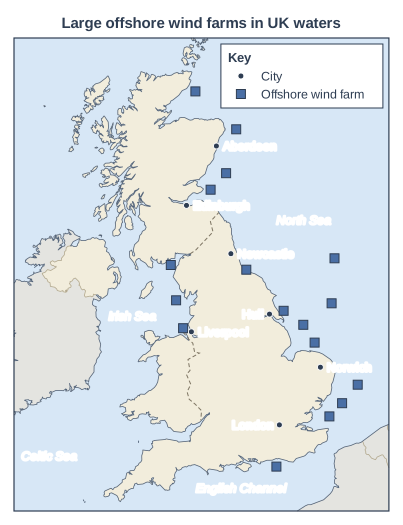
Figure 1 shows the location of large offshore wind farms in UK waters.
Suggest reasons for the distribution of offshore wind farms shown in Figure 1.
Model answer
Most offshore wind farms are in the North Sea off eastern England because much of this sea is shallow, especially around Dogger Bank, so turbines can be fixed to the seabed even 100 km or more from the coast, which keeps costs down. Winds over the open sea are strong and steady. These sites are also close to the large populations of London and Yorkshire, where demand for electricity is high, and ports such as Hull and Grimsby are used as bases for building and maintaining turbines. In contrast, there are few wind farms off western Scotland and south-west England, where the water is deeper and more exposed to Atlantic storms, making turbines harder and more expensive to build.
Explanation
Link each reason to the pattern: shallow water and strong winds explain the North Sea cluster, while nearby demand, grid connections and ports are human factors. Level 2 answers also explain the gaps, such as deep, stormy water to the west.
Mark scheme
4 marks
Levels of response (4 marks). Level 2 (3-4 marks): clear suggestions with developed reasons that link physical and/or human factors to the pattern on the map (e.g. why so many are in the North Sea off eastern England); uses evidence from Figure 1. Level 1 (1-2 marks): basic suggestions with simple, unlinked points (e.g. 'it is windy at sea'); little use of Figure 1. 0 marks: nothing worthy of credit.
Indicative content (not a checklist; credit other valid points): the southern North Sea (e.g. Dogger Bank) is shallow, so turbines can be fixed to the seabed cheaply, even far offshore; winds are strong and consistent over the sea with no obstacles; the east coast is near large markets for electricity (London, Yorkshire, the Midlands) and connections to the National Grid, sometimes at the sites of old coal power stations; ports such as Hull and Grimsby provide bases for building and maintaining turbines; locations offshore reduce visual and noise impacts on people; farms avoid busy shipping lanes and the deep water of the Atlantic; the Irish Sea is also shallow and close to Liverpool and Manchester; few off western Scotland or south-west England because the water is deeper and more exposed to Atlantic storms, making construction harder and more expensive (although floating turbines such as Hywind off Aberdeen are now used in deeper water).
Question 4
6 marks
Using Hinkley Point C or another named example, explain the economic and environmental issues of building new nuclear power stations in the UK.
Model answer
Hinkley Point C is a nuclear power station being built by EDF on the coast of Somerset. When complete, its two reactors are expected to provide about 7% of the UK's electricity for around 60 years.
Economically, the project brings benefits but also huge costs. Thousands of people have worked on the construction site and there will be about 900 permanent jobs, which boosts local businesses through the multiplier effect. Because nuclear power produces a steady supply whatever the weather, it improves energy security and reduces the need to import gas. However, the cost has risen to over 30 billion pounds and completion has been delayed by several years. The government also guaranteed EDF a high price for its electricity for 35 years, so consumers may pay more on their bills than for electricity from cheaper sources such as wind.
Environmentally, nuclear power has very low carbon emissions, only about 12 grams per kWh over its lifetime, so it helps the UK cut emissions and reach net zero. On the other hand, it produces radioactive waste that remains dangerous for thousands of years, and the UK still has no permanent site to store it safely. There is also a small risk of a serious accident, as happened at Fukushima in Japan in 2011, and there are concerns that taking cooling water from the Severn estuary will kill large numbers of fish. Overall, Hinkley Point C offers reliable low-carbon electricity, but at a very high economic cost and with long-term environmental risks.
Explanation
Strong answers balance positives (low carbon, reliable baseload, jobs) against negatives (cost overruns, delays, guaranteed high price, radioactive waste, accident risk) and use Hinkley-specific detail. Generic points about nuclear power without the named example stay in Level 1 or 2.
Mark scheme
6 marks
Levels of response (6 marks). Level 3 (5-6 marks): detailed, well-developed explanation of BOTH economic and environmental issues of new nuclear power, including benefits and problems; detailed place-specific knowledge of Hinkley Point C or another named example. Level 2 (3-4 marks): clear explanation with some development; may be unbalanced; some place-specific detail. Level 1 (1-2 marks): basic statements about nuclear power; generic, not place-specific. 0 marks: nothing worthy of credit.
Indicative content (not a checklist; credit other valid points): Hinkley Point C, Somerset (being built by EDF) - two reactors expected to supply about 7% of UK electricity (enough for around 6 million homes) for about 60 years; reliable baseload supply that is not affected by the weather, improving energy security and reducing gas imports. Economic - cost has risen to over 30 billion pounds and completion has been delayed from the mid-2020s to around 2030 or later; the government guaranteed a high price for its electricity (92.50 pounds per MWh in 2012 prices) for 35 years, paid through bills; thousands of construction jobs and about 900 permanent jobs; boost to local businesses in Somerset (housing, shops, suppliers); some investment came from China, which raised security concerns. Environmental - very low carbon emissions (about 12 g per kWh), helping the UK reach net zero; radioactive waste stays dangerous for thousands of years and the UK has no permanent disposal site yet; risk of accidents (e.g. Fukushima, Japan, 2011), although rare; cooling water taken from the Severn estuary could kill large numbers of fish; construction affected the landscape and brought heavy traffic. Credit Sizewell C (Suffolk) or other appropriate named examples.
Ready to try the rest? Every answer you write is marked against the mark scheme, so you can see exactly where the marks are.
Ctrl + Enter to check
AI TutorHints first, answers after you try
Hi! Stuck? Ask me for a hint and I’ll help you work it out. Once you’ve checked your answer I can explain exactly where the marks are.