Practise 34 exam-style questions on Energy: increasing supply and sustainable energy for AQA GCSE Geography (Paper 2). Write your answer as you would in the exam and get it marked in seconds against the mark scheme, point by point, with an AI tutor on hand if you get stuck.
34 questions
1–12 marks each
Instant marking
No sign-up needed
20 questions, marked as you go
Sample questions with model answers
Here are 4 of the questions in this topic, each with a model answer, an explanation of why it earns the marks and the mark scheme an examiner would use.
Question 1
1 mark
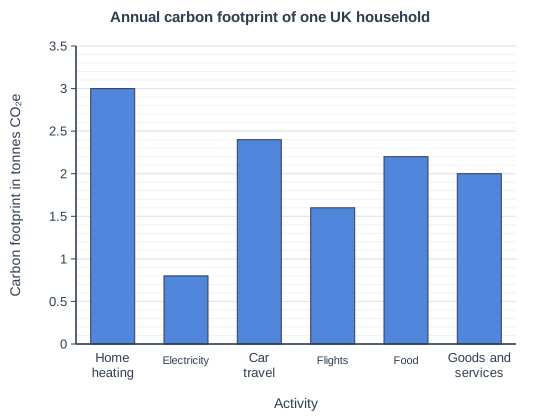
Figure 1 shows the annual carbon footprint of one UK household, divided into six activities.
Calculate the household's total carbon footprint.
Model answer
3.0 + 0.8 + 2.4 + 1.6 + 2.2 + 2.0 = 12 tonnes of CO₂e per year.
Explanation
Read each bar carefully against the scale (each light line is 0.1 tonnes) and add the six values. The most common errors are misreading the shorter bars, such as electricity (0.8 tonnes), or leaving a category out.
Mark scheme
1 mark
12 tonnes CO₂e per year (3.0 + 0.8 + 2.4 + 1.6 + 2.2 + 2.0)
accept 11.8-12.2 tonnes; the unit is not required
Question 2
2 marks
Explain one way in which smart meters can help to reduce the demand for energy.
Model answer
A smart meter shows a household exactly how much energy it is using and how much it costs, in real time. This makes people more aware of wasted energy, so they are more likely to switch off lights and appliances or turn the heating down, which reduces demand.
Explanation
Demand reduction often depends on changing people's behaviour, and information is the first step. A full answer explains the chain: the meter gives information, people change what they do, and less energy is used.
Mark scheme
1 mark
They show households how much energy they are using and what it costs, in real time
max 2; 1 mark for a basic point, 1 for its development; credit one way only
1 mark
so people become more aware and change their behaviour, e.g. switching off lights and appliances or turning the heating down, which reduces demand
development of the previous point
1 mark
They allow cheaper off-peak / time-of-use tariffs
alternative basic point
1 mark
so people use appliances (e.g. charging an electric car) at quiet times, reducing peak demand and the need for extra power stations
development of the previous point
Question 3
4 marks
Using an example, explain the economic advantages of extracting a fossil fuel.
Model answer
The Alberta oil sands in Canada hold most of Canada's oil reserves, which are among the largest in the world, and they produce about 3 million barrels of oil a day. Extracting the oil creates tens of thousands of jobs in mining, processing and transport, and many more indirect jobs in firms that supply equipment and services, which made towns such as Fort McMurray grow rapidly. This sets off a positive multiplier effect, as workers spend their wages in local shops and services. Oil companies pay royalties and taxes to the Alberta and Canadian governments, which help fund schools and hospitals, and oil is Canada's most valuable export, mostly sold to the USA.
Explanation
The specification requires an example of fossil fuel extraction with advantages and disadvantages; this question focuses on the economic advantages. Level 2 answers go beyond 'jobs and money' by explaining the chain of benefits (jobs, multiplier effect, government revenue, exports, energy security) with details from a named example.
Mark scheme
4 marks
Levels of response (4 marks). Level 2 (3-4 marks): clear explanation of economic advantages of extracting a fossil fuel, with developed points (e.g. jobs → multiplier effect); place-specific detail from a named example. Level 1 (1-2 marks): basic explanation; simple statements such as 'it creates jobs'; generic, with little or no detail about a named example. 0 marks: nothing worthy of credit.
Indicative content (not a checklist; credit other valid points): Alberta oil sands, Canada - Canada's oil reserves are among the largest in the world, mostly in the oil sands, producing about 3 million barrels of oil a day; tens of thousands of direct jobs in mining, processing and transport and many more indirect jobs in supply firms; rapid growth of Fort McMurray; positive multiplier effect as workers spend wages locally; royalties and taxes paid to the Alberta and Canadian governments fund public services; oil is Canada's most valuable export, mostly sold to the USA; energy security. Fracking in the UK (e.g. Preston New Road, Lancashire) - could reduce the UK's reliance on imported gas and improve energy security; jobs in drilling and supply industries; tax revenue; community payments (the industry offered about £100 000 per well site plus a share of revenues); the US shale boom created many jobs and lowered gas prices; credit any appropriate named example.
Question 4
6 marks
Discuss the advantages and disadvantages of nuclear power as a way of increasing energy supply.
Model answer
Nuclear power has important advantages. Its lifecycle carbon emissions are very low, about the same as wind power, so it helps countries cut greenhouse gas emissions. Unlike wind and solar power, it provides a reliable, constant supply whatever the weather, and a small amount of uranium produces a huge amount of energy. France generates about two-thirds of its electricity from nuclear power, which makes it less dependent on imported gas.
However, there are serious disadvantages. Nuclear power produces radioactive waste that stays dangerous for thousands of years and must be stored securely. Accidents are rare but can be devastating: the Chernobyl disaster in 1986 and the Fukushima disaster in 2011, caused by a tsunami, forced many thousands of people to leave their homes. New power stations are also extremely expensive and slow to build. Hinkley Point C in Somerset has been delayed to around 2030 and its estimated cost has risen to over £30 billion. Because of safety concerns, Germany closed its last nuclear power stations in 2023.
Overall, nuclear power is a valuable low-carbon and reliable source that works well alongside intermittent renewables, but its high cost, long construction times and the problem of waste mean it is not a quick or cheap way of increasing supply.
Explanation
'Discuss' requires both sides and a conclusion. The strongest points in favour are low carbon emissions and reliability; the strongest against are waste, accident risk and cost. Level 3 answers weigh these with real examples (France, Fukushima, Hinkley Point C) and reach a supported conclusion.
Mark scheme
6 marks
Levels of response (6 marks). Level 3 (5-6 marks): detailed, well-developed discussion of both advantages and disadvantages of nuclear power, weighing them against each other; accurate, specific examples; reaches a supported conclusion. Level 2 (3-4 marks): clear discussion with some development; may be unbalanced; some examples; conclusion absent or weakly supported. Level 1 (1-2 marks): basic statements of advantages and/or disadvantages; little development; generic. 0 marks: nothing worthy of credit.
Indicative content (not a checklist; credit other valid points): advantages - very low lifecycle carbon emissions (about 12 g CO₂e per kWh, similar to wind), so it helps meet climate targets; reliable, constant output (baseload) that does not depend on the weather; a small amount of uranium produces a huge amount of energy; uranium reserves are plentiful and come from stable countries, improving energy security; France produces about two-thirds of its electricity from nuclear power; power stations last for decades. Disadvantages - radioactive waste stays dangerous for thousands of years and needs secure long-term storage; risk of accidents, e.g. Chernobyl (1986) and Fukushima (2011, after a tsunami); very expensive and slow to build - Hinkley Point C in Somerset is delayed to around 2030 and its estimated cost has risen to over £30 billion; costly decommissioning; uranium is non-renewable; security risks; public opposition - Germany closed its last nuclear power stations in 2023. Conclusion - e.g. nuclear is a useful low-carbon, reliable source in a mix with renewables, but cost, waste and safety concerns mean it is controversial.
Ready to try the rest? Every answer you write is marked against the mark scheme, so you can see exactly where the marks are.
Ctrl + Enter to check
AI TutorHints first, answers after you try
Hi! Stuck? Ask me for a hint and I’ll help you work it out. Once you’ve checked your answer I can explain exactly where the marks are.