Economic development in an LIC or NEE: industry and TNCs
Practise 35 exam-style questions on Economic development in an LIC or NEE: industry and TNCs for AQA GCSE Geography (Paper 2). Write your answer as you would in the exam and get it marked in seconds against the mark scheme, point by point, with an AI tutor on hand if you get stuck.
35 questions
1–12 marks each
Instant marking
No sign-up needed
20 questions, marked as you go
Sample questions with model answers
Here are 4 of the questions in this topic, each with a model answer, an explanation of why it earns the marks and the mark scheme an examiner would use.
Question 1
1 mark
Define the term transnational corporation (TNC).
Model answer
A transnational corporation is a company that has factories, offices or other operations in more than one country.
Explanation
The key idea is operating in several countries, not just being large or exporting. TNCs usually have their headquarters in an HIC and factories or other operations in LICs and NEEs, such as Shell and Unilever in Nigeria.
Mark scheme
1 mark
A company that operates (has factories, offices or other operations) in more than one country
accept 'a company with branches in many countries'; do not accept 'a large company' or 'a company that sells goods abroad' alone
Question 2
2 marks
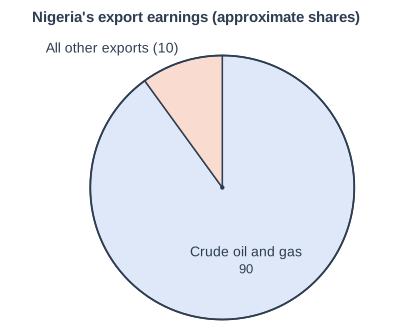
Figure 1 shows the approximate share of Nigeria's export earnings that comes from crude oil and gas.
Suggest one problem for Nigeria of relying on oil and gas for most of its export earnings.
Model answer
The price of oil goes up and down on the world market. When the oil price fell sharply between 2014 and 2016, Nigeria's export earnings and government income fell, and the economy went into recession in 2016.
Explanation
Figure 1 shows that about 90% of export earnings come from oil and gas, so the economy is very vulnerable to anything that affects oil. The second mark comes from explaining the consequence of the problem, ideally with an example such as the 2016 recession.
Mark scheme
1 mark
A valid problem, e.g. oil prices rise and fall on the world market / oil is non-renewable and will run out / the oil industry employs few people / other sectors such as farming are neglected / profits go to foreign TNCs / environmental damage
1 mark for a problem; 1 further mark for developing that problem; only one problem is credited
1 mark
Development, e.g. so when the oil price fell sharply in 2014-2016, Nigeria's export earnings and government income fell and the economy went into recession in 2016 / so the country will have little income in future unless the economy is diversified / so unemployment stays high
development of the problem given
Question 3
4 marks
Describe the social and cultural context of an LIC or NEE you have studied.
Model answer
Nigeria is a very diverse country with over 250 ethnic groups. The largest are the Hausa-Fulani in the north, the Yoruba in the south-west and the Igbo in the south-east, and many languages are spoken, although English is the official language. The north is mainly Muslim and the south mainly Christian. Nigeria has a rich culture: its film industry, Nollywood, is one of the largest in the world, and its music and writers, such as Chinua Achebe, are famous internationally. It also has a very young population, with over 40% aged under 15.
Explanation
Social and cultural context covers the people: ethnic groups, languages, religions, the arts, sport and population features. Each accurate point earns a mark and adding precise detail, such as naming the main ethnic groups, earns a second. Vague statements such as 'it has lots of culture' do not score.
Mark scheme
1 mark
The population is very diverse, with many ethnic groups (Nigeria has over 250)
max 4; 1 mark per valid descriptive point and a further mark where a point is developed with accurate detail; points shown for Nigeria, but credit accurate points about any named LIC or NEE
1 mark
the largest groups are the Hausa-Fulani in the north, the Yoruba in the south-west and the Igbo in the south-east
development of the previous point
1 mark
Religion is divided between a mainly Muslim north and a mainly Christian south
1 mark
differences between groups and regions have sometimes led to tension and conflict, e.g. the civil war of 1967-1970
development of the previous point
1 mark
Many languages are spoken, but English is the official language
1 mark
It has a famous film industry, Nollywood, one of the largest in the world by number of films
1 mark
Its music (e.g. Afrobeats), literature (e.g. Chinua Achebe, Wole Soyinka) and football are known around the world
1 mark
It has a very young population / over 40% are under 15 / rapid population growth
1 mark
Rapid urbanisation: about half the population lives in cities such as Lagos
1 mark
Large inequalities, e.g. the south is generally wealthier than the north / many people live in poverty
Question 4
6 marks
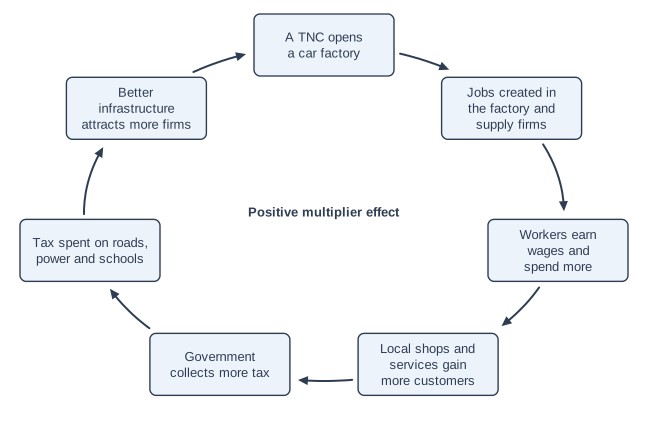
Figure 1 shows the positive multiplier effect that can follow when a TNC opens a car factory in an NEE.
Using Figure 1 and your own knowledge, explain how manufacturing industry can stimulate economic development in LICs and NEEs.
Model answer
Figure 1 shows that when a TNC opens a car factory, jobs are created both in the factory itself and in supply firms that make parts. Workers earn regular wages, which they spend in local shops and services, so these businesses gain customers and take on more staff. This is the positive multiplier effect: one investment creates many more jobs than it employs directly.
As more people earn wages and businesses make profits, the government collects more tax. It can spend this on roads, electricity and schools, and better infrastructure and a better-educated workforce attract even more firms, so the cycle continues.
Manufacturing also brings benefits that are not shown in Figure 1. Workers gain new skills and technology is transferred from the TNC, so local people may start their own businesses. Manufactured goods sell for more than raw materials because value has been added, and their prices are more stable, so exports earn more and the country relies less on a single primary product. In Nigeria, for example, factories such as Dangote Cement have reduced the need to import cement and created many jobs, helping to reduce the country's dependence on oil.
Explanation
To reach Level 3 you need to use the figure and go beyond it with your own knowledge. Explain the chain of cause and effect rather than repeating the boxes: jobs → wages → spending → more jobs and tax → better infrastructure → more investment. Extra ideas such as skills, value added and diversification show wider understanding.
Mark scheme
6 marks
Levels of response (6 marks). Level 3 (5-6 marks): detailed, well-developed explanation of how manufacturing leads to wider economic development, with clear chains of reasoning; makes effective use of Figure 1 and adds own knowledge, such as supply chains, skills, exports or a named example. Level 2 (3-4 marks): clear explanation with some linked points; some use of Figure 1 and/or own knowledge. Level 1 (1-2 marks): basic explanation with simple statements, or lifts steps from Figure 1 with little explanation. 0 marks: nothing worthy of credit.
Indicative content (not a checklist; credit other valid points): from Figure 1: the factory creates direct jobs with regular wages; workers spend their wages, so local shops and services gain customers and take on more staff; the government collects more tax and spends it on roads, power and schools; better infrastructure attracts more firms, so the cycle repeats and growth builds up. Own knowledge: supply firms making parts, packaging or providing transport get orders and create indirect jobs; workers gain skills and new technology is transferred, which raises productivity and can lead to new local businesses; manufactured exports add value and earn more foreign currency than raw materials, with more stable prices; reduces dependence on a single primary export such as oil; less need to import goods; higher incomes improve quality of life (diet, healthcare, education); examples: Nigeria - food and drink factories near Lagos (e.g. Unilever, Nestle), Dangote Cement, Innoson cars at Nnewi, the Dangote refinery; Vietnam - Samsung phone factories in Bac Ninh and Thai Nguyen created many jobs and a large share of exports; the multiplier can also work in reverse if a factory closes.
Ready to try the rest? Every answer you write is marked against the mark scheme, so you can see exactly where the marks are.
Ctrl + Enter to check
AI TutorHints first, answers after you try
Hi! Stuck? Ask me for a hint and I’ll help you work it out. Once you’ve checked your answer I can explain exactly where the marks are.