Level:
Correct: 0
Incorrect: 0
Marks: 0/0
Exam Practice
Subject:
Topics:
AQA GCSE Geography (Paper 2) Smart practice A mixed round aimed at your weak spots
Avg
score:
–
Topics
done:
0/23

Sustainable urban living and transport

Practise 32 exam-style questions on Sustainable urban living and transport for AQA GCSE Geography (Paper 2). Write your answer as you would in the exam and get it marked in seconds against the mark scheme, point by point, with an AI tutor on hand if you get stuck.

  • 32 questions
  • 1–12 marks each
  • Instant marking
  • No sign-up needed
20 questions, marked as you go

Sample questions with model answers

Here are 4 of the questions in this topic, each with a model answer, an explanation of why it earns the marks and the mark scheme an examiner would use.

Question 1

1 mark

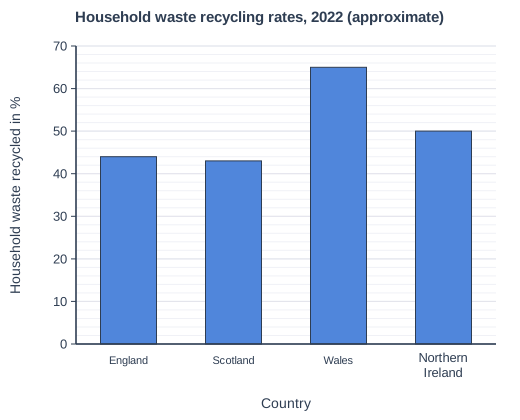
Figure 1 shows the percentage of household waste recycled in the four countries of the UK in 2022.

Calculate the difference between the highest and the lowest recycling rates shown.

Household waste recycling rates, 2022 (approximate). Bar chart of household waste recycled in % for each country: England 44, Scotland 43, Wales 65, Northern Ireland 50.

Model answer

Wales 65% − Scotland 43% = 22 percentage points.

Explanation

Find the tallest bar (Wales, about 65%) and the shortest (Scotland, about 43%, just below England at about 44%) and subtract. Wales recycles far more of its household waste than the rest of the UK, so it is often used as an example of successful recycling policy.

Mark scheme
  1. 1 mark

    22 percentage points (65% for Wales − 43% for Scotland)

    accept 20-24 (readings within ±1%); accept '22%'

Question 2

2 marks

Suggest two ways in which cities can encourage people to recycle more of their household waste.

Model answer

Councils could provide kerbside collections with separate boxes for paper, glass and plastics, and collect food waste every week so it can be composted.

Explanation

People recycle more when it is easy (kerbside collections), when there is an incentive (deposits, smaller general waste bins) and when they understand why it matters (campaigns). Wales, which uses many of these methods, has one of the highest household recycling rates in the world.

Mark scheme
  1. 1 mark

    Kerbside collections with separate bins or boxes for different materials

    max 2; 1 mark per different way

  2. 1 mark

    Weekly collections of food waste

  3. 1 mark

    Smaller bins or less frequent collections for general (non-recyclable) waste

  4. 1 mark

    More recycling centres or bring banks

  5. 1 mark

    Education and publicity campaigns, e.g. in schools

  6. 1 mark

    Deposit return schemes for bottles and cans, or rewards and incentives

  7. 1 mark

    Fines or charges for people who do not sort their waste correctly

Question 3

4 marks

Using an example of a sustainable housing development, describe its main features.

Model answer

BedZED is a sustainable housing development in Hackbridge, south London, completed in 2002 with about 100 homes and some workspaces. It was built on brownfield land, a former sewage works. The homes face south and have large triple-glazed windows to capture the Sun's heat, together with very thick insulation, so they need very little heating. Photovoltaic panels generate electricity, and colourful wind cowls on the roofs provide fresh air while recovering heat from the stale air leaving the homes. Green sedum roofs, rainwater harvesting and water-saving appliances reduce water use, many building materials were reclaimed or sourced locally, and a car club and cycle storage reduce the need for car ownership.

Explanation

Describe the actual features of one named development, grouped if possible under energy, water, materials and transport, with accurate details. Level 2 needs place-specific facts; a description of a 'typical eco-home' without a named place stays in Level 1.

Mark scheme
  1. 4 marks

    Levels of response (4 marks).
    Level 2 (3-4 marks): clear description of several features of a named sustainable housing development (e.g. energy and water conservation, waste, green space, transport), with accurate place-specific detail.
    Level 1 (1-2 marks): basic description of simple or generic features; little or no place-specific detail.
    0 marks: nothing worthy of credit.

    Indicative content (not a checklist; credit other valid points): BedZED (Beddington Zero Energy Development), Hackbridge, south London, completed in 2002 with about 100 homes and workspaces; built on brownfield land (a former sewage works); south-facing, triple-glazed windows to capture the Sun's heat; very thick insulation; photovoltaic panels; wind cowls for natural ventilation with heat recovery; green (sedum) roofs; rainwater harvesting and water-saving appliances; many building materials reclaimed or sourced locally; a car club and cycle storage to reduce car use. Vauban, Freiburg (Germany): built on a former army barracks; streets largely free of cars, with parking in garages at the edge of the district; most households do not own a car; a tram line through the district; passive houses and the Solar Settlement, whose homes produce more energy than they use; green spaces; rainwater soaks into the ground; credit any appropriate named development.

Question 4

9 marks

Using a named example, evaluate the success of a transport strategy used to reduce traffic congestion in a city.

Model answer

Curitiba in Brazil, a city of about 1.8 million people, is famous for its bus rapid transit (BRT) system, which has been largely successful in reducing traffic congestion.

The system began in the 1970s. Express buses run on their own lanes along the main routes into the city centre, so they are not held up by cars. Passengers pay before boarding at distinctive tube-shaped stations and step straight onto the bus at floor level, which makes stops very quick. Long bi-articulated buses carry over 200 passengers each, and the network is integrated, with a single fare allowing people to change between colour-coded express, feeder and inter-district routes. The city also planned high-density housing and offices along the bus corridors, so many people live close to a fast bus route.

The strategy has had many successes. The BRT carries a large share of the city's commuters, so far fewer people need to drive, which reduces congestion, fuel use and air pollution compared with what it would otherwise be. It was much cheaper to build than an underground railway, so the city could afford it, and it has been copied by many other cities around the world, such as Bogotá in Colombia - strong evidence that it works.

However, there are limitations. The buses are often overcrowded at peak times, and the system has struggled to keep up with the city's growth. Car ownership in Curitiba has still increased as people have become wealthier, so congestion has not been eliminated, and the network needs continual investment to stay attractive.

Overall, I think Curitiba's BRT has been very successful. It has kept the city's congestion much lower than it would otherwise be, at a low cost, and has become a model for cities worldwide. Its limitations show that public transport must keep improving, and may need to be combined with measures that discourage car use, if it is to stay effective as a city grows.

Explanation

An evaluation needs the details of how the strategy works, evidence of what it achieved, its limitations, and a final judgement. Strong answers judge success against the aim (reducing congestion) and consider cost and change over time. Any named strategy can be used - Curitiba's BRT, London's congestion charge or Bristol's MetroBus, for example.

Mark scheme
  1. 9 marks

    Levels of response (9 marks).
    Level 3 (7-9 marks): detailed knowledge of how a named transport strategy works; thorough evaluation of its successes and limitations (e.g. effect on congestion, passengers, pollution, cost, who benefits), supported by evidence; a clear, substantiated judgement on how successful it has been; detailed place-specific knowledge.
    Level 2 (4-6 marks): clear knowledge of the strategy; some evaluation, which may be one-sided; some place-specific detail; a judgement may be given but is not fully supported.
    Level 1 (1-3 marks): basic knowledge with simple statements; little or no evaluation; generic, not place-specific.
    0 marks: nothing worthy of credit.

    Indicative content (not a checklist; credit other valid points): Curitiba, Brazil (about 1.8 million people): bus rapid transit began in the 1970s, with express buses on dedicated lanes along main routes into the centre; tube-shaped stations where passengers pay before boarding and step straight on at floor level; long bi-articulated buses carrying over 200 passengers; an integrated network with a single fare and colour-coded routes; high-density development along the bus corridors. Successes: carries a large share of the city's commuters, reducing car use, congestion, fuel use and pollution; much cheaper to build than an underground railway; copied by many cities around the world, e.g. Bogotá. Limitations: buses become overcrowded at peak times; car ownership in Curitiba has still grown; the network needs constant investment. London congestion charge (2003): traffic entering the zone fell by almost a fifth and congestion fell by about 30% at first; money raised improves public transport; but congestion later returned because of roadworks, road space given to buses, cyclists and pedestrians, and more private hire and delivery vehicles; traffic may divert round the zone. Bristol MetroBus (2018) and park and ride. Credit any appropriate named strategy.

Ready to try the rest? Every answer you write is marked against the mark scheme, so you can see exactly where the marks are.

AI Tutor Hints first, answers after you try

Hi! Stuck? Ask me for a hint and I’ll help you work it out. Once you’ve checked your answer I can explain exactly where the marks are.