Economic development in an LIC or NEE: trade, aid and quality of life
Practise 34 exam-style questions on Economic development in an LIC or NEE: trade, aid and quality of life for AQA GCSE Geography (Paper 2). Write your answer as you would in the exam and get it marked in seconds against the mark scheme, point by point, with an AI tutor on hand if you get stuck.
34 questions
1–12 marks each
Instant marking
No sign-up needed
20 questions, marked as you go
Sample questions with model answers
Here are 4 of the questions in this topic, each with a model answer, an explanation of why it earns the marks and the mark scheme an examiner would use.
Question 1
1 mark
Which one of the following is the name for burning off natural gas that is released during oil extraction?
A Fracking B Gas flaring C Bunkering D Desertification
Give the letter of the correct answer.
Model answer
B
Explanation
Gas flaring burns the natural gas that comes up with crude oil, wasting a valuable energy source and releasing carbon dioxide and other pollutants. Nigeria has long been one of the world's biggest gas-flaring countries, even though flaring has officially been illegal there since 1984.
Mark scheme
1 mark
B (gas flaring)
accept the letter or the option written out; do not accept more than one answer
Question 2
2 marks
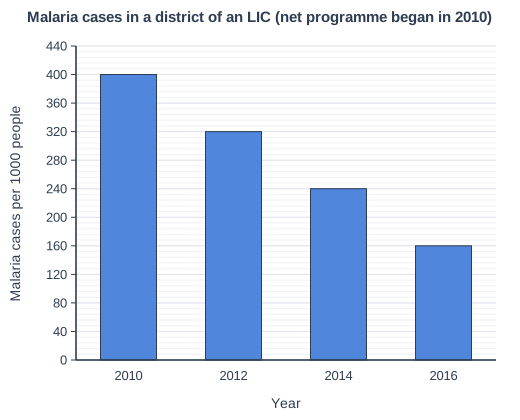
Figure 1 shows the number of malaria cases per 1000 people in a district of an LIC where a mosquito net programme began in 2010.
Calculate the percentage decrease in malaria cases between 2010 and 2016.
Percentage change = (change ÷ original value) × 100, and the original value is the earlier year (2010). 40% is the 2016 value as a percentage of the 2010 value, and 150% comes from wrongly dividing by the 2016 value.
Mark scheme
1 mark
Working: (400 − 160) ÷ 400 × 100 / a decrease of 240 divided by 400
correct answer with no working scores full marks
1 mark
60%
do not accept 40% or 150%
Question 3
4 marks
Explain why China has become an important trading partner for many LICs and NEEs, such as Nigeria.
Model answer
China's industries have grown very fast, so it needs large amounts of raw materials such as oil, which countries like Nigeria can supply. At the same time, China produces cheap manufactured goods such as phones and machinery, which people and businesses in Nigeria can afford, so China has become Nigeria's biggest source of imports. Chinese companies have also invested in infrastructure, building railways such as the line from Lagos to Ibadan and the new Lekki Deep Sea Port. This makes trade easier and has strengthened the relationship between the two countries.
Explanation
Trade happens because each side gains: China gets raw materials and markets, and LICs and NEEs get cheap goods, investment and infrastructure. Explaining both sides of the relationship, with Nigerian examples such as Chinese-built railways, gives a Level 2 answer.
Mark scheme
4 marks
Levels of response (4 marks). Level 2 (3-4 marks): clear explanation with developed points that link China's needs and offers to the interests of LICs and NEEs; some specific detail, e.g. about Nigeria. Level 1 (1-2 marks): basic explanation with simple statements; little development or detail. 0 marks: nothing worthy of credit.
Indicative content (not a checklist; credit other valid points): China's fast-growing industries need large amounts of raw materials such as oil and minerals, which LICs and NEEs can supply; China makes cheap manufactured goods (phones, machinery, vehicles, textiles) that consumers and firms in LICs and NEEs can afford, so it has become Nigeria's largest source of imports; Chinese companies and banks invest in and lend money for infrastructure, e.g. in Nigeria the Abuja-Kaduna and Lagos-Ibadan railways and the Lekki Deep Sea Port near Lagos, built by a Chinese company and opened in 2023; Chinese loans often come with fewer political conditions than Western aid; projects are built quickly; LICs and NEEs want to diversify their partners away from former colonial powers and the USA, whose demand for Nigerian oil fell in the 2010s.
Question 4
6 marks
Explain the environmental impacts of economic development in an LIC or NEE you have studied.
Model answer
In Nigeria, the oil industry has caused the most serious environmental damage. Oil spills from old, corroded pipelines and from oil theft have polluted creeks, mangrove swamps and farmland in the Niger Delta. In Ogoniland, a UN report in 2011 found that land and drinking water were so contaminated that cleaning up could take 25-30 years. Gas flaring, which burns gas released with the oil, releases carbon dioxide and gases that cause acid rain.
The growth of farming and industry has also led to deforestation. Forests have been cleared for timber, for plantations such as cocoa and oil palm, and for fuelwood for a growing population, and Nigeria has had one of the highest rates of deforestation in the world. This destroys habitats and leaves soil exposed to erosion.
Rapid urban growth has created further problems. In Lagos, traffic congestion and diesel generators, used because of power cuts, cause air pollution, and the city produces huge amounts of waste, much of which ends up in open dumps. Untreated industrial waste and sewage pollute rivers and lagoons. In this way, the processes that drive economic growth, such as oil, farming, industry and urbanisation, all put pressure on the environment.
Explanation
Explain each impact by linking it to the economic activity that causes it: oil extraction → spills and flaring; commercial farming and logging → deforestation; urbanisation → air pollution and waste. Precise Nigerian detail, such as the UNEP Ogoniland report, lifts an answer to Level 3.
Mark scheme
6 marks
Levels of response (6 marks). Level 3 (5-6 marks): detailed, well-developed explanation of a range of environmental impacts, each clearly linked to a cause in economic development; accurate place-specific detail about the named country. Level 2 (3-4 marks): clear explanation of some environmental impacts with some links to economic development; some place-specific detail. Level 1 (1-2 marks): basic statements about pollution or damage with little explanation of causes; generic. 0 marks: nothing worthy of credit.
Indicative content (not a checklist; credit other valid points): Nigeria: oil extraction in the Niger Delta - oil spills from pipelines (corrosion, theft, sabotage) pollute creeks, mangroves and farmland, e.g. Ogoniland (UNEP 2011 found contamination that could take 25-30 years to clean up); gas flaring releases carbon dioxide, soot and acid rain; deforestation - Nigeria has had one of the highest rates of deforestation in the world as forests are cleared for logging, farmland (cocoa, oil palm), fuelwood and roads, causing loss of habitats and soil erosion; desertification in the north, made worse by overgrazing and fuelwood collection as the population grows; industry - factories release untreated waste into rivers and air; mining - e.g. illegal gold mining in Zamfara State caused lead poisoning in 2010 that killed hundreds of children; urban growth - air pollution from traffic and diesel generators in Lagos, huge amounts of waste and electronic waste in landfill sites, water pollution from untreated sewage. Credit any appropriate named LIC or NEE.
Ready to try the rest? Every answer you write is marked against the mark scheme, so you can see exactly where the marks are.
Ctrl + Enter to check
AI TutorHints first, answers after you try
Hi! Stuck? Ask me for a hint and I’ll help you work it out. Once you’ve checked your answer I can explain exactly where the marks are.