
Level:
Correct: 0
Incorrect: 0
Marks: 0/0
Exam Practice
Subject:
Topics:
AQA GCSE Geography (Paper 2) Smart practice A mixed round aimed at your weak spots
Avg
score:
–
Topics
done:
0/23

Food: increasing supply and sustainable food

Practise 35 exam-style questions on Food: increasing supply and sustainable food for AQA GCSE Geography (Paper 2). Write your answer as you would in the exam and get it marked in seconds against the mark scheme, point by point, with an AI tutor on hand if you get stuck.

  • 35 questions
  • 1–12 marks each
  • Instant marking
  • No sign-up needed
20 questions, marked as you go

Sample questions with model answers

Here are 4 of the questions in this topic, each with a model answer, an explanation of why it earns the marks and the mark scheme an examiner would use.

Question 1

1 mark

Which one of the following would help to make sure that fish come from sustainable sources?

A Using nets with a smaller mesh size so that more fish are caught
B Buying fish with a Marine Stewardship Council (MSC) label
C Increasing the number of fishing boats in the North Sea
D Eating only the most popular species, such as cod and tuna

Give the letter of the correct answer.

Model answer

B

Explanation

The MSC blue label shows that fish come from a fishery that is managed so that stocks are not overfished. Smaller mesh sizes (A) catch young fish before they can breed, more boats (C) increase overfishing, and eating only a few species (D) puts extra pressure on those stocks.

Mark scheme
  1. 1 mark

    B (buying fish with a Marine Stewardship Council (MSC) label)

    Accept the letter or the option written out; do not accept more than one answer.
Question 2

2 marks

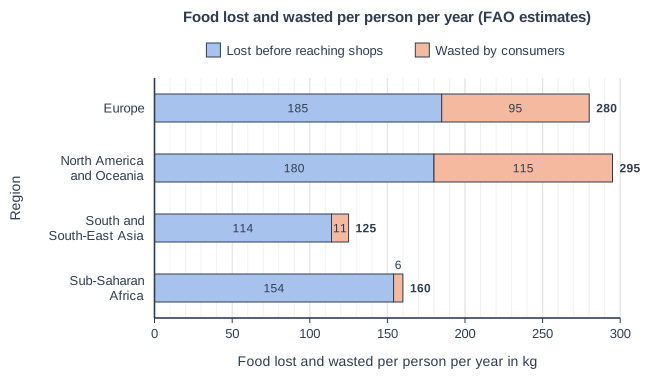
Figure 1 shows estimates of the amount of food lost and wasted per person each year in four world regions.

Calculate the percentage of the food lost and wasted per person in Europe that is wasted by consumers.

Food lost and wasted per person per year (FAO estimates). Stacked bar chart with 4 horizontal bars. The value axis (x-axis) is "Food lost and wasted per person per year in kg", from 0 to 300 marked every 50; the bars are labelled along the y-axis, "Region", from top to bottom. Each bar is split into 2 parts, shown in the key: Lost before reaching shops (left, blue) and Wasted by consumers (right, orange). Values: Europe: lost before reaching shops 185 kg, wasted by consumers 95 kg, total 280 kg; North America and Oceania: lost before reaching shops 180 kg, wasted by consumers 115 kg, total 295 kg; South and South-East Asia: lost before reaching shops 114 kg, wasted by consumers 11 kg, total 125 kg; Sub-Saharan Africa: lost before reaching shops 154 kg, wasted by consumers 6 kg, total 160 kg. The value of each part is printed on it (just outside the bar, next to the part, where a part is too thin). Each bar's total is printed at the end of it.

Model answer

95 ÷ 280 × 100 = 33.9%
About 34% of the food lost and wasted per person in Europe is wasted by consumers.

Explanation

The whole is the total for Europe (280 kg), and the part is the consumer waste (95 kg). Dividing by 185 kg is a common error because it compares the two parts with each other rather than with the total.

Mark scheme
  1. 1 mark

    Working: 95 ÷ 280 × 100

    Correct answer with no working scores full marks.

  2. 1 mark

    33.9%

    Accept 34% or 33.9% (or more decimal places, e.g. 33.93%). Do not accept 51% (95 ÷ 185, consumer waste compared with the food lost before shops).

Question 3

4 marks

Explain how organic farming can help to provide sustainable food supplies.

Model answer

Organic farmers do not use artificial fertilisers or pesticides. Instead they keep the soil fertile with manure, compost and crop rotation, including plants such as clover that add nitrogen to the soil. This keeps the soil healthy and rich in organic matter, so it holds water better and is less easily eroded, meaning it can keep producing food in the future. Because no artificial fertilisers are used, fewer nitrates wash into rivers, reducing water pollution, and making fertilisers uses lots of fossil fuel energy, so organic farming also has lower emissions. Without pesticides, more insects such as bees survive, which protects biodiversity and pollination.

Explanation

Sustainable means meeting needs now without harming the ability of future generations to meet theirs. The best answers explain how each feature of organic farming protects soil, water, wildlife or energy resources in the long term; saying it is 'healthier' or 'natural' without explanation stays in Level 1.

Mark scheme
  1. 4 marks

    Levels of response (4 marks).
    Level 2 (3-4 marks): clear explanation with developed points that link features of organic farming to long-term sustainability (environment, soil, resources or local economy); accurate terminology.
    Level 1 (1-2 marks): basic explanation with simple statements about organic farming, e.g. 'no chemicals', with little explanation of why this is sustainable.
    0 marks: nothing worthy of credit.

    Indicative content (not a checklist; credit other valid points): no artificial fertilisers, so less nitrate runoff into rivers and less eutrophication; no artificial pesticides, so more wildlife and pollinators such as bees, protecting biodiversity; soil fertility maintained naturally with manure, compost, crop rotation and nitrogen-fixing plants such as clover, so soil stays healthy for the future; more organic matter in the soil holds water and reduces erosion; less energy used (artificial fertilisers are made using fossil fuels), so lower greenhouse gas emissions; often small, local farms selling locally, fewer food miles; higher animal welfare standards; limitation (credit but not required): yields are often lower, so more land may be needed and food costs more.

Question 4

6 marks

Discuss the advantages and disadvantages of using biotechnology, such as genetically modified (GM) crops, to increase food supply.

Model answer

Biotechnology can bring important advantages. Scientists can modify crops to give higher yields from the same area of land, which is important as the world's population grows. Crops can be made resistant to pests: Bt cotton, grown widely in India, produces its own insecticide, so farmers need to spray fewer pesticides. Drought-tolerant and salt-tolerant varieties could allow crops to be grown in dry areas and help farmers cope with climate change. Crops can also be made more nutritious; golden rice has been modified to contain beta-carotene, which the body turns into vitamin A, helping to reduce deficiency in countries where rice is the main food.

However, there are disadvantages. GM seeds are expensive and usually have to be bought each year from large TNCs, which can push small farmers into debt and make them dependent on seed companies. There are environmental worries that GM genes could spread to wild plants, creating 'superweeds' resistant to herbicides, and pests can evolve resistance; in India some bollworms have become resistant to Bt cotton. Growing a few GM varieties can also reduce biodiversity as traditional varieties are abandoned. Many people are worried about possible long-term health effects, and some countries strictly limit GM crops.

In conclusion, biotechnology can help to increase food supply, especially in areas affected by drought and pests, but only if the seeds are affordable and carefully regulated. It cannot solve food insecurity on its own, because hunger is often caused by poverty and unequal access to food rather than a lack of production.

Explanation

'Discuss' requires both sides, developed with examples, and a conclusion. Named examples such as Bt cotton and golden rice lift answers above generic statements, and the best conclusions weigh up when biotechnology helps and what it cannot solve.

Mark scheme
  1. 6 marks

    Levels of response (6 marks).
    Level 3 (5-6 marks): detailed, well-balanced discussion of the advantages and disadvantages of biotechnology, with well-developed points and examples; reaches a clear, substantiated conclusion.
    Level 2 (3-4 marks): clear discussion with some development; may be unbalanced; a conclusion may be stated but not well supported.
    Level 1 (1-2 marks): basic, simple statements about advantages and/or disadvantages; little development; no conclusion.
    0 marks: nothing worthy of credit.

    Indicative content (not a checklist; credit other valid points): advantages - higher yields from the same land; pest-resistant crops such as Bt cotton (widely grown in India) need fewer pesticide sprays; drought-tolerant or salt-tolerant varieties for dry areas and in a changing climate; herbicide-tolerant crops make weed control easier; more nutritious crops such as golden rice, modified to contain beta-carotene (vitamin A) to reduce vitamin A deficiency; longer shelf life, reducing waste; disadvantages - seeds are expensive and often must be bought every year from large TNCs, causing debt for small farmers and dependence on seed companies; GM genes may spread to wild plants by cross-pollination, e.g. creating herbicide-resistant 'superweeds'; pests can evolve resistance (e.g. pink bollworm resistance to Bt cotton in India); loss of traditional crop varieties and biodiversity; public concern about long-term health effects, so some countries restrict GM crops; does not solve unequal distribution or poverty, which are major causes of food insecurity; conclusion - can help increase supply if affordable and carefully regulated, but is not a solution on its own.

Ready to try the rest? Every answer you write is marked against the mark scheme, so you can see exactly where the marks are.

AI Tutor Hints first, answers after you try

Hi! Stuck? Ask me for a hint and I’ll help you work it out. Once you’ve checked your answer I can explain exactly where the marks are.