
Level:
Correct: 0
Incorrect: 0
Marks: 0/0
Exam Practice
Course:
Topics:
AQA A-Level Biology (Paper 3) Smart practice A mixed round aimed at your weak spots
Unit 1
Required practical activities
Unit 2
Practical and mathematical skills
Unit 3
Critical analysis of experimental data
Unit 4
The essay
Avg
score:
–
Topics
done:
0/26

Required practical 9: respiration in single-celled organisms

Practise 15 exam-style questions on Required practical 9: respiration in single-celled organisms for AQA A-Level Biology (Paper 3). Write your answer as you would in the exam and get it marked in seconds against the mark scheme, point by point, with the Study Helper on hand if you get stuck.

  • 15 questions
  • 1–8 marks each
  • Instant marking
  • No sign-up needed
15 questions, marked as you go

Sample questions with model answers

Here are 4 of the questions in this topic, each with a model answer, an explanation of why it earns the marks and the mark scheme an examiner would use.

Question 1

2 marks

Other than using a redox indicator, give two ways of measuring the rate of respiration of a culture of yeast.

Model answer

1. Collect the carbon dioxide released in a gas syringe and measure its volume every minute.
2. Use a respirometer containing potassium hydroxide solution to measure the volume of oxygen taken up.

Explanation

The rate of respiration can be found from the rate of use of a reactant (oxygen) or the rate of production of a product (carbon dioxide). Volumes of gas can be measured with a gas syringe or a respirometer, concentrations with sensors and dataloggers, and the loss of carbon dioxide from a flask as a loss in mass. Counting bubbles is the least accurate, because bubble size varies.

Mark scheme
  1. 1 mark

    Measure the volume of carbon dioxide / gas released in a given time (e.g. with a gas syringe or by collecting it over water)

    Max 2. List rule: if more than two answers are given, each wrong or contradictory extra answer cancels one correct answer. Each answer must say what is measured. Ignore 'measure the carbon dioxide' with no idea of volume, mass or concentration.

  2. 1 mark

    Measure the uptake of oxygen with a respirometer (containing potassium hydroxide / soda lime) / the distance moved by liquid in a capillary tube

  3. 1 mark

    Use a carbon dioxide sensor / datalogger to measure the change in carbon dioxide concentration

  4. 1 mark

    Use an oxygen sensor / probe to measure the decrease in (dissolved) oxygen concentration

  5. 1 mark

    Measure the loss in mass of the flask (as carbon dioxide escapes)

  6. 1 mark

    Measure the decrease in pH (with a pH probe or hydrogencarbonate indicator) as carbon dioxide is produced

  7. 1 mark

    Count the bubbles of gas released per minute
Question 2

3 marks

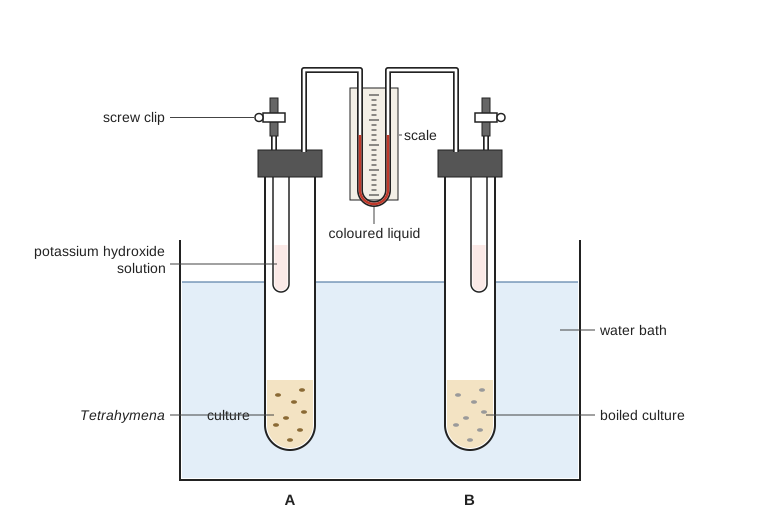
Tetrahymena is a single-celled organism that lives in fresh water. The diagram shows a differential respirometer used to measure its rate of oxygen uptake.

Tube A contains a culture of Tetrahymena. Tube B contains the same volume of the same culture that had been boiled and then cooled. Both tubes contain potassium hydroxide solution, which absorbs carbon dioxide, and both stand in the same water bath. The screw clips are closed when readings start.

Explain why the respirometer includes tube B.

Explain why tube B contains the same volume of liquid as tube A.

Explain why this respirometer cannot detect anaerobic respiration by Tetrahymena.

Two boiling tubes, labelled A and B, stand side by side in a water bath. Each is closed with a bung and has the same volume of liquid at the bottom, labelled Tetrahymena culture in A and boiled culture in B. A small tube labelled potassium hydroxide solution hangs from the bung of each boiling tube. A glass tube from each bung rises and joins one arm of a U-shaped tube between the two boiling tubes. Coloured liquid fills the bottom of the U-tube to the same level in both arms, in front of a scale. A short outlet with rubber tubing and a screw clip also passes through each bung.

Model answer

Tube B contains no living cells, so it compensates for changes in temperature and atmospheric pressure: these change the gas volume in both tubes equally, so the coloured liquid moves only because the living Tetrahymena in tube A take up oxygen.

Tube B contains the same volume of liquid so that it contains the same volume of air as tube A. A change in temperature or pressure then has the same effect on the gas in both tubes, and the effects cancel out.

Anaerobic respiration does not use oxygen, and any carbon dioxide it releases is absorbed by the potassium hydroxide solution, so it causes no change in gas volume and the liquid does not move.

Explanation

In a differential respirometer the two tubes are joined through the manometer, so a change that affects both tubes equally, such as a change in temperature or atmospheric pressure, does not move the coloured liquid. This works only if both tubes contain the same volume of gas, which is why the volumes of liquid are matched. Because potassium hydroxide absorbs carbon dioxide, the respirometer detects only oxygen uptake, so it measures aerobic respiration alone.

Mark scheme
  1. 1 mark

    Tube B compensates for changes in temperature / (atmospheric) pressure, which change the volume of gas in both tubes equally, so the liquid moves only because of oxygen uptake by the living cells in tube A

    1 mark for each part. Accept 'cancels out the effect of changes in temperature or pressure'. Accept 'acts as a thermobarometer' only with this explanation. Accept 'shows that any oxygen uptake is due to (respiration by) living cells' as an alternative. Ignore 'it is a control' with no explanation.

  2. 1 mark

    So that the volume of air / gas in tube B is the same as in tube A, so a change in temperature or pressure has the same effect on (the gas in) both tubes

    Accept 'so the effects in the two tubes are equal and cancel out'. Ignore 'to make it a fair test' unqualified.

  3. 1 mark

    Anaerobic respiration does not take up oxygen (and any carbon dioxide released is absorbed by the potassium hydroxide), so there is no change in gas volume / the liquid does not move

    Accept 'the respirometer measures only oxygen uptake, and anaerobic respiration does not use oxygen'. Ignore 'anaerobic respiration produces lactate' unless linked to no change in gas volume.

Question 3

4 marks

A student measured the rate of respiration of yeast by standing a flask containing yeast in glucose solution, plugged with cotton wool, on a balance. The balance reads to 0.01 g and each reading has an uncertainty of ±0.005 g. In 30 minutes the mass of the flask fell from 152.46 g to 152.28 g.

Calculate the percentage uncertainty in the loss in mass.

Suggest one reason why the loss in mass may overestimate the mass of carbon dioxide produced by the yeast.

Suggest one way of reducing the percentage uncertainty in the loss in mass.

Model answer

Loss in mass = 152.46 - 152.28 = 0.18 g
The loss is the difference between two readings, so its uncertainty = 2 × 0.005 = ±0.01 g
Percentage uncertainty = 0.01 ÷ 0.18 × 100 = 5.6%

Some water evaporates from the flask through the cotton wool, so not all of the loss in mass is carbon dioxide.

The percentage uncertainty could be reduced by measuring the loss in mass over a longer time, so the loss is larger compared with the uncertainty.

Explanation

A loss in mass is the difference between two balance readings, so the uncertainties of both readings add: ±0.01 g. Percentage uncertainty = uncertainty ÷ measured value × 100, so a larger loss in mass (a longer time or more yeast) or a balance with a higher resolution gives a smaller percentage uncertainty. The method assumes that all the mass lost is carbon dioxide, but water vapour also escapes.

Mark scheme
  1. 1 mark

    Correct method: (2 × 0.005) ÷ 0.18 × 100 = 0.01 ÷ 0.18 × 100; or a correct final answer of 5.6 (accept 5.55 to 5.6, or 6) with no working

    Max 4. Points 1 and 2 are the calculation: a correct answer of 5.6% (accept 5.55 to 5.6, or 6) with no working scores 2 marks. Accept for 1 mark: 2.8 (the uncertainty of only one reading used) OR 0.056 (not multiplied by 100).

  2. 1 mark

    5.6 (%) (accept 5.55 to 5.6, or 6)

  3. 1 mark

    Water (vapour) / ethanol evaporates from the flask (through the cotton wool), so it is also lost

    Accept 'some of the mass lost is water'.

  4. 1 mark

    Measure over a longer time OR use more yeast / a higher temperature (within the range the yeast tolerates) so the loss in mass is larger OR use a balance with a higher resolution (e.g. reading to 0.001 g)

    Ignore 'repeat the experiment'.

Question 4

6 marks

Chlorella is a single-celled alga that photosynthesises in the light. A student wants to investigate the effect of temperature on the rate of aerobic respiration of Chlorella.

She has: a culture of Chlorella, respirometers (each a boiling tube with a bung, a capillary tube beside a millimetre scale, a syringe and a tap), potassium hydroxide solution, aluminium foil, water baths that can be set at different temperatures, and a timer.

Describe how she could carry out this investigation.

Model answer

Put 10 cm³ of well-mixed Chlorella culture into each respirometer, with potassium hydroxide solution in a small tube above the culture to absorb carbon dioxide. Wrap each respirometer in aluminium foil so that the algae cannot photosynthesise. Stand the respirometer in a water bath at 10 °C with the tap open and leave it for 10 minutes to reach the temperature. Close the tap and measure the distance the coloured liquid moves along the capillary tube in 10 minutes. Use the syringe to reset the liquid and repeat twice more. Calculate the volume of oxygen used as πr²l and divide by the time. Repeat at 15, 20, 25, 30 and 35 °C, and set up a control respirometer containing boiled culture at each temperature to correct for changes in temperature and pressure.

Explanation

A respirometer with an absorber for carbon dioxide measures oxygen uptake, but a photosynthetic organism produces oxygen in the light, so it must be kept in the dark to measure respiration alone. A valid method controls the volume and density of the culture, lets the apparatus reach the set temperature before readings, converts the distance moved to a volume, and uses repeats and a control with no living cells.

Mark scheme
  1. 1 mark

    Put the same volume of (well-mixed) Chlorella culture into each respirometer / same number of cells

    Max 6. Accept steps in any sensible order. Accept 'same density of culture'.

  2. 1 mark

    Put potassium hydroxide solution in the tube, separated from the culture, to absorb carbon dioxide

  3. 1 mark

    Wrap the respirometer in aluminium foil / keep it in the dark, so that the alga does not photosynthesise (releasing oxygen and taking up carbon dioxide)

    Must give the reason or refer to preventing photosynthesis.

  4. 1 mark

    Stand the respirometer in a water bath at the chosen temperature and leave it (with the tap open) to reach that temperature before taking readings

  5. 1 mark

    Close the tap and measure the distance moved by the coloured liquid in a set time

  6. 1 mark

    Calculate the volume of oxygen taken up using πr²l (r = radius of the capillary bore) and divide by time to give a rate

    Accept 'distance moved per minute' as a rate if the bore is the same in every respirometer.

  7. 1 mark

    Use a range of at least five temperatures (e.g. 10 °C to 40 °C)

  8. 1 mark

    Repeat (at least three times) at each temperature and calculate a mean

    Accept 'repeat and identify anomalous results'.

  9. 1 mark

    Set up a control respirometer with no living cells (e.g. boiled culture / culture medium only / glass beads of the same volume) and use its movement to correct the readings

    Accept 'thermobarometer'.

Ready to try the rest? Every answer you write is marked against the mark scheme, so you can see exactly where the marks are.

Study Helper Hints first, answers after you try

Stuck on this one? Ask for a hint and I’ll point you in the right direction, without giving the answer away. Once you’ve checked your answer, I’ll show you how the marks are awarded.