Level:
Correct: 0
Incorrect: 0
Marks: 0/0
Exam Practice
Course:
Topics:
AQA A-Level Biology (Paper 3) Smart practice A mixed round aimed at your weak spots
Unit 1
Required practical activities
Unit 2
Practical and mathematical skills
Unit 3
Critical analysis of experimental data
Unit 4
The essay
Avg
score:
–
Topics
done:
0/26

Required practical 4: permeability of cell membranes

Practise 17 exam-style questions on Required practical 4: permeability of cell membranes for AQA A-Level Biology (Paper 3). Write your answer as you would in the exam and get it marked in seconds against the mark scheme, point by point, with the Study Helper on hand if you get stuck.

  • 17 questions
  • 1–8 marks each
  • Instant marking
  • No sign-up needed
17 questions, marked as you go

Sample questions with model answers

Here are 4 of the questions in this topic, each with a model answer, an explanation of why it earns the marks and the mark scheme an examiner would use.

Question 1

3 marks

Beetroot cells contain a red pigment called betalain. Betalain is a large, water-soluble molecule found in the vacuole of each cell.

Explain why betalain does not leave undamaged beetroot cells.

Model answer

To leave a cell, betalain must cross two membranes: the membrane around the vacuole (the tonoplast) and the cell-surface membrane. Betalain is water-soluble (polar), so it cannot diffuse through the hydrophobic fatty acid tails in the middle of the phospholipid bilayer. It is also too large to pass through channel proteins, and the membranes have no carrier proteins for it, so it stays inside undamaged cells.

Explanation

Required practical 4 depends on the pigment being trapped by intact membranes: only damaged membranes let it leak out, so the colour of the surrounding liquid measures membrane damage. Polar and charged substances cannot cross the hydrophobic core of the bilayer and need specific channel or carrier proteins. Remember that the pigment is in the vacuole, so two membranes are involved; the cell wall is not a barrier.

Mark scheme
  1. 1 mark

    To leave the cell, betalain must cross two membranes: the vacuole membrane (tonoplast) and the cell-surface membrane

    Max 3. Accept 'it has to pass through the membrane around the vacuole as well as the cell-surface membrane'. Ignore references to the cell wall (it is freely permeable).

  2. 1 mark

    Betalain is polar / water-soluble / charged, so it cannot diffuse through the hydrophobic (fatty acid tail) region of the phospholipid bilayer

    Accept 'cannot pass through the non-polar interior / core of the membrane'. Insufficient: 'it cannot pass through the membrane' with no reason.

  3. 1 mark

    Betalain (molecules) are too large to pass between the phospholipids / through channel proteins

    Accept 'too big to diffuse through the membrane'.

  4. 1 mark

    There are no (specific) carrier proteins or channel proteins for betalain in the membranes

    Accept 'membrane proteins are specific, and none of them transports betalain'.
Question 2

3 marks

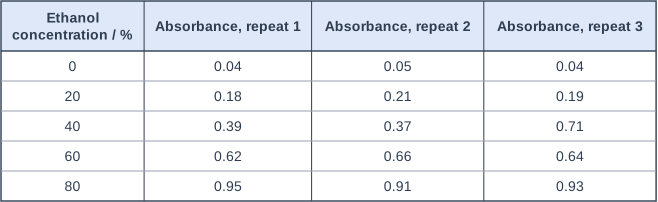
A student investigated the effect of ethanol concentration on the permeability of beetroot cell membranes. She did the investigation three times at each concentration. The table shows her results.

Identify the anomalous result. Calculate the mean absorbance at that concentration that the student should record. Give your answer to 2 decimal places.

Suggest one reason for the anomalous result.

Table with columns "Ethanol concentration / %", "Absorbance, repeat 1", "Absorbance, repeat 2", "Absorbance, repeat 3". Ethanol concentration / %: 0; Absorbance, repeat 1: 0.04; Absorbance, repeat 2: 0.05; Absorbance, repeat 3: 0.04 | Ethanol concentration / %: 20; Absorbance, repeat 1: 0.18; Absorbance, repeat 2: 0.21; Absorbance, repeat 3: 0.19 | Ethanol concentration / %: 40; Absorbance, repeat 1: 0.39; Absorbance, repeat 2: 0.37; Absorbance, repeat 3: 0.71 | Ethanol concentration / %: 60; Absorbance, repeat 1: 0.62; Absorbance, repeat 2: 0.66; Absorbance, repeat 3: 0.64 | Ethanol concentration / %: 80; Absorbance, repeat 1: 0.95; Absorbance, repeat 2: 0.91; Absorbance, repeat 3: 0.93.

Model answer

The anomalous result is 0.71, the third result at 40% ethanol.
Mean = (0.39 + 0.37) ÷ 2 = 0.38

The discs in that tube may not have been rinsed for long enough, so pigment from cells damaged by cutting was also measured.

Explanation

An anomaly is a result that does not fit the pattern of the repeats; leave it out of the mean, which should be given to the same number of decimal places as the data. A good suggestion names a specific fault that would give a higher reading, such as extra pigment from poorly rinsed discs, rather than 'human error'.

Mark scheme
  1. 1 mark

    Mean = 0.38, from (0.39 + 0.37) ÷ 2 with the anomaly left out; a correct answer of 0.38 with no working scores this mark

    Point 1 is the calculation: a correct answer of 0.38 with no working scores this mark. Do not accept 0.49 (anomaly included) or 0.4 (not to 2 decimal places). ECF: accept the mean of the other two repeats at the concentration identified in point 2.

  2. 1 mark

    The anomalous result is 0.71 (at 40% ethanol, repeat 3)

    Accept 'the third result at 40%'. This mark can be awarded from the working of point 1 if 0.71 is clearly the value left out.

  3. 1 mark

    One suitable reason, e.g. the discs were not rinsed enough OR a disc was damaged (squashed) when handled OR a disc was thicker / larger OR an extra disc was added OR the discs were left in the ethanol for longer OR the temperature was higher OR the ethanol was made up to a higher concentration OR the cuvette was dirty / scratched

    One reason is needed. Ignore 'human error' or 'measured wrongly' with no detail.

Question 3

4 marks

A student investigated the effect of temperature on the permeability of beetroot cell membranes. Part of her method is shown.

1. Use a cork borer to cut cylinders of beetroot. On a tile, cut each cylinder into discs exactly 3 mm thick.
2. Rinse the discs in running water until the water stays clear.
3. Put 10 cm³ of distilled water into a boiling tube and stand it in a water bath at the test temperature for 10 minutes.
4. Add six discs to the tube and start a stop clock.
5. Shake the tube gently every 2 minutes.
6. After exactly 20 minutes, pour the liquid into a clean tube, leaving the discs behind.
7. Measure the absorbance of the liquid with a colorimeter.

Give a reason for each of steps 1, 3, 5 and 6.

Model answer

Step 1: so that every disc has the same surface area and volume, so the same amount of tissue can release pigment.
Step 3: so that the water reaches the test temperature before the discs are added, and the discs are at that temperature for the whole 20 minutes.
Step 5: to mix the liquid so the pigment is evenly spread and the concentration gradient next to the discs is maintained.
Step 6: to stop any more pigment leaking out, so that every tube measures the pigment released in exactly 20 minutes.

Explanation

Each step controls a variable other than temperature that would change the amount of pigment in the liquid: the surface area of tissue, the time at the test temperature, how evenly the pigment is mixed and the time the discs spend in the liquid. A reason must say what the step achieves in this investigation; 'to make it fair' or 'to make it accurate' on its own earns nothing.

Mark scheme
  1. 1 mark

    Step 1: so that every disc has the same surface area (and volume / number of cells) from which pigment can leak

    One mark for a correct reason for each step. Accept 'so the same amount of tissue is used in each tube'. Insufficient: 'to make it a fair test' or 'to control variables' alone.

  2. 1 mark

    Step 3: so that the water has reached the test temperature before the discs are added / so the discs are at the test temperature for the whole 20 minutes

    Insufficient: 'to keep the temperature constant' with no idea of the water reaching the temperature first.

  3. 1 mark

    Step 5: to mix the liquid so that the pigment is spread evenly (so the sample measured is representative) OR to maintain a concentration gradient next to the discs

    Accept 'so all the surfaces of the discs are in contact with the water'. Ignore 'to speed up the reaction'.

  4. 1 mark

    Step 6: to stop more pigment leaking into the liquid, so that every tube measures leakage over the same time

    Accept 'the discs would keep releasing pigment, so the readings would depend on how long each tube waited'.

Question 4

5 marks

Red chard is a leafy plant closely related to beetroot. The cells of its red leaf stalks contain betalain, the red pigment found in beetroot.

Scientists grew red chard plants at 10 °C and at 25 °C. In the plants grown at 10 °C, 74% of the fatty acids in the membrane phospholipids were unsaturated, compared with 58% in the plants grown at 25 °C.

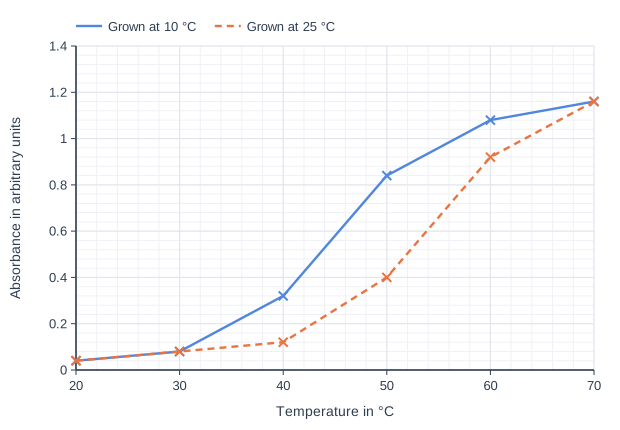
They cut discs from the leaf stalks of each group, rinsed them and put them into distilled water at different temperatures for 20 minutes. They then measured the absorbance of each solution. The graph shows their results.

Describe how the results for the two groups of plants differ. Use values from the graph in your answer.

Use the information about fatty acids to explain the difference between the two groups.

The scientists concluded that the higher proportion of unsaturated fatty acids caused the greater leakage from the plants grown at 10 °C. Suggest one reason why these results do not prove this.

Line graph of absorbance in arbitrary units (y-axis, 0 to 1.4) against temperature in °C (x-axis, 20 to 70). "Grown at 10 °C" joins the points (20, 0.04), (30, 0.08), (40, 0.32), (50, 0.84), (60, 1.08), (70, 1.16). "Grown at 25 °C" (dashed) joins the points (20, 0.04), (30, 0.08), (40, 0.12), (50, 0.4), (60, 0.92), (70, 1.16).

Model answer

The leakage from the plants grown at 10 °C starts to rise steeply at a lower temperature, above 30 °C, compared with above 40 °C for the plants grown at 25 °C. Between 40 and 60 °C the absorbance is higher for the plants grown at 10 °C, for example 0.84 compared with 0.40 at 50 °C, but the absorbances are the same at 20, 30 and 70 °C.

The plants grown at 10 °C have more unsaturated fatty acids in their membrane phospholipids. Unsaturated fatty acids have carbon-carbon double bonds that put kinks in their tails, so the phospholipids cannot pack as tightly and the bilayer is more fluid. As the temperature rises, gaps form in these membranes at a lower temperature, so they become permeable and pigment leaks out sooner.

The results do not prove that the fatty acids are the cause, because plants grown at different temperatures may also differ in other ways that affect permeability, such as the types and amounts of protein in their membranes.

Explanation

The kinks caused by C=C double bonds stop phospholipids packing closely together, which makes a membrane more fluid, so membranes rich in unsaturated fatty acids leak at lower temperatures when heated. When describing data, compare the two groups at the same temperature using values, and say where the results are the same as well as where they differ. A link between two variables in groups that differ in other ways does not prove cause: other membrane components could also have changed with the growing temperature.

Mark scheme
  1. 1 mark

    Leakage from the plants grown at 10 °C starts to rise steeply at a lower temperature: above 30 °C, compared with above 40 °C for the plants grown at 25 °C

    Max 5. Points 1 and 2 describe the results, points 3 and 4 explain them and points 5 and 6 evaluate the conclusion (max 1 from points 5 and 6). Accept 'the curve for the plants grown at 10 °C is shifted to a lower temperature' or 'leakage rises sharply between 30 and 40 °C for plants grown at 10 °C but between 40 and 50 °C for plants grown at 25 °C'.

  2. 1 mark

    Between 40 and 60 °C the absorbance is higher for the plants grown at 10 °C, e.g. 0.32 compared with 0.12 at 40 °C, 0.84 compared with 0.40 at 50 °C or 1.08 compared with 0.92 at 60 °C (the absorbances are the same at 20, 30 and 70 °C)

    At least one correct pair of values at the same temperature is needed. Accept a correctly calculated difference, e.g. 0.44 higher at 50 °C.

  3. 1 mark

    Unsaturated fatty acids have (carbon-carbon) double bonds, which put kinks / bends in their hydrocarbon tails

    Accept 'C=C bonds'. Reject 'double bonds between the fatty acids'.

  4. 1 mark

    So the phospholipids pack less tightly / the bilayer is more fluid, so gaps form / the membranes become permeable (and pigment leaks out) at a lower temperature

    Accept 'the membranes are disrupted at a lower temperature'. Ignore references to membrane proteins denaturing (this would affect both groups). Reject 'unsaturated fatty acids make the membrane less fluid'.

  5. 1 mark

    The plants grown at different temperatures may also differ in other ways that affect membrane permeability, e.g. in the proteins or sterols in their membranes, or in the length of their fatty acid chains, so the difference may not be caused by the fatty acids

    Points 5 and 6: 1 mark each, max 1. List rule: if more than one reason is given, a wrong or contradictory extra answer cancels the correct one. Accept cholesterol for sterols. Accept another suitable difference between the two groups of plants that could affect leakage. Accept 'correlation does not show causation' only if it is linked to another difference between the plants. Insufficient: 'other factors' with no example or link to the membranes or cells.

  6. 1 mark

    No repeats / standard deviations / statistical test are shown, so the differences between the two groups may be due to chance

    Reject 'the results are due to chance'.

Ready to try the rest? Every answer you write is marked against the mark scheme, so you can see exactly where the marks are.

Study Helper Hints first, answers after you try

Stuck on this one? Ask for a hint and I’ll point you in the right direction, without giving the answer away. Once you’ve checked your answer, I’ll show you how the marks are awarded.