
Level:
Correct: 0
Incorrect: 0
Marks: 0/0
Exam Practice
Course:
Topics:
Avg
score:
–
Topics
done:
0/31

Static electricity

Practise 18 exam-style questions on Static electricity for OCR GCSE Physics (Paper 1). Write your answer as you would in the exam and get it marked in seconds against the mark scheme, point by point, with the Study Helper on hand if you get stuck.

  • 18 questions
  • 1–6 marks each
  • Instant marking
  • No sign-up needed
18 questions, marked as you go

Sample questions with model answers

Here are 4 of the questions in this topic, each with a model answer, an explanation of why it earns the marks and the mark scheme an examiner would use.

Question 1

1 mark

Some factory workers put together circuit boards for computers. Each worker wears a band around one wrist, joined by a wire to an earth connection on the bench.

A spark from a charged worker could damage a circuit board.

Why does the wrist band protect the circuit boards?

Choose your answer.

  • A It connects the worker to earth, so no charge builds up on the worker.
  • B It gives the worker extra protons, so the worker always stays uncharged.
  • C It is made of plastic, so it stops electrons from reaching the worker's body.
  • D It stores the charge from the worker's clothes, so that it can be used later.

Model answer

A - It connects the worker to earth, so no charge builds up on the worker.

Explanation

Static charge builds up only when it cannot flow away, as on an insulator or on a person standing on an insulating floor. The wrist band gives the charge a conducting path to earth, so the worker never becomes charged. With no build-up of charge, there is no spark to damage the circuit boards.

Mark scheme
  1. 1 mark

    A / It connects the worker to earth, so no charge builds up on the worker.

    The only correct answer is A: the band and wire conduct, so any charge produced on the worker (for example by clothes rubbing) flows to or from earth straight away; no charge builds up, so no spark can jump to a circuit board. B is not correct because protons are not transferred, and adding protons would charge the worker, not keep them uncharged. C is not correct because the band must conduct to work; a plastic band would be an insulator and charge could build up. D is not correct because the band does not store charge: the charge flows away to earth. ALLOW the letter or the option. If more than one option is given, do not award the mark.
Question 2

2 marks

A sheet of paper is uncharged.

A Perspex rod has been rubbed with a duster, and it is now positively charged.

For each object, compare the number of protons in it with the number of electrons in it.

Model answer

In the uncharged paper, the number of protons is the same as the number of electrons, so the positive and negative charges cancel.
In the positively charged Perspex rod, there are more protons than electrons, because the rod lost some electrons to the duster when it was rubbed.

Explanation

All matter contains positive protons and negative electrons. Most objects have equal numbers of each, so they have zero net charge, like the paper. The Perspex rod became positive by losing electrons; its protons did not change, so after rubbing it has more protons than electrons.

Mark scheme
  1. 1 mark

    paper: the number of protons is equal to the number of electrons (so the positive and negative charges cancel)

    ALLOW the paper has the same number of positive and negative charges. DO NOT ALLOW the paper has no protons or electrons / no charges. DO NOT ALLOW equal numbers of protons and neutrons.

  2. 1 mark

    Perspex rod: there are more protons than electrons / fewer electrons than protons (because it has lost electrons)

    ALLOW the rod has more positive charges than negative charges. DO NOT ALLOW the rod has gained protons. DO NOT ALLOW the rod has no electrons.

Question 3

2 marks

A student draws the electric field around a small, negatively charged sphere. In her drawing:
• the field lines are straight lines that spread out from the sphere in all directions
• the arrows on the field lines point away from the sphere
• two of the field lines cross each other.

Two of these features are wrong.

Describe how each wrong feature should be drawn.

Model answer

The arrows should point towards the sphere, because the sphere is negatively charged and field lines point towards a negative charge.
The field lines should never cross, so the two crossing lines should be redrawn so that each one goes straight out from the sphere without crossing another line.

Explanation

Field lines show the direction of the force on a small positive charge. A positive charge would be attracted to the negative sphere, so the arrows point towards it; around a positive sphere they would point away. Field lines never cross, because a charge at any point can be pushed in only one direction. Around a single charged sphere the lines are straight and spread out evenly in all directions.

Mark scheme
  1. 1 mark

    the arrows should point towards the sphere / inwards (because field lines point towards a negative charge)

    If more than two features are changed, a wrong change cancels a right one (the straight lines spreading out in all directions are correct, so changing them is a wrong answer). ALLOW the arrows should point into the sphere / to the centre of the sphere. ALLOW field lines go from positive to negative, so they point into a negative charge. ALLOW the arrows show the direction of the force on a positive charge, which is attracted to the negative sphere. DO NOT ALLOW the arrows should point away from the sphere.

  2. 1 mark

    the field lines should not cross (each other) / no two field lines should cross / the two crossing lines should be redrawn so that they do not cross

    ALLOW field lines never cross. ALLOW each line should go straight out from the sphere on its own, without crossing another line. DO NOT ALLOW the lines should be curved / should go round (circle) the sphere. DO NOT ALLOW 'draw fewer lines' or 'rub out a line' with no idea that the lines must not cross.

Question 4

3 marks

A student rubs a plastic rod with a cloth. She holds the rod close to a thin stream of water from a tap, and the stream bends towards the rod.

She holds the rod at different distances from the stream and measures how far the stream bends sideways each time. She rubs the rod in the same way before each reading.

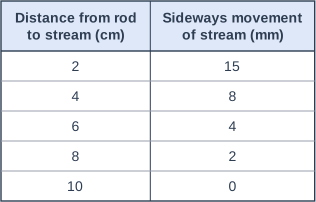
The table shows her results.

Describe the pattern in the results, and suggest what the results show about the force between the charged rod and the water.

Table with columns "Distance from rod to stream (cm)", "Sideways movement of stream (mm)". Distance from rod to stream (cm): 2; Sideways movement of stream (mm): 15 | Distance from rod to stream (cm): 4; Sideways movement of stream (mm): 8 | Distance from rod to stream (cm): 6; Sideways movement of stream (mm): 4 | Distance from rod to stream (cm): 8; Sideways movement of stream (mm): 2 | Distance from rod to stream (cm): 10; Sideways movement of stream (mm): 0.

Model answer

As the rod is held further from the stream, the stream bends less. At 2 cm the stream moves 15 mm sideways, at 4 cm it moves 8 mm, and at 10 cm it does not move at all. This suggests that the force of attraction between the charged rod and the water is bigger when they are closer together, and becomes smaller as the distance increases.

Explanation

Describe the trend (more distance, less bending) and back it up with values from the table. The bending is caused by the electrostatic force between the charged rod and the water, so a bigger bend means a bigger force. The force acts without contact and gets weaker with distance, until at 10 cm it is too small to see an effect.

Mark scheme
  1. 1 mark

    as the distance between the rod and the stream increases, the sideways movement (bend) of the stream decreases

    ORA (allow the reverse argument): the closer the rod, the more the stream bends. DO NOT ALLOW 'they are (inversely) proportional'.

  2. 1 mark

    use of data: for example the stream moves 15 mm when the rod is 2 cm away, but 0 mm when it is 10 cm away / the movement roughly halves for each extra 2 cm

    At least two pairs of values (distance and movement) are needed, or one pair with a comparison. ALLOW values quoted without units.

  3. 1 mark

    the force (of attraction) between the rod and the water is greater when they are closer together / the force decreases as the distance increases

    ORA (allow the reverse argument). ALLOW at 10 cm the force is too small to move the water (or there is no noticeable force). DO NOT ALLOW the force is repulsive.

Ready to try the rest? Every answer you write is marked against the mark scheme, so you can see exactly where the marks are.

Study Helper Hints first, answers after you try

Stuck on this one? Ask for a hint and I’ll point you in the right direction, without giving the answer away. Once you’ve checked your answer, I’ll show you how the marks are awarded.