
Level:
Correct: 0
Incorrect: 0
Marks: 0/0
Exam Practice
Course:
Topics:
Avg
score:
–
Topics
done:
0/31

Gas pressure and volume

Practise 12 exam-style questions on Gas pressure and volume for OCR GCSE Physics (Paper 1). Write your answer as you would in the exam and get it marked in seconds against the mark scheme, point by point, with the Study Helper on hand if you get stuck.

  • 12 questions
  • 1–6 marks each
  • Instant marking
  • No sign-up needed
12 questions, marked as you go

Sample questions with model answers

Here are 4 of the questions in this topic, each with a model answer, an explanation of why it earns the marks and the mark scheme an examiner would use.

Question 1

1 mark

Some buses run on natural gas. The gas is stored on the bus in tanks at a very high pressure.

Suggest why the tanks must have very strong walls.

Model answer

The gas is at a very high pressure, so it pushes outwards on every part of the walls with a large force. Weak walls could burst.

Explanation

The pressure of a gas produces a force at right angles to every surface it touches. When the pressure is very high, the outward force on each part of the tank wall is very large, so the tank must be strong enough not to burst. Saying only 'so it does not leak' misses the point about the force from the gas.

Mark scheme
  1. 1 mark

    the (high-pressure) gas pushes outwards on (every part of) the walls with a large force / exerts a large force at right angles to the walls, which could burst a weak tank

    ALLOW 'the high-pressure gas pushes very hard on the walls' / 'the high pressure of the gas could burst a weak tank'. The answer must link the high pressure (or the large force from the gas) to the walls. IGNORE 'so that the gas does not leak' on its own and 'in case the bus crashes' on its own. DO NOT ALLOW 'because the gas is heavy'.
Question 2

2 marks

Rescue teams use air lifting bags to raise heavy objects, such as a car after a crash. A flat, strong rubber bag is slid under the car. Air is then pumped into the bag. The air in the bag reaches a high pressure, and the bag swells and lifts the car.

Explain how the air in the bag lifts the car. Use ideas about the force that the air exerts on the bag.

Model answer

The air in the bag is at a high pressure, so its particles hit every part of the inside of the bag and push on it. The force from this pressure acts at right angles to the surface of the bag. On the top of the bag, the surface is horizontal, so the force acts upwards on the car, and it is large enough to lift the car.

Explanation

The pressure of a gas produces a net force at right angles to any surface it touches. The top of the lifting bag is flat and horizontal, so the force on it from the air inside acts straight upwards, onto the car. A high pressure acting on the large top surface of the bag gives a force big enough to lift a car.

Mark scheme
  1. 1 mark

    the air (at high pressure) pushes on every part of the inside of the bag / the air particles hit every part of the inside surface of the bag

    ALLOW 'the pressure of the air acts on all of the inside surface of the bag'. IGNORE 'the bag gets bigger' on its own.

  2. 1 mark

    the force from the air acts at right angles to the surface of the bag, so on the top of the bag it acts upwards on the car (and is large enough to lift it)

    ALLOW perpendicular / normal / at 90° to the top of the bag. The direction of the force (at right angles to the top surface of the bag, or upwards on the car) is needed for this mark. ALLOW 'the upward force is greater than the weight of the car'.

Question 3

2 marks

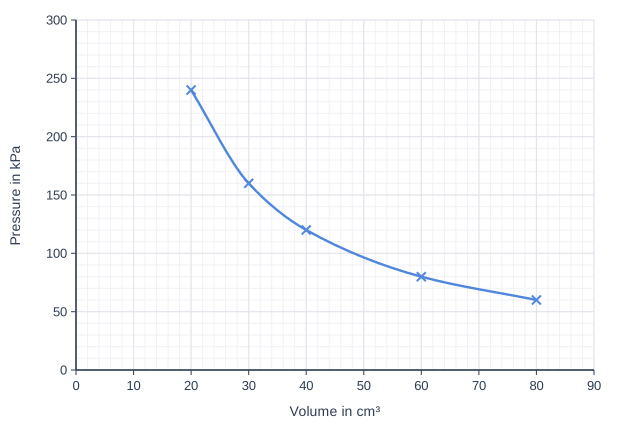
A scientist traps a fixed mass of helium gas in a cylinder with a piston. She moves the piston to change the volume of the helium, and measures its pressure at each volume. The temperature of the helium stays the same.

The graph shows her results.

Describe the pattern shown by her results. Use data from the graph in your answer.

Line graph of pressure in kPa (y-axis, 0 to 300) against volume in cm³ (x-axis, 0 to 90). The line is a smooth curve through (20, 240), (30, 160), (40, 120), (60, 80), (80, 60).

Model answer

As the volume of the helium increases, its pressure decreases. For example, when the volume doubles from 20 cm³ to 40 cm³, the pressure halves from 240 kPa to 120 kPa, and when the volume doubles again to 80 cm³, the pressure halves again to 60 kPa.

Explanation

The graph is a curve that slopes downwards and gets less steep, so a larger volume always means a lower pressure. Using data, doubling the volume halves the pressure, which is what pressure × volume = constant predicts (240 × 20 = 120 × 40 = 4800). Make sure each value you quote is read accurately from the graph.

Mark scheme
  1. 1 mark

    as the volume increases, the pressure decreases

    ORA (allow the reverse argument): as the volume decreases, the pressure increases. ALLOW 'pressure is inversely proportional to volume' / 'negative correlation' for this mark.

  2. 1 mark

    correct use of data from the graph to support the pattern, for example: doubling the volume halves the pressure (from 240 kPa at 20 cm³ to 120 kPa at 40 cm³ / from 120 kPa at 40 cm³ to 60 kPa at 80 cm³) / the pressure falls by smaller amounts as the volume increases (by 80 kPa from 20 to 30 cm³ but by only 20 kPa from 60 to 80 cm³) / pressure × volume is the same (4800) for every point

    ALLOW any two correct pairs of values from the graph quoted to show the pattern, for example 'at 20 cm³ the pressure is 240 kPa and at 80 cm³ it is 60 kPa'. Values must be read correctly from the graph (ALLOW ± 5 kPa). IGNORE units.

Question 4

3 marks

A student traps 45 cm³ of air at a pressure of 100 kPa in a sealed syringe. The syringe is connected to a pressure gauge. The highest pressure that the gauge can measure is 160 kPa.

She wants to push the plunger in until the volume of the air is 25 cm³. The temperature of the air stays the same.

Use the equation: pressure × volume = constant

Use calculations to decide whether the gauge will be able to measure the pressure of the air when its volume is 25 cm³.

Model answer

constant = 100 × 45 = 4500
Pressure at 25 cm³ = 4500 ÷ 25 = 180 kPa
180 kPa is greater than 160 kPa, so the gauge will not be able to measure the pressure when the volume is 25 cm³.

Explanation

Pressure × volume stays at 4500 kPa cm³, so at 25 cm³ the pressure is 4500 ÷ 25 = 180 kPa, which is off the scale of the gauge. Another route is to find the volume at the gauge's highest reading: 4500 ÷ 160 = 28 cm³, so she can only push the plunger in to about 28 cm³. A yes or no answer without a calculation scores nothing.

Mark scheme
  1. 1 mark

    constant = 100 × 45 = 4500 (kPa cm³); or a correct final answer of 180 kPa (or of 28 cm³ at 160 kPa) with no working

    An answer of 180 kPa (or a volume at 160 kPa of 28 cm³, 28.1 cm³ or 28.125 cm³) with no working scores marking points 1 and 2; together with the correct decision it scores 3 marks. A decision with no calculation scores 0. ALLOW the working in one line, pressure = 100 × 45 ÷ 25, for marking points 1 and 2.

  2. 1 mark

    pressure at 25 cm³ = 4500 ÷ 25 = 180 (kPa) / volume at 160 kPa = 4500 ÷ 160 = 28 (cm³); or a correct final answer of 180 kPa (or of 28 cm³ at 160 kPa) with no working

    ALLOW 28.1 / 28.125 cm³. ALLOW ECF from a wrong constant.

  3. 1 mark

    decision: no, because 180 kPa is greater than 160 kPa / the gauge reaches its highest reading when the volume is 28 cm³, before the volume reaches 25 cm³

    This mark needs a calculated value that supports the decision. ALLOW ECF: a decision that correctly follows from a wrong calculated pressure or volume.

Ready to try the rest? Every answer you write is marked against the mark scheme, so you can see exactly where the marks are.

Study Helper Hints first, answers after you try

Stuck on this one? Ask for a hint and I’ll point you in the right direction, without giving the answer away. Once you’ve checked your answer, I’ll show you how the marks are awarded.