Question 1
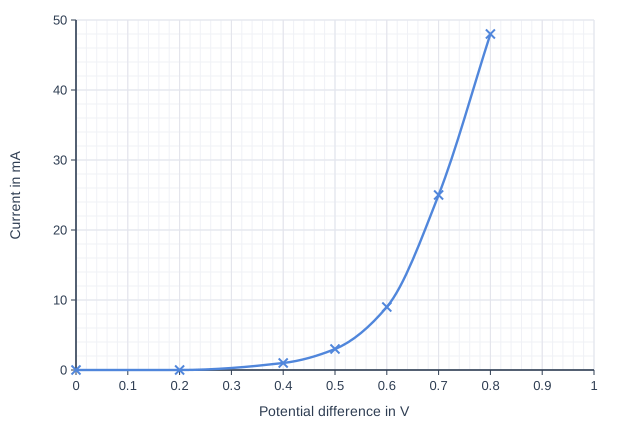
1 markA student connects a diode so that it conducts. She measures the current in it for forward potential differences from 0 V to 0.8 V.
The graph shows her results.
At which potential difference does the diode have the smallest resistance?
Choose your answer.
- A 0.2 V
- B 0.4 V
- C 0.6 V
- D 0.8 V
Model answer
D - 0.8 V
Explanation
Resistance = potential difference ÷ current. As the p.d. across the diode increases above about 0.5 V, the current rises much faster than the p.d., so the resistance falls. At 0.8 V the current is largest compared with the p.d., so the resistance is smallest (about 17 Ω). Below about 0.3 V there is almost no current, so the resistance is very high.
Mark scheme
-
1 mark
D / 0.8 V
The only correct answer is D: resistance = potential difference ÷ current, and at 0.8 V the current is 48 mA, so the resistance is 0.8 ÷ 0.048 = about 17 Ω, the smallest of the four. A is not correct because at 0.2 V the current is zero, so the resistance is very high. B is not correct because at 0.4 V the current is only 1 mA, so the resistance is 400 Ω. C is not correct because at 0.6 V the current is 9 mA, so the resistance is about 67 Ω. ALLOW the letter or the option. If more than one option is given, do not award the mark.