
Level:
Correct: 0
Incorrect: 0
Marks: 0/0
Exam Practice
Course:
Topics:
Avg
score:
–
Topics
done:
0/31

Moments, levers and gears

Practise 14 exam-style questions on Moments, levers and gears for OCR GCSE Physics (Paper 1). Write your answer as you would in the exam and get it marked in seconds against the mark scheme, point by point, with the Study Helper on hand if you get stuck.

  • 14 questions
  • 1–6 marks each
  • Instant marking
  • No sign-up needed
14 questions, marked as you go

Sample questions with model answers

Here are 4 of the questions in this topic, each with a model answer, an explanation of why it earns the marks and the mark scheme an examiner would use.

Question 1

1 mark

On a canal, a lock keeper opens a heavy lock gate by pushing on its long wooden balance beam. The gate and the beam turn together about a hinge at one end of the beam.

She pushes at right angles to the beam, at a point halfway between the hinge and the end of the beam.

Which change would make the moment of her push about the hinge larger?

Choose your answer.

  • A pushing along the beam, towards the hinge, with the same force
  • B pushing at right angles to the beam with a smaller force, at the same point
  • C pushing at right angles to the beam with the same force, nearer the end of the beam
  • D pushing at right angles to the beam with the same force, nearer the hinge

Model answer

C - pushing at right angles to the beam with the same force, nearer the end of the beam

Explanation

Moment = force × distance from the pivot, where the distance is measured at right angles to the force. With the same force, moving further from the hinge increases the distance and so increases the moment. That is why lock gates have long balance beams: a push far from the hinge has a large turning effect. A push straight towards the hinge has no turning effect, however large it is.

Mark scheme
  1. 1 mark

    C / pushing at right angles to the beam with the same force, nearer the end of the beam

    The only correct answer is C: the moment of a force is the force multiplied by its perpendicular distance from the pivot, so the same force at right angles but further from the hinge gives a larger moment. A is not correct because a push along the beam towards the hinge acts through the pivot, so it has no moment (no turning effect) at all. B is not correct because a smaller force at the same distance gives a smaller moment. D is not correct because pushing nearer the hinge makes the distance from the pivot smaller, so the moment is smaller. ALLOW the letter or the option. If more than one option is given, do not award the mark.
Question 2

2 marks

At an old water mill, water from a channel pours into buckets fixed around the edge of a large wheel. The water fills the buckets on the right-hand side of the wheel's axle. The buckets on the left-hand side are empty, because they tip their water out at the bottom of the wheel.

Seen from the front, the wheel turns clockwise.

Explain, in terms of moments, why the wheel turns clockwise.

Model answer

The water in the full buckets on the right-hand side has weight, and this weight acts at a distance from the axle, so it gives a clockwise moment about the axle. The buckets on the left-hand side are empty, so the anticlockwise moment on that side is much smaller. The clockwise moment is larger than the anticlockwise moment, so there is a resultant clockwise moment and the wheel turns clockwise.

Explanation

A wheel turns when the moments about its axle are not balanced. Here the weight of the water on the right gives a clockwise moment that is not cancelled by an equal anticlockwise moment, because the buckets on the left are empty. As each full bucket reaches the bottom it empties, so the right-hand side stays heavier and the wheel keeps turning.

Mark scheme
  1. 1 mark

    the weight of the water in the (full) buckets on the right acts at a distance from the axle, so it gives a clockwise moment (about the axle)

    ALLOW the full buckets on the right are heavier, so they have a (large) clockwise turning effect about the axle. ALLOW turning effect or turning force for moment. IGNORE 'the water pushes the wheel round' unless it is linked to a clockwise moment or turning effect.

  2. 1 mark

    the buckets on the left are empty (lighter), so the anticlockwise moment is smaller than the clockwise moment (there is a resultant clockwise moment)

    ORA (allow the reverse argument): the clockwise moment is larger than the anticlockwise moment. The idea that the moments on the two sides of the axle are not equal (not balanced) is needed. DO NOT ALLOW 'the wheel is unbalanced' with no reference to moments or turning effects.

Question 3

2 marks

A pasta machine has two steel rollers, one above the other, with a narrow gap between them. The handle turns the top roller. A gear on the end of the top roller meshes with an identical gear on the end of the bottom roller, so the bottom roller is turned too.

Seen from the handle end, the top roller turns clockwise.

Describe how the bottom roller turns. Explain why this helps to pull a sheet of pasta dough through the gap.

Model answer

The bottom roller turns anticlockwise, the opposite way to the top roller, and at the same rate because the gears are identical. At the gap, the bottom of the top roller and the top of the bottom roller both move in the same direction, so both rollers grip the dough and pull it through the gap together.

Explanation

When two gears mesh, the teeth of one push the teeth of the other, so the two gears always turn in opposite directions; identical gears also turn at the same rate. Opposite turning is exactly what is needed here: at the gap the two roller surfaces move the same way, so they work together to pull the dough through.

Mark scheme
  1. 1 mark

    anticlockwise / in the opposite direction to the top roller

    ALLOW 'the other way to the top roller'. ALLOW 'at the same rate (speed)' added to the direction; IGNORE it if it is missing. DO NOT ALLOW clockwise / in the same direction as the top roller.

  2. 1 mark

    at the gap, the surfaces of both rollers move in the same direction, so both rollers pull (grip) the dough through the gap the same way

    ALLOW the bottom of the top roller and the top of the bottom roller both move towards the same side. ALLOW the gears make the rollers turn in opposite directions, so both rollers move the dough in the same direction. IGNORE friction on its own.

Question 4

4 marks

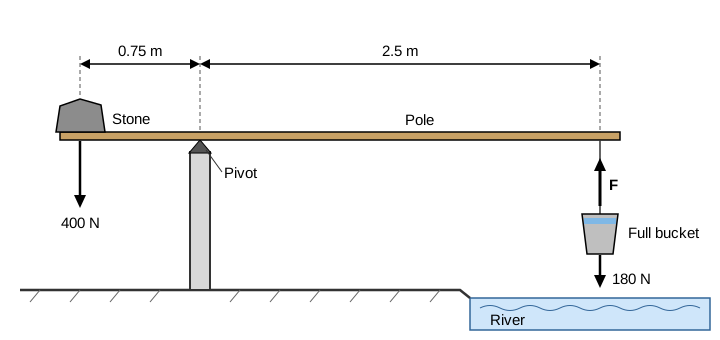
A shadoof is a simple machine that has been used for thousands of years to lift water from rivers. A long pole rests on a pivot at the top of a post. A heavy stone is fixed to one end of the pole, and a bucket hangs from a rope at the other end.

The diagram shows a shadoof just after a farmer has lifted a full bucket out of the river. The pole is horizontal and still.

• The weight of the stone is 400 N. It acts 0.75 m from the pivot.
• The weight of the full bucket is 180 N. It acts 2.5 m from the pivot, on the other side.
• To keep the pole still, the farmer pulls upwards on the bucket rope with a force F.

Ignore the weight of the pole.

Use the equation: moment of a force = force × distance (normal to direction of the force)

Find the upward force F that the farmer must exert.

Side view of a shadoof. A horizontal pole rests on a pivot at the top of a post. A stone is fixed to the left-hand end of the pole, with a downward arrow labelled 400 N, 0.75 m from the pivot. A full bucket hangs from a rope at the right-hand end, 2.5 m from the pivot, above a river, with a downward arrow labelled 180 N. An upward arrow labelled F on the bucket rope shows the farmer's pull.

Model answer

Moment of the stone = 400 × 0.75 = 300 N m (anticlockwise)
Moment of the full bucket = 180 × 2.5 = 450 N m (clockwise)
The pole is still, so total anticlockwise moment = total clockwise moment:
300 + F × 2.5 = 450
F × 2.5 = 150
F = 150 ÷ 2.5 = 60 N

Explanation

The pole is balanced, so the principle of moments applies: the total anticlockwise moment equals the total clockwise moment. The stone and the farmer's upward pull both turn the pole the same way, against the moment of the full bucket, so F × 2.5 must make up the 150 N m difference. This is why a shadoof is useful: without the stone the farmer would have to pull up with the whole 180 N, but with it he needs only 60 N.

Mark scheme
  1. 1 mark

    moment of the stone = 400 × 0.75 = 300 (N m); or a correct final answer of 60 N with no working

    An answer of 60 N with no working scores 4 marks. ALLOW 150 N (the 150 N m not divided by 2.5) for 3 marks. ALLOW 120 N (the downward pull of the rope on the pole, 180 − F, given as F) for 3 marks. ALLOW 200 N (150 divided by 0.75 instead of 2.5) for 2 marks (points 1 and 2). An answer of 180 N (the stone ignored) scores 0.

  2. 1 mark

    a correct equation of moments: 300 + F × 2.5 = 180 × 2.5 (= 450) / (180 − F) × 2.5 = 300 / F × 2.5 = 450 − 300; or a correct final answer of 60 N with no working

    ALLOW the moment of the full bucket, 180 × 2.5 = 450 (N m), used with the stone's moment in an equation of moments. ALLOW ECF from a wrong moment of the stone. DO NOT ALLOW F × 2.5 = 450 (the stone ignored).

  3. 1 mark

    F × 2.5 = 150 (N m) / 180 − F = 120 (N); or a correct final answer of 60 N with no working

    ALLOW ECF from point 2.

  4. 1 mark

    evaluation: F = 60 (N)

    ALLOW ECF from point 3, for example (their moment) ÷ 2.5. IGNORE units.

Ready to try the rest? Every answer you write is marked against the mark scheme, so you can see exactly where the marks are.

Study Helper Hints first, answers after you try

Stuck on this one? Ask for a hint and I’ll point you in the right direction, without giving the answer away. Once you’ve checked your answer, I’ll show you how the marks are awarded.