Level:
Correct: 0
Incorrect: 0
Marks: 0/0
Exam Practice
Course:
Topics:
Avg
score:
–
Topics
done:
0/31

Series and parallel circuits and circuit symbols

Practise 13 exam-style questions on Series and parallel circuits and circuit symbols for OCR GCSE Physics (Paper 1). Write your answer as you would in the exam and get it marked in seconds against the mark scheme, point by point, with the Study Helper on hand if you get stuck.

  • 13 questions
  • 1–4 marks each
  • Instant marking
  • No sign-up needed
13 questions, marked as you go

Sample questions with model answers

Here are 4 of the questions in this topic, each with a model answer, an explanation of why it earns the marks and the mark scheme an examiner would use.

Question 1

1 mark

Four groups of students each connect a lamp and a motor in parallel with a battery. Each group uses different lamps and motors.

Each group measures:
• the current from the battery
• the current in the lamp
• the current in the motor.

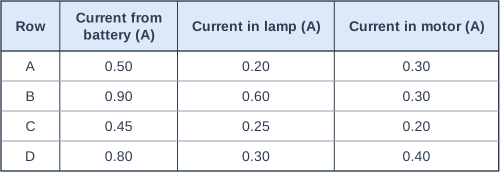
The table shows their results.

One row of results cannot be correct.

Which row?

Choose your answer.

  • A row A
  • B row B
  • C row C
  • D row D
Table with columns "Row", "Current from battery (A)", "Current in lamp (A)", "Current in motor (A)". Row: A; Current from battery (A): 0.50; Current in lamp (A): 0.20; Current in motor (A): 0.30 | Row: B; Current from battery (A): 0.90; Current in lamp (A): 0.60; Current in motor (A): 0.30 | Row: C; Current from battery (A): 0.45; Current in lamp (A): 0.25; Current in motor (A): 0.20 | Row: D; Current from battery (A): 0.80; Current in lamp (A): 0.30; Current in motor (A): 0.40.

Model answer

D - row D

Explanation

In a parallel circuit the current from the battery splits between the branches, so the branch currents must add up to the current from the battery. Rows A, B and C all add up correctly, but in row D the lamp and motor currents add up to 0.70 A, not 0.80 A. The lamp and motor currents do not have to be equal, because the components are different.

Mark scheme
  1. 1 mark

    D / row D

    The only correct answer is D: in a parallel circuit the current from the battery is the sum of the currents in the branches, and in row D 0.30 A + 0.40 A = 0.70 A, not 0.80 A. A is not correct because 0.20 A + 0.30 A = 0.50 A, the current from the battery. B is not correct because 0.60 A + 0.30 A = 0.90 A, the current from the battery. C is not correct because 0.25 A + 0.20 A = 0.45 A, the current from the battery. ALLOW the letter or the option. If more than one option is given, do not award the mark.
Question 2

1 mark

A student builds a series circuit with a 4.5 V battery, a closed switch and a lamp. The lamp is lit.

A closed switch has almost no resistance.

She connects a voltmeter across the closed switch.

What is the reading on the voltmeter?

Model answer

0 V

Explanation

A closed switch has almost no resistance, so the potential difference across it (current × resistance) is almost zero: almost no energy is transferred from the charge as it passes through the switch. Almost all of the 4.5 V is across the lamp, where energy is transferred. (If the switch were open, the voltmeter across the gap would read the full 4.5 V.)

Mark scheme
  1. 1 mark

    0 V / zero / (almost) nothing

    ALLOW almost 0 V / very close to 0 V. DO NOT ALLOW 4.5 V or 2.25 V. IGNORE explanations.

Question 3

2 marks

A 9.0 V battery is connected in series with a lamp and a buzzer.

• Each coulomb of charge gains 9.0 J of energy as it passes through the battery.
• Each coulomb of charge transfers 5.4 J of energy in the lamp.

Give the energy transferred by each coulomb of charge in the buzzer.

Give the potential difference across the buzzer.

Model answer

Energy transferred in the buzzer = 9.0 − 5.4 = 3.6 J for each coulomb.
Potential difference across the buzzer = 3.6 V.

Explanation

In a series circuit each coulomb of charge passes through both components, so the 9.0 J it gains in the battery is shared between them: 9.0 − 5.4 = 3.6 J in the buzzer. Potential difference is the energy transferred per coulomb of charge (1 V = 1 J per coulomb), so the p.d. across the buzzer is 3.6 V. This is why the p.d.s across components in series add up to the p.d. of the battery.

Mark scheme
  1. 1 mark

    3.6 J (9.0 − 5.4)

    An answer of 3.6 J with no working scores marking point 1 only, and 3.6 V with no working scores marking point 2 only. IGNORE units for this point.

  2. 1 mark

    3.6 V

    ALLOW ECF: the same number as the student's answer for the energy per coulomb, given in volts (for example 3.4 J gives 3.4 V). IGNORE units for this point.

Question 4

3 marks

A student connects identical lamps in series with a 6.0 V battery. She adds one lamp at a time. Each time, she measures the potential difference across the first lamp only.

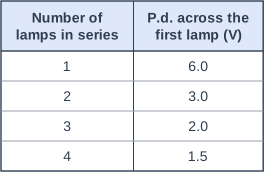
The table shows her results.

Describe the pattern in her results and explain it.

Use data from the table in your answer.

Table with columns "Number of lamps in series", "P.d. across the first lamp (V)". Number of lamps in series: 1; P.d. across the first lamp (V): 6.0 | Number of lamps in series: 2; P.d. across the first lamp (V): 3.0 | Number of lamps in series: 3; P.d. across the first lamp (V): 2.0 | Number of lamps in series: 4; P.d. across the first lamp (V): 1.5.

Model answer

As more lamps are added, the potential difference across the first lamp decreases: 6.0 V with one lamp, 3.0 V with two, 2.0 V with three and 1.5 V with four. In a series circuit the 6.0 V of the battery is shared between the lamps, so the p.d.s add up to 6.0 V. The lamps are identical, so they share it equally: with three lamps each has 2.0 V, and 3 × 2.0 V = 6.0 V.

Explanation

Components in series share the p.d. of the supply, and the p.d.s across them add up to the supply p.d. Identical lamps share it equally, so each lamp's p.d. is 6.0 V divided by the number of lamps. Using numbers from the table (such as 4 × 1.5 V = 6.0 V) is what earns the data mark.

Mark scheme
  1. 1 mark

    (pattern) the p.d. across the first lamp decreases as more lamps are added (in series)

    Max 2 if no data from the table are used. ALLOW the more lamps, the smaller the p.d. across each lamp. DO NOT ALLOW 'the p.d. decreases' with no link to the number of lamps.

  2. 1 mark

    (explanation) the 6.0 V of the battery is shared between the lamps (in series) / the p.d.s across the lamps add up to the p.d. of the battery

    ALLOW the energy from the battery is shared between the lamps. ALLOW AW.

  3. 1 mark

    (use of data) the lamps are identical, so the p.d. is shared equally: for example 3 × 2.0 V = 6.0 V / 4 × 1.5 V = 6.0 V / 2 × 3.0 V = 6.0 V / p.d. = 6.0 ÷ number of lamps

    ALLOW doubling the number of lamps (1 to 2, or 2 to 4) halves the p.d. across the first lamp, with the values quoted. ALLOW the p.d. across the first lamp is inversely proportional to the number of lamps, with data.

Ready to try the rest? Every answer you write is marked against the mark scheme, so you can see exactly where the marks are.

Study Helper Hints first, answers after you try

Stuck on this one? Ask for a hint and I’ll point you in the right direction, without giving the answer away. Once you’ve checked your answer, I’ll show you how the marks are awarded.