
Level:
Correct: 0
Incorrect: 0
Marks: 0/0
Exam Practice
Course:
Topics:
Avg
score:
–
Topics
done:
0/31

Newton's second law

Practise 16 exam-style questions on Newton's second law for OCR GCSE Physics (Paper 1). Write your answer as you would in the exam and get it marked in seconds against the mark scheme, point by point, with the Study Helper on hand if you get stuck.

  • 16 questions
  • 1–4 marks each
  • Instant marking
  • No sign-up needed
16 questions, marked as you go

Sample questions with model answers

Here are 4 of the questions in this topic, each with a model answer, an explanation of why it earns the marks and the mark scheme an examiner would use.

Question 1

1 mark

A polar bear starts to run across the ice. At the start of its run, the resultant force on the bear is 900 N and its acceleration is 2.0 m/s².

What is the mass of the polar bear?

Use the equation: force = mass × acceleration

Choose your answer.

  • A 450 kg
  • B 898 kg
  • C 902 kg
  • D 1800 kg

Model answer

A - 450 kg

Explanation

Rearrange force = mass × acceleration to give mass = force ÷ acceleration. Then mass = 900 ÷ 2.0 = 450 kg. Multiplying instead of dividing gives 1800 kg, which is far too heavy for a polar bear.

Mark scheme
  1. 1 mark

    A / 450 kg

    The only correct answer is A: mass = force ÷ acceleration = 900 ÷ 2.0 = 450 kg. B is not correct because it subtracts the acceleration from the force. C is not correct because it adds the acceleration to the force. D is not correct because it multiplies the force by the acceleration. ALLOW the letter or the option. If more than one option is given, do not award the mark.
Question 2

2 marks

An electric train has a mass of 400 000 kg. As it leaves a station, the resultant force on the train is 200 000 N.

Calculate the acceleration of the train.

Use the equation: force = mass × acceleration

Model answer

Acceleration = force ÷ mass
= 200 000 ÷ 400 000
= 0.50 m/s²

Explanation

Rearrange force = mass × acceleration to give acceleration = force ÷ mass. Dividing the mass by the force gives 2.0, which is the wrong way round: a check is that a very heavy train should have a small acceleration.

Mark scheme
  1. 1 mark

    (acceleration =) 200 000 ÷ 400 000; or a correct final answer of 0.50 m/s² with no working

    An answer of 0.50 m/s² (or 0.5 m/s²) with no working scores 2 marks. ALLOW acceleration = force ÷ mass seen with the correct values. DO NOT ALLOW 400 000 ÷ 200 000 (2.0).

  2. 1 mark

    0.50 (m/s²) / 0.5 (m/s²)

    ALLOW 1/2. IGNORE units unless the question asks for them.

Question 3

3 marks

A snowmobile and its rider have a total mass of 300 kg. The snowmobile moves forwards across flat, level snow.

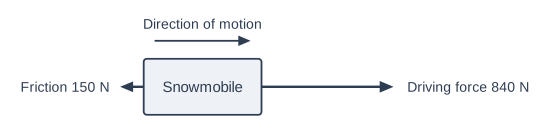
The diagram shows the horizontal forces on the snowmobile at one moment.

Find the acceleration of the snowmobile at this moment.

Use the equation: force = mass × acceleration

Free body diagram: a box labelled "Snowmobile" with 2 force arrows. An arrow labelled "Driving force 840 N" starts at the object and points to the right; an arrow labelled "Friction 150 N" starts at the object and points to the left. Arrow lengths are in proportion to the forces: "Friction 150 N" is about 18% of the length of "Driving force 840 N". A separate arrow labelled "Direction of motion" points to the right.

Model answer

Resultant force = 840 − 150 = 690 N (forwards)
Acceleration = force ÷ mass
= 690 ÷ 300
= 2.3 m/s²

Explanation

Newton's second law uses the resultant force, so first take the backward friction force away from the forward driving force. Then divide the resultant force by the mass. Using the 840 N driving force on its own gives 2.8 m/s², which is too large because it ignores friction.

Mark scheme
  1. 1 mark

    resultant force = 840 − 150 = 690 (N); or a correct final answer of 2.3 m/s² with no working

    An answer of 2.3 m/s² with no working scores 3 marks. ALLOW 2.8 m/s² (840 ÷ 300, friction ignored) for 1 mark. ALLOW 3.3 m/s² ((840 + 150) ÷ 300, forces added) for 1 mark.

  2. 1 mark

    (acceleration =) 690 ÷ 300; or a correct final answer of 2.3 m/s² with no working

    ALLOW acceleration = force ÷ mass seen with the resultant force. DO NOT ALLOW 300 ÷ 690.

  3. 1 mark

    2.3 (m/s²)

    IGNORE units unless the question asks for them.

Question 4

4 marks

A jet ski and its rider have a total weight of 4000 N. As the jet ski pulls away from a jetty, the resultant force on it is 800 N.

Gravitational field strength = 10 N/kg

Use the equation: gravitational force = mass × gravitational field strength

Calculate the acceleration of the jet ski and rider.

Model answer

Mass = weight ÷ gravitational field strength
= 4000 ÷ 10
= 400 kg
Acceleration = force ÷ mass
= 800 ÷ 400
= 2.0 m/s²

Explanation

Newton's second law needs the mass in kilograms, not the weight in newtons. So first use gravitational force = mass × gravitational field strength to find the mass, then recall force = mass × acceleration and divide the resultant force by the mass. Dividing the force by the weight (giving 0.20 m/s²) is a common mistake: weight is a force, not a mass.

Mark scheme
  1. 1 mark

    mass = 4000 ÷ 10; or a correct final answer of 2.0 m/s² (or 1.96 m/s²) with no working

    An answer of 2.0 m/s² (or 1.96 m/s², from 9.8 N/kg) with no working scores 4 marks. ALLOW use of 9.8 N/kg: mass 408 kg, acceleration 1.96 m/s² or 2.0 m/s². ALLOW 0.20 m/s² (800 ÷ 4000, the weight used as the mass) for 2 marks (points 3 and 4 by ECF). DO NOT ALLOW 4000 × 10.

  2. 1 mark

    mass = 400 (kg); or a correct final answer of 2.0 m/s² (or 1.96 m/s²) with no working

    ALLOW 408 kg (9.8 N/kg used).

  3. 1 mark

    acceleration = 800 ÷ 400 (acceleration = force ÷ mass, recalled); or a correct final answer of 2.0 m/s² (or 1.96 m/s²) with no working

    ALLOW force = mass × acceleration recalled and used with 800 and the mass. ALLOW ECF from a wrong mass in point 2: 800 ÷ (their mass). DO NOT ALLOW 400 ÷ 800.

  4. 1 mark

    2.0 (m/s²) / 1.96 (m/s²)

    ALLOW 2 m/s². ALLOW ECF from a wrong mass correctly used. IGNORE units unless the question asks for them.

Ready to try the rest? Every answer you write is marked against the mark scheme, so you can see exactly where the marks are.

Study Helper Hints first, answers after you try

Stuck on this one? Ask for a hint and I’ll point you in the right direction, without giving the answer away. Once you’ve checked your answer, I’ll show you how the marks are awarded.