
Level:
Correct: 0
Incorrect: 0
Marks: 0/0
Exam Practice
Course:
Topics:
Avg
score:
–
Topics
done:
0/31

Practical skills (physics PAGs P1-P8)

Practise 15 exam-style questions on Practical skills (physics PAGs P1-P8) for OCR GCSE Physics (Paper 1). Write your answer as you would in the exam and get it marked in seconds against the mark scheme, point by point, with the Study Helper on hand if you get stuck.

  • 15 questions
  • 1–6 marks each
  • Instant marking
  • No sign-up needed
15 questions, marked as you go

Sample questions with model answers

Here are 4 of the questions in this topic, each with a model answer, an explanation of why it earns the marks and the mark scheme an examiner would use.

Question 1

1 mark

A student measures the resistance of a resistor using an ammeter and a voltmeter. The resistor is labelled 47 Ω. She calculates a resistance of 470 Ω.

Which mistake would make her value ten times too large?

Choose your answer.

  • A She did not reset the voltmeter to zero, and it read 0.1 V with nothing connected.
  • B She measured the current at a different point in the series circuit.
  • C She recorded the current in milliamps but used the number as amps.
  • D She wrote the current as 0.010 A when the ammeter showed 0.10 A.

Model answer

D - She wrote the current as 0.010 A when the ammeter showed 0.10 A.

Explanation

Comparing a result with the expected value is a quick check: a value exactly ten times too big points to a slip with a decimal point or a power of ten. Because resistance = p.d. ÷ current, a current recorded ten times too small makes the resistance ten times too large. A small zero error changes the result only a little, and moving the ammeter round a series circuit does not change its reading at all.

Mark scheme
  1. 1 mark

    D / She wrote the current as 0.010 A when the ammeter showed 0.10 A.

    The only correct answer is D: resistance = p.d. ÷ current, so a current ten times too small gives a resistance ten times too large (for example 4.7 V ÷ 0.010 A = 470 Ω instead of 4.7 V ÷ 0.10 A = 47 Ω). A is not correct because a 0.1 V zero error changes the p.d., and so the resistance, by only a small amount. B is not correct because the current is the same at every point in a series circuit. C is not correct because using milliamps as amps makes the current a thousand times too large, so the resistance would be far too small. ALLOW the letter or the option. If more than one option is given, do not award the mark.
Question 2

1 mark

A student investigates how the height of the starting point on a ramp affects how far a marble rolls across a carpet after leaving the ramp.

Each time, she holds the marble at the starting point and lets it go. She does not push it.

Explain why she does not push the marble.

Model answer

She lets go without pushing so that the marble starts from rest every time. A push would give the marble a different starting speed each time, so the distance it rolls would not depend only on the height of the starting point.

Explanation

The starting speed is a control variable. Releasing the marble from rest keeps it the same (zero) every time, so the only thing that changes the distance is the height. 'Fair test' on its own does not say which variable is kept the same.

Mark scheme
  1. 1 mark

    so that the marble starts from rest (with the same starting speed, zero) every time / a push would give it a different extra speed each time, so the distance would not depend only on the height

    ALLOW 'to make it a fair test, because a push would change the starting speed'. IGNORE 'to make it a fair test' or 'to make it accurate' on their own.

Question 3

2 marks

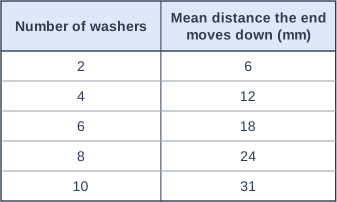
A student clamps a plastic ruler to the edge of a bench so that most of it sticks out. She hangs identical metal washers from the free end of the ruler and measures how far the end moves down. The table shows her mean results.

Her hypothesis is: 'The distance the end moves down is directly proportional to the number of washers.'

Do her results support the hypothesis? Use data from the table in your answer.

Table with columns "Number of washers", "Mean distance the end moves down (mm)". Number of washers: 2; Mean distance the end moves down (mm): 6 | Number of washers: 4; Mean distance the end moves down (mm): 12 | Number of washers: 6; Mean distance the end moves down (mm): 18 | Number of washers: 8; Mean distance the end moves down (mm): 24 | Number of washers: 10; Mean distance the end moves down (mm): 31.

Model answer

Yes, the results support the hypothesis. When the number of washers doubles from 2 to 4, the distance doubles from 6 mm to 12 mm, and from 4 to 8 washers it doubles again from 12 mm to 24 mm. The distance ÷ number of washers is about 3 mm per washer for every result.

Explanation

Directly proportional means that when one quantity doubles, the other doubles too, so their ratio stays the same (and a graph would be a straight line through the origin). Showing only that the distance increases is not enough. Checking a doubling, or dividing each distance by the number of washers, tests the hypothesis properly.

Mark scheme
  1. 1 mark

    yes / the results support the hypothesis

    Point 2 can only be awarded if the answer says the results support the hypothesis. ALLOW 'yes, approximately'.

  2. 1 mark

    data showing proportionality: doubling the number of washers (about) doubles the distance (for example 2 to 4 washers gives 6 mm to 12 mm, or 4 to 8 washers gives 12 mm to 24 mm) / distance ÷ number of washers is (about) the same, 3 mm per washer, for every row

    The data must show that the ratio stays (about) the same, not only that both increase. DO NOT ALLOW 'as the number of washers increases, the distance increases' on its own: that shows a positive relationship, not proportionality.

Question 4

3 marks

A student wants to find out whether thicker resistance wire has a smaller resistance. She measures the resistance of a 30 cm length of thin wire and a 50 cm length of thick wire, made of the same metal.

The thick wire has the larger resistance. She concludes: 'Thicker wire has a larger resistance.'

Explain why her conclusion is not valid. Suggest how she should improve her method.

Model answer

Her conclusion is not valid because she changed two variables at once: the thick wire was also longer (50 cm compared with 30 cm). The resistance of a wire increases with its length, so the extra length could be the reason the thick wire had the larger resistance; she cannot tell what effect the thickness had. She should use the same length of each wire, for example 30 cm, so that only the thickness changes.

Explanation

A valid test changes only the independent variable and keeps the other variables that affect the result the same. Length affects the resistance of a wire, so comparing different lengths hides the effect of thickness. Repeating the readings would not help, because the problem is in the design, not in random error.

Mark scheme
  1. 1 mark

    she changed two variables / the length as well as the thickness (it was not a fair test)

    1 mark for each of points 1 to 3. IGNORE 'she should repeat the readings' (this does not deal with the problem).

  2. 1 mark

    a longer wire has a larger resistance, so the larger resistance of the thick wire could be caused by its greater length / she cannot tell whether the thickness or the length caused the difference

    ALLOW 'resistance increases with length, so the length difference could explain the result'.

  3. 1 mark

    use the same length of each wire (for example 30 cm of each) / keep the length the same and change only the thickness

    ALLOW 'use lengths of wire that are the same'. ALLOW 'test several thicknesses, all the same length'.

Ready to try the rest? Every answer you write is marked against the mark scheme, so you can see exactly where the marks are.

Study Helper Hints first, answers after you try

Stuck on this one? Ask for a hint and I’ll point you in the right direction, without giving the answer away. Once you’ve checked your answer, I’ll show you how the marks are awarded.