
Level:
Correct: 0
Incorrect: 0
Marks: 0/0
Exam Practice
Course:
Topics:
Avg
score:
–
Topics
done:
0/31

Interactions between objects and forces as vectors

Practise 13 exam-style questions on Interactions between objects and forces as vectors for OCR GCSE Physics (Paper 1). Write your answer as you would in the exam and get it marked in seconds against the mark scheme, point by point, with the Study Helper on hand if you get stuck.

  • 13 questions
  • 1–4 marks each
  • Instant marking
  • No sign-up needed
13 questions, marked as you go

Sample questions with model answers

Here are 4 of the questions in this topic, each with a model answer, an explanation of why it earns the marks and the mark scheme an examiner would use.

Question 1

1 mark

A student throws a ball. At one moment, the ball is moving upwards and to the right through the air.

In which direction does the weight of the ball act at this moment?

Choose your answer.

  • A along the direction in which the ball is moving
  • B horizontally, in the direction it was thrown
  • C downwards, towards the centre of the Earth
  • D upwards, in the direction in which it is rising

Model answer

C - downwards, towards the centre of the Earth

Explanation

Force is a vector, so its direction matters as well as its size. The weight of an object is the pull of the Earth's gravity, so it always acts vertically downwards, towards the centre of the Earth. A common wrong idea is that the forces on an object act in the direction in which it is moving.

Mark scheme
  1. 1 mark

    C / downwards, towards the centre of the Earth

    The only correct answer is C: weight is the gravitational force of the Earth on the ball, and it always acts downwards, towards the centre of the Earth, whichever way the ball is moving. A is not correct because a force does not have to act in the direction of motion: the weight acts downwards even while the ball moves upwards. B is not correct because no horizontal force from the throw acts once the ball has left the hand, and the weight is vertical. D is not correct because the weight pulls the ball down, which is why the ball slows down as it rises. ALLOW the letter or the option. If more than one option is given, do not award the mark.
Question 2

1 mark

A speed skater wears a smooth, tight-fitting suit when she races. The suit makes one of the forces on her smaller as she moves.

Name the contact force that the suit makes smaller.

Model answer

Air resistance (drag)

Explanation

Air resistance is a contact force: the air touches the skater and pushes against her as she moves through it, in the opposite direction to her motion. A smooth, tight suit lets the air flow past her more easily, so the air resistance is smaller. The suit does not change the friction between her skates and the ice.

Mark scheme
  1. 1 mark

    air resistance / drag

    ALLOW friction from the air / air friction / wind resistance. DO NOT ALLOW friction on its own or friction from the ice (the suit does not change the friction between the skates and the ice). DO NOT ALLOW weight / gravity / normal contact force / upthrust.

Question 3

2 marks

Two students stand on the corridor side of a classroom door.

Student A pushes the door with a force of 15 N. Later, student B pulls the same door with a force of 15 N.

Force is a vector quantity.

Explain why these two forces are not the same, even though both are 15 N.

Model answer

Force is a vector, so it has both a size and a direction. The two forces have the same size, 15 N, but they act in opposite directions: student A's push is away from the corridor and student B's pull is towards the corridor. So they have different effects on the door.

Explanation

To describe a force fully you need its size and its direction. On a force diagram the two forces would be arrows of the same length pointing opposite ways. Two forces with the same size but different directions are different forces.

Mark scheme
  1. 1 mark

    a vector has a size / magnitude and a direction

    ALLOW a force needs a direction as well as a size. DO NOT ALLOW a vector has a direction only.

  2. 1 mark

    the forces act in opposite directions (the push is away from the corridor / into the room and the pull is towards the corridor), so they have different effects (one opens the door, the other closes it)

    ALLOW they are in different directions. ALLOW one pushes the door away from them and the other pulls it towards them. IGNORE 'one is a push and one is a pull' with no reference to direction.

Question 4

3 marks

A student tests how well three different trainers grip a wooden board.

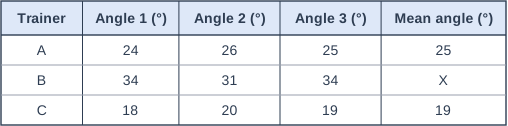
She puts one trainer on the board and slowly lifts one end of the board. She records the angle of the board when the trainer starts to slide. She does this three times for each trainer.

The table shows her results.

Calculate the mean angle X for trainer B. Then identify which trainer grips the board best, and give a reason for your answer.

Table with columns "Trainer", "Angle 1 (°)", "Angle 2 (°)", "Angle 3 (°)", "Mean angle (°)". Trainer: A; Angle 1 (°): 24; Angle 2 (°): 26; Angle 3 (°): 25; Mean angle (°): 25 | Trainer: B; Angle 1 (°): 34; Angle 2 (°): 31; Angle 3 (°): 34; Mean angle (°): X | Trainer: C; Angle 1 (°): 18; Angle 2 (°): 20; Angle 3 (°): 19; Mean angle (°): 19.

Model answer

X = (34 + 31 + 34) ÷ 3 = 33°
Trainer B grips the board best. It had the largest mean angle (33°, compared with 25° for A and 19° for C), so friction held it still on the steepest board.

Explanation

To find a mean, add the repeat readings and divide by how many there are. A trainer with more grip needs a steeper board before friction can no longer hold it, so the largest angle means the best grip. Adding the three angles but forgetting to divide gives 99, which is not an angle the board reached.

Mark scheme
  1. 1 mark

    X = (34 + 31 + 34) ÷ 3 = 33 (°); or a correct final answer of 33° with no working

    An answer of 33° with no working scores marking point 1 only. DO NOT ALLOW 99 (total not divided by 3).

  2. 1 mark

    (trainer) B

    ALLOW trainer B identified using an incorrect value of X if that value is still the largest mean.

  3. 1 mark

    it has the largest (mean) angle before it slides / it stays still on the steepest board, so the friction between its sole and the board is greatest

    Only award this mark if trainer B is identified in point 2. ALLOW it needed the board to be tilted the most before it slipped. DO NOT ALLOW 'it has the biggest numbers' with no reference to the angle.

Ready to try the rest? Every answer you write is marked against the mark scheme, so you can see exactly where the marks are.

Study Helper Hints first, answers after you try

Stuck on this one? Ask for a hint and I’ll point you in the right direction, without giving the answer away. Once you’ve checked your answer, I’ll show you how the marks are awarded.