
Level:
Correct: 0
Incorrect: 0
Marks: 0/0
Exam Practice
Course:
Topics:
Avg
score:
–
Topics
done:
0/31

Magnets and magnetic fields

Practise 14 exam-style questions on Magnets and magnetic fields for OCR GCSE Physics (Paper 1). Write your answer as you would in the exam and get it marked in seconds against the mark scheme, point by point, with the Study Helper on hand if you get stuck.

  • 14 questions
  • 1–6 marks each
  • Instant marking
  • No sign-up needed
14 questions, marked as you go

Sample questions with model answers

Here are 4 of the questions in this topic, each with a model answer, an explanation of why it earns the marks and the mark scheme an examiner would use.

Question 1

1 mark

A student moves a small plotting compass slowly along one field line of a bar magnet. She starts near the north pole and finishes near the south pole.

What happens to the needle of the compass as she moves it?

Choose your answer.

  • A It always points straight at the nearer pole of the magnet.
  • B It keeps pointing in the same direction all the way.
  • C It spins round and round without stopping.
  • D It turns so that it always lines up along the field line.

Model answer

D

Explanation

A plotting compass needle lines up with the magnetic field where it is placed. Field lines around a bar magnet are curved, so the direction of the field changes from point to point, and the needle turns to follow it. Near the north pole the needle points away from the magnet; beside the middle it lies parallel to the magnet; near the south pole it points into the magnet.

Mark scheme
  1. 1 mark

    D / It turns so that it always lines up along the field line.

    The only correct answer is D: the needle is a small magnet that lines up with the magnetic field, and the direction of the field changes from one point to another along a curved field line. A is not correct because the needle points along the field line, which is not always towards a pole (beside the middle of the magnet it is parallel to the magnet). B is not correct because the field line curves, so the direction of the field changes. C is not correct because the needle settles in the direction of the field at each point. ALLOW the letter or the option. If more than one option is given, do not award the mark.
Question 2

2 marks

A magnetic window cleaner has two pads, one for each side of a window. Each pad contains a flat permanent magnet with its north pole on one face and its south pole on the other face.

When the pads are placed on opposite sides of a window, the outside pad stays on the glass and moves when the inside pad is moved.

Explain why the outside pad stays on the glass. Then suggest why the cleaner does not stay on a window with very thick glass.

Model answer

The faces of the two magnets that face each other across the glass are unlike poles, so the magnets attract and the outside pad is held against the glass. With very thick glass the magnets are further apart, where the magnetic field is weaker, so the attraction is too small to hold the outside pad up.

Explanation

Unlike poles attract, and the magnetic field passes through glass because glass is not a magnetic material. The field of a magnet gets weaker further away, so the force between the two pads gets smaller as the glass gets thicker. If the force becomes smaller than what is needed to hold the pad against its weight, the pad slides off.

Mark scheme
  1. 1 mark

    unlike poles (a north pole and a south pole) face each other across the glass, so the magnets attract (and the attraction holds the outside pad against the glass)

    The idea of unlike / opposite poles is needed. ALLOW the magnets attract through the glass because glass is not a magnetic material / the field passes through glass, only if attraction between unlike poles is stated or clearly implied. DO NOT ALLOW like poles attract.

  2. 1 mark

    with thick glass the magnets are further apart, where the magnetic field (of each magnet) is weaker, so the force of attraction is too small to hold the outside pad up (against its weight)

    The idea of a weaker field / smaller force at a greater distance is needed. ALLOW the attraction is weaker when the magnets are further apart. DO NOT ALLOW thick glass blocks the magnetic field / glass is magnetic.

Question 3

2 marks

A student puts two small plotting compasses very close together on a wooden table. There are no magnets nearby.

The needles do not point north. Both needles turn to lie along the line joining the two compasses, with the north end of one needle next to the south end of the other needle.

When the student moves the compasses further apart, both needles point north again.

Explain these observations.

Model answer

Each compass needle is a small magnet. The north end of one needle and the south end of the other are unlike poles, so they attract and the needles turn to line up with each other. When the compasses are close, the field of each needle is stronger than the Earth's field. Further apart, the field of each needle is much weaker, so the Earth's field is stronger and both needles point north again.

Explanation

A compass needle lines up with the strongest magnetic field where it is. Close to another needle, that needle's field is strong, and unlike poles attract, so the needles point at each other. The field of a magnet gets weaker with distance, so when the compasses are moved apart the Earth's field becomes the stronger one again.

Mark scheme
  1. 1 mark

    each needle is a (small) magnet, and unlike poles (the north end of one needle and the south end of the other) attract, so the needles turn towards each other

    The idea of attraction between unlike poles is needed. ALLOW opposite poles attract. DO NOT ALLOW the needles are attracted because they are made of metal / like poles attract.

  2. 1 mark

    close together, the magnetic field of each needle at the other compass is stronger than the Earth's field; further apart, the field of each needle is weaker (it decreases with distance), so the Earth's field is stronger and the needles line up with it (point north)

    The idea that the field (or force) of a needle gets weaker with distance is needed. ALLOW the force between the needles becomes smaller when they are further apart, so the Earth's magnetic field turns them back to north. DO NOT ALLOW the Earth's field is stronger further from the table.

Question 4

3 marks

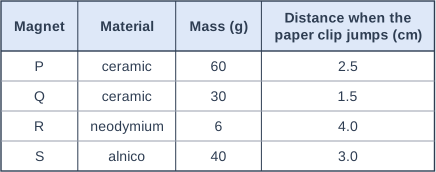
A student tests four magnets. She puts a steel paper clip on the bench and lowers each magnet slowly towards it. She measures the distance between the magnet and the paper clip when the paper clip jumps up to the magnet. A stronger magnet makes the paper clip jump from further away.

The table shows her results.

The student says:

'The bigger the magnet, the stronger it is.'

Use the results to evaluate the student's statement.

Table with columns "Magnet", "Material", "Mass (g)", "Distance when the paper clip jumps (cm)". Magnet: P; Material: ceramic; Mass (g): 60; Distance when the paper clip jumps (cm): 2.5 | Magnet: Q; Material: ceramic; Mass (g): 30; Distance when the paper clip jumps (cm): 1.5 | Magnet: R; Material: neodymium; Mass (g): 6; Distance when the paper clip jumps (cm): 4.0 | Magnet: S; Material: alnico; Mass (g): 40; Distance when the paper clip jumps (cm): 3.0.

Model answer

The student is not correct. Magnet R has the smallest mass, only 6 g, but the paper clip jumps to it from 4.0 cm, the greatest distance, so R is the strongest magnet. The two ceramic magnets do fit the statement: P (60 g) works from 2.5 cm but Q (30 g) only from 1.5 cm. So a bigger magnet is stronger only when the magnets are made of the same material; the strength also depends on the material.

Explanation

Evaluate a statement by testing it against every row of the data. The neodymium magnet R is the smallest and the strongest, so size alone does not decide strength. Comparing magnets of the same material (P and Q) shows that a bigger magnet can be stronger, so the fair conclusion is that strength depends on the material as well as the size.

Mark scheme
  1. 1 mark

    magnet R has the smallest mass (6 g) but the paper clip jumps from the greatest distance (4.0 cm), so R is the strongest magnet

    Max 2 if no data from the table are used. ALLOW R is the smallest magnet but the strongest, with at least one value quoted. ALLOW magnet S (40 g, 3.0 cm) is stronger than the bigger magnet P (60 g, 2.5 cm) as an alternative use of data for this mark.

  2. 1 mark

    for the two ceramic magnets, the bigger one (P, 60 g) is stronger than the smaller one (Q, 30 g) / P makes the clip jump from 2.5 cm and Q from 1.5 cm

    ALLOW the statement is true for magnets made of the same material. ALLOW the biggest magnet (P) is not the strongest.

  3. 1 mark

    the statement is wrong / only partly true: the strength of a magnet depends on what it is made of (its material) as well as its size

    A judgement is needed for this mark, with a reason. ALLOW bigger magnets are not always stronger, because R is made of a different material (neodymium). DO NOT ALLOW the student is right.

Ready to try the rest? Every answer you write is marked against the mark scheme, so you can see exactly where the marks are.

Study Helper Hints first, answers after you try

Stuck on this one? Ask for a hint and I’ll point you in the right direction, without giving the answer away. Once you’ve checked your answer, I’ll show you how the marks are awarded.