
Level:
Correct: 0
Incorrect: 0
Marks: 0/0
Exam Practice
Course:
Topics:
Avg
score:
–
Topics
done:
0/31

Internal energy and specific heat capacity

Practise 16 exam-style questions on Internal energy and specific heat capacity for OCR GCSE Physics (Paper 1). Write your answer as you would in the exam and get it marked in seconds against the mark scheme, point by point, with the Study Helper on hand if you get stuck.

  • 16 questions
  • 1–6 marks each
  • Instant marking
  • No sign-up needed
16 questions, marked as you go

Sample questions with model answers

Here are 4 of the questions in this topic, each with a model answer, an explanation of why it earns the marks and the mark scheme an examiner would use.

Question 1

1 mark

A mug of hot chocolate is left on a table. It cools from 70 °C to 25 °C.

Which statement describes what happens to the energy stored in the hot chocolate?

Choose your answer.

  • A It decreases, because energy is transferred to the surroundings.
  • B It increases, because the particles move closer together.
  • C It stays the same, because energy cannot be created or destroyed.
  • D It stays the same, because the mass of the drink does not change.

Model answer

A (it decreases, because energy is transferred to the surroundings)

Explanation

The energy stored in a system goes up when it is heated and down when it cools. As the hot chocolate cools, energy is transferred to its cooler surroundings and its particles move more slowly. Energy is not destroyed: it ends up in the surroundings, which is why option C is wrong.

Mark scheme
  1. 1 mark

    A / it decreases, because energy is transferred to the surroundings

    The only correct answer is A: the hot chocolate is hotter than the mug, the table and the air, so energy is transferred from it to them and the energy stored in the hot chocolate decreases. B is not correct because the energy stored decreases, not increases, when a drink cools. C is not correct because energy is conserved overall, but it moves into the surroundings, so the hot chocolate itself stores less. D is not correct because the energy stored depends on the temperature as well as the mass, so it falls as the temperature falls. ALLOW the letter or the option. If more than one option is given, do not award the mark.
Question 2

2 marks

A teapot contains 0.80 kg of tea. The tea cools down by 45 °C.

The specific heat capacity of the tea is 4200 J/kg °C.

Calculate the energy transferred from the tea to the surroundings. Give your answer in kJ.

Use the equation: change in thermal energy = mass × specific heat capacity × change in temperature

Model answer

Change in thermal energy = 0.80 × 4200 × 45
= 151 200 J
= 151.2 kJ

Explanation

Substitute the mass, the specific heat capacity and the change in temperature into the equation to get the energy in joules: 0.80 × 4200 × 45 = 151 200 J. The question asks for kJ, so divide by 1000: 151.2 kJ. Leaving the answer as 151 200 J loses the last mark.

Mark scheme
  1. 1 mark

    substitution: 0.80 × 4200 × 45 (= 151 200 J); or a correct final answer of 151.2 kJ, 151 kJ or 150 kJ with no working

    An answer of 151.2 kJ, 151 kJ or 150 kJ with no working scores 2 marks. ALLOW 151 200 J (or 151 000 J or 150 000 J) for 1 mark (joules not converted to kJ).

  2. 1 mark

    evaluation: 151.2 (kJ) / 151 (kJ) / 150 (kJ)

    ALLOW 1.512 × 10² kJ. ALLOW a correct conversion to kJ of a wrong value in joules (ECF). IGNORE a minus sign. IGNORE units.

Question 3

2 marks

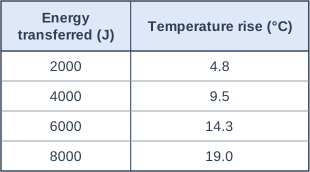
A student transfers different amounts of energy to 0.10 kg of water and measures the temperature rise each time.

The table shows her results.

Use the pattern in her results to predict the temperature rise when 10 000 J of energy is transferred to the same mass of water. Explain how you made your prediction.

Table with columns "Energy transferred (J)", "Temperature rise (°C)". Energy transferred (J): 2000; Temperature rise (°C): 4.8 | Energy transferred (J): 4000; Temperature rise (°C): 9.5 | Energy transferred (J): 6000; Temperature rise (°C): 14.3 | Energy transferred (J): 8000; Temperature rise (°C): 19.0.

Model answer

The temperature rise goes up by about 4.8 °C for every 2000 J, so the rise is proportional to the energy. 10 000 J is 5 × 2000 J, so the temperature rise should be about 5 × 4.8 = 24 °C.

Explanation

Look for the pattern: every extra 2000 J gives about 4.8 °C more, and doubling the energy doubles the rise. Continuing the pattern to 10 000 J (5 × 2000 J) gives about 24 °C. This matches the equation too: 10 000 ÷ (0.10 × 4200) = 23.8 °C. Any value from 23.5 to 24.0 °C with a correct method scores both marks.

Mark scheme
  1. 1 mark

    a prediction from 23.5 to 24.0 (°C); or a correct final answer from 23.5 to 24.0 °C with no working

    An answer from 23.5 to 24.0 °C with no working scores marking point 1 only. ALLOW 24 (°C). IGNORE units.

  2. 1 mark

    the temperature rise goes up by about 4.8 °C for every extra 2000 J (so 10 000 J gives 5 × 4.8 °C) / doubling the energy doubles the temperature rise (so 10 000 J gives 2.5 × 9.5 °C) / the temperature rise is about the energy ÷ 420 (each degree needs about 420 J)

    ALLOW any correct method that uses the pattern in the data, for example continuing the table: 10 000 J is 2000 J more than 8000 J, so about 19.0 + 4.8 °C. ALLOW the temperature rise is (directly) proportional to the energy, with a correct use of a row of the table. DO NOT ALLOW a statement such as 'the temperature rise increases' with no use of the numbers in the table.

Question 4

4 marks

A student heats a 1.2 kg block of metal with an electric heater. The power of the heater is 36 W. The heater is switched on for 15 minutes. The temperature of the block rises by 30 °C.

Calculate the specific heat capacity of the metal. Assume that all of the energy from the heater is transferred to the block.

Use the equation: change in thermal energy = mass × specific heat capacity × change in temperature

Model answer

Time = 15 × 60 = 900 s
Energy transferred = power × time = 36 × 900 = 32 400 J
32 400 = 1.2 × specific heat capacity × 30
Specific heat capacity = 32 400 ÷ (1.2 × 30) = 32 400 ÷ 36
= 900 J/kg °C

Explanation

Power is in watts (joules per second), so the time must be in seconds: 15 minutes = 900 s, and the energy from the heater is energy = power × time = 36 × 900 = 32 400 J. Then rearrange the second equation: specific heat capacity = energy ÷ (mass × change in temperature) = 32 400 ÷ 36 = 900 J/kg °C. Forgetting to change minutes into seconds gives 15 J/kg °C, which is far too small for a metal.

Mark scheme
  1. 1 mark

    unit conversion: 15 minutes = 900 s; or a correct final answer of 900 J/kg °C with no working

    An answer of 900 J/kg °C with no working scores 4 marks. ALLOW 15 J/kg °C for 3 marks (minutes not converted to seconds: 36 × 15 = 540 J, then 540 ÷ (1.2 × 30)).

  2. 1 mark

    (recall and use of energy transferred = power × time:) energy transferred = 36 × 900 = 32 400 (J); or a correct final answer of 900 J/kg °C with no working

    The equation energy transferred = power × time is not given: it must be recalled. ALLOW E = P × t / E = Pt. ALLOW ECF from a wrong time (for example 36 × 15 = 540 J).

  3. 1 mark

    rearrangement and substitution: specific heat capacity = 32 400 ÷ (1.2 × 30) / 32 400 = 1.2 × specific heat capacity × 30; or a correct final answer of 900 J/kg °C with no working

    ALLOW ECF from a wrong energy value. DO NOT ALLOW 32 400 ÷ 30 (= 1080) without the mass.

  4. 1 mark

    evaluation: 900 (J/kg °C)

    ALLOW ECF from a wrong energy value. IGNORE units.

Ready to try the rest? Every answer you write is marked against the mark scheme, so you can see exactly where the marks are.

Study Helper Hints first, answers after you try

Stuck on this one? Ask for a hint and I’ll point you in the right direction, without giving the answer away. Once you’ve checked your answer, I’ll show you how the marks are awarded.