
Level:
Correct: 0
Incorrect: 0
Marks: 0/0
Exam Practice
Course:
Topics:
Avg
score:
–
Topics
done:
0/31

Gravity, weight and free fall

Practise 18 exam-style questions on Gravity, weight and free fall for OCR GCSE Physics (Paper 1). Write your answer as you would in the exam and get it marked in seconds against the mark scheme, point by point, with the Study Helper on hand if you get stuck.

  • 18 questions
  • 1–4 marks each
  • Instant marking
  • No sign-up needed
18 questions, marked as you go

Sample questions with model answers

Here are 4 of the questions in this topic, each with a model answer, an explanation of why it earns the marks and the mark scheme an examiner would use.

Question 1

1 mark

A kayak is lifted from the ground onto the roof rack of a car. The roof rack is 1.6 m above the ground.

The gravitational potential energy of the kayak increases by 320 J.

Gravitational field strength = 10 N/kg

What is the mass of the kayak?

Use the equation: gravitational potential energy = mass × gravitational field strength × height

Choose your answer.

  • A 0.05 kg
  • B 20 kg
  • C 200 kg
  • D 5120 kg

Model answer

B - 20 kg (mass = 320 ÷ (10 × 1.6) = 320 ÷ 16 = 20 kg)

Explanation

Rearrange the equation to make mass the subject: mass = gravitational potential energy ÷ (gravitational field strength × height). Work out the bottom first: 10 × 1.6 = 16, then 320 ÷ 16 = 20 kg, a sensible mass for a kayak. Dividing by the height only gives 200 kg, ten times too big, because the gravitational field strength has been left out.

Mark scheme
  1. 1 mark

    B / 20 kg

    The only correct answer is B: mass = gravitational potential energy ÷ (gravitational field strength × height) = 320 ÷ (10 × 1.6) = 320 ÷ 16 = 20 kg. A is not correct because it divides the wrong way round: (10 × 1.6) ÷ 320 = 0.05. C is not correct because it leaves out the gravitational field strength: 320 ÷ 1.6 = 200. D is not correct because it multiplies the three values instead of dividing: 320 × 10 × 1.6 = 5120. ALLOW the letter or the option. If more than one option is given, do not award the mark.
Question 2

2 marks

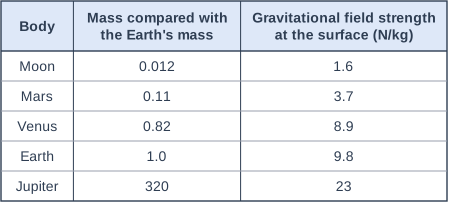
The table shows data from NASA's Planetary Fact Sheet (last updated in March 2025) for some bodies in the Solar System. The mass of each body is given as a multiple of the Earth's mass. The table gives the Earth's value as 9.8 N/kg, which is rounded to 10 N/kg in calculations.

Describe the pattern shown by the data.

Use data from the table in your answer.

Table with columns "Body", "Mass compared with the Earth's mass", "Gravitational field strength at the surface (N/kg)". Body: Moon; Mass compared with the Earth's mass: 0.012; Gravitational field strength at the surface (N/kg): 1.6 | Body: Mars; Mass compared with the Earth's mass: 0.11; Gravitational field strength at the surface (N/kg): 3.7 | Body: Venus; Mass compared with the Earth's mass: 0.82; Gravitational field strength at the surface (N/kg): 8.9 | Body: Earth; Mass compared with the Earth's mass: 1.0; Gravitational field strength at the surface (N/kg): 9.8 | Body: Jupiter; Mass compared with the Earth's mass: 320; Gravitational field strength at the surface (N/kg): 23.

Model answer

The more massive the body, the greater its gravitational field strength. For example, the Moon has the smallest mass (0.012 times the Earth's mass) and the smallest field strength, 1.6 N/kg, while Jupiter has the largest mass (320 times the Earth's mass) and the largest field strength, 23 N/kg.

Explanation

Read along each row: as the mass column goes up, the gravitational field strength column goes up too, so more massive bodies have stronger gravitational fields. A good description quotes pairs of values. The relationship is not direct proportion: multiplying the mass by about 320 (Earth to Jupiter) multiplies g by only about 2.3, because the size of the body matters as well.

Mark scheme
  1. 1 mark

    the greater the mass of the body, the greater the gravitational field strength (at its surface)

    ORA (allow the reverse argument): the smaller the mass, the smaller the gravitational field strength. ALLOW as the mass increases, the gravitational field strength increases. DO NOT ALLOW 'the gravitational field strength is (directly) proportional to the mass': Jupiter has about 320 times the Earth's mass but only about 2.3 times its gravitational field strength.

  2. 1 mark

    use of data from the table to support the pattern: for example the Moon has the smallest mass (0.012) and the smallest gravitational field strength (1.6 N/kg), and Jupiter has the largest mass (320) and the largest gravitational field strength (23 N/kg)

    At least two bodies must be compared, each with its mass and gravitational field strength, or a comparison using values such as 'Mars has a mass of 0.11 and g of 3.7 N/kg but Venus has a mass of 0.82 and g of 8.9 N/kg'. ALLOW values quoted without units. ALLOW 10 N/kg for the Earth.

Question 3

2 marks

An astronaut on the Moon drops a spanner from a height of 1.5 m. It takes about 1.4 s to reach the ground. On the Earth, the same spanner dropped from the same height would take about 0.55 s.

Gravitational field strength on the Moon = 1.6 N/kg
Gravitational field strength on the Earth = 10 N/kg

Explain why the spanner takes longer to fall on the Moon. Ignore air resistance.

Model answer

The gravitational field strength on the Moon (1.6 N/kg) is much smaller than on the Earth (10 N/kg). The spanner has the same mass, so the gravitational force on it, its weight, is much smaller on the Moon. This means that its acceleration as it falls is smaller: 1.6 m/s² instead of 10 m/s². Its speed increases more slowly, so it takes longer to fall the 1.5 m.

Explanation

For an object falling freely, acceleration = force ÷ mass = (mass × gravitational field strength) ÷ mass, so its acceleration is equal to g. On the Moon g is about a sixth of its value on the Earth, so a dropped object speeds up much more slowly and takes longer to fall the same height. The mass of the spanner does not change; only the force on it does.

Mark scheme
  1. 1 mark

    the gravitational field strength is smaller on the Moon, so the gravitational force on the spanner (its weight) is smaller, although its mass is the same

    ALLOW 'the Moon's gravity pulls the spanner with a smaller force'. ALLOW weight = mass × gravitational field strength used to show that the weight is smaller (6.25 times smaller). DO NOT ALLOW 'there is no gravity on the Moon' or 'the spanner has a smaller mass on the Moon'. IGNORE references to air or air resistance.

  2. 1 mark

    so its acceleration as it falls is smaller (1.6 m/s² instead of 10 m/s²): its speed increases more slowly, so it takes longer to fall 1.5 m

    ALLOW 'it speeds up more slowly' / 'it gains only 1.6 m/s of speed each second (instead of 10 m/s)'. ALLOW 'the acceleration in free fall is equal to the gravitational field strength, which is smaller on the Moon'. The idea of a smaller acceleration, or of the speed increasing more slowly, is needed. DO NOT ALLOW 'it falls at a slower speed' with no reference to acceleration or to how quickly the speed increases.

Question 4

3 marks

Space agencies are planning to send astronauts to Mars. To practise walking on Mars, an astronaut trains on the Earth wearing a harness hung from an overhead support. The harness pulls upwards on her, so that the ground pushes up on her feet with the same force as it would on Mars.

The astronaut and her spacesuit have a total mass of 100 kg.

Gravitational field strength on the Earth = 10 N/kg
Gravitational field strength on Mars = 3.7 N/kg

Use the equation: gravitational force = mass × gravitational field strength

Calculate the upward force that the harness must exert on the astronaut when she stands still.

Model answer

Weight on the Earth = 100 × 10 = 1000 N
On Mars the ground would push up with a force equal to her weight there = 100 × 3.7 = 370 N
She is standing still, so the upward forces balance her weight on the Earth: force of harness + 370 = 1000
Force of harness = 1000 − 370 = 630 N

Explanation

The astronaut's mass, 100 kg, is the same on both planets, but her weight depends on the gravitational field strength. When she stands still the forces on her are balanced, so the harness and the ground together must hold up her weight on the Earth, 1000 N. For the ground to push up with only 370 N, as it would on Mars, the harness must provide the other 630 N. Note that 370 N is the push of the ground, not the force of the harness.

Mark scheme
  1. 1 mark

    weight on the Earth = 100 × 10 = 1000 (N); or a correct final answer of 630 N (or 610 N) with no working

    An answer of 630 N (or 610 N, using 9.8 N/kg for the Earth) with no working scores 3 marks. ALLOW the one-step route 100 × (10 − 3.7) = 100 × 6.3 for marking points 1 and 2. ALLOW 370 N (her weight on Mars, which is the push of the ground, given as the force of the harness) for 1 mark (point 2). ALLOW 1000 N (her weight on the Earth given as the force of the harness) for 1 mark (point 1). DO NOT ALLOW 1370 N (the two weights added) for point 3.

  2. 1 mark

    upward force from the ground = her weight on Mars = 100 × 3.7 = 370 (N); or a correct final answer of 630 N (or 610 N) with no working

    DO NOT ALLOW 100 ÷ 3.7 (27).

  3. 1 mark

    evaluation: (force of the harness =) 1000 − 370 = 630 (N)

    ALLOW ECF: (their weight on the Earth) − (their weight on Mars). ALLOW 610 N (using 9.8 N/kg: 980 − 370). IGNORE units.

Ready to try the rest? Every answer you write is marked against the mark scheme, so you can see exactly where the marks are.

Study Helper Hints first, answers after you try

Stuck on this one? Ask for a hint and I’ll point you in the right direction, without giving the answer away. Once you’ve checked your answer, I’ll show you how the marks are awarded.