
Level:
Correct: 0
Incorrect: 0
Marks: 0/0
Exam Practice
Course:
Topics:
Avg
score:
–
Topics
done:
0/31

Current, potential difference and resistance

Practise 15 exam-style questions on Current, potential difference and resistance for OCR GCSE Physics (Paper 1). Write your answer as you would in the exam and get it marked in seconds against the mark scheme, point by point, with the Study Helper on hand if you get stuck.

  • 15 questions
  • 1–6 marks each
  • Instant marking
  • No sign-up needed
15 questions, marked as you go

Sample questions with model answers

Here are 4 of the questions in this topic, each with a model answer, an explanation of why it earns the marks and the mark scheme an examiner would use.

Question 1

1 mark

Which list gives the units of current, potential difference and resistance, in that order?

Choose your answer.

  • A ampere, ohm, volt
  • B ampere, volt, ohm
  • C volt, ampere, ohm
  • D volt, ohm, ampere

Model answer

B - ampere, volt, ohm

Explanation

Current is measured in amperes (A), potential difference in volts (V) and resistance in ohms (Ω). A useful check: an ammeter measures current in amps and a voltmeter measures potential difference in volts. Resistance is the potential difference divided by the current, so 1 Ω is 1 V per ampere.

Mark scheme
  1. 1 mark

    B / ampere, volt, ohm

    The only correct answer is B: current is measured in amperes (A), potential difference in volts (V) and resistance in ohms (Ω). A is not correct because it swaps the units of potential difference and resistance. C is not correct because it swaps the units of current and potential difference. D is not correct because none of the three units is matched to its quantity. ALLOW the letter or the option. If more than one option is given, do not award the mark.
Question 2

1 mark

The current in a component depends on two other quantities.

Name these two quantities.

Model answer

The potential difference across the component and the resistance of the component.

Explanation

The current depends on both the potential difference and the resistance: current = potential difference ÷ resistance. A larger p.d. gives a larger current; a larger resistance gives a smaller current.

Mark scheme
  1. 1 mark

    potential difference (across the component) AND resistance (of the component)

    Both are needed for the mark. ALLOW voltage for potential difference. If more than two quantities are given, a wrong one cancels a right one. IGNORE charge, time and power.

Question 3

2 marks

Some fixed resistors are made from a coil of constantan wire, not copper wire.

• The resistance of constantan changes very little when its temperature changes.
• The resistance of copper increases when its temperature increases.

The resistance of a fixed resistor must stay the same when the current in it changes.

Explain why constantan is used instead of copper.

Model answer

A current heats the wire, and a larger current makes it hotter. If the resistor were made of copper, its resistance would increase as it got hotter, so its resistance would change whenever the current changed. The resistance of constantan changes very little with temperature, so a constantan resistor keeps the same resistance at different currents.

Explanation

For some resistors the resistance stays constant, but in others it changes as the current changes. The reason is heating: a current warms a wire, and for most metals, such as copper, a hotter wire has a larger resistance. Constantan is an alloy whose resistance hardly changes with temperature, so a resistor made from it keeps the same resistance at different currents.

Mark scheme
  1. 1 mark

    a current heats the wire / the larger the current, the hotter the wire becomes

    ALLOW the wire warms up when there is a current in it. IGNORE 'the wire gets hot' with no link to the current.

  2. 1 mark

    so the resistance of a copper resistor would increase as the current increases (would change when the current changes), but the resistance of a constantan resistor stays (almost) the same

    ALLOW constantan keeps the current proportional to the potential difference. A repeat of the information that the resistance of copper increases with temperature, with no link to the current changing, does not score.

Question 4

4 marks

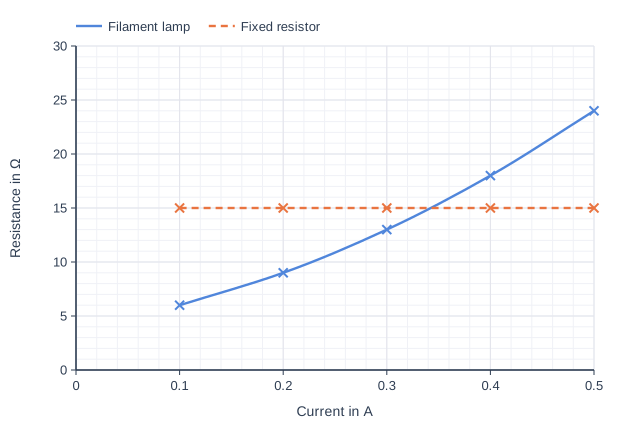
A student measures the current in a filament lamp and in a fixed resistor at different potential differences. She uses her results to work out the resistance of each component at each current.

The graph shows her results.

Describe how the resistance of each component changes as the current increases. Use data from the graph.

Explain why the resistance of the filament lamp changes.

Line graph of resistance in Ω (y-axis, 0 to 30) against Current in A (x-axis, 0 to 0.5). "Filament lamp" is a smooth curve through (0.1, 6), (0.2, 9), (0.3, 13), (0.4, 18), (0.5, 24). "Fixed resistor" (dashed) joins the points (0.1, 15), (0.2, 15), (0.3, 15), (0.4, 15), (0.5, 15).

Model answer

The resistance of the fixed resistor stays the same, 15 Ω, at every current. The resistance of the filament lamp increases as the current increases: it is 6 Ω at 0.1 A but 24 Ω at 0.5 A, and it rises faster at larger currents. The larger the current in the lamp, the hotter the filament becomes, and the resistance of the metal filament increases as its temperature increases.

Explanation

A fixed resistor at a constant temperature has a constant resistance, so its line is flat. In a filament lamp the current heats the thin metal filament, and a hotter metal has a larger resistance, so the lamp's resistance rises as the current rises. Quoting a pair of readings, such as 6 Ω at 0.1 A and 24 Ω at 0.5 A, earns the data mark.

Mark scheme
  1. 1 mark

    fixed resistor: the resistance stays the same / is constant (at 15 Ω) as the current increases

    Max 3 if no data from the graph are used. ALLOW the line for the resistor is flat / horizontal.

  2. 1 mark

    filament lamp: the resistance increases as the current increases

    ALLOW the resistance increases more and more steeply / faster at larger currents. IGNORE 'it changes' on its own.

  3. 1 mark

    correct data for the lamp, for example 6 Ω at 0.1 A and 24 Ω at 0.5 A / the lamp's resistance is less than 15 Ω below about 0.35 A and more than 15 Ω above it

    ALLOW any pair of values read from the lamp's curve: (0.1 A, 6 Ω), (0.2 A, 9 Ω), (0.3 A, 13 Ω), (0.4 A, 18 Ω), (0.5 A, 24 Ω), with a tolerance of ±1 Ω. ALLOW a value for the resistor (15 Ω) together with one lamp value.

  4. 1 mark

    (explanation) the larger current heats the filament / makes the filament hotter, and the resistance of the (metal) filament increases as its temperature increases

    Both ideas are needed: current heats the filament AND hotter means a larger resistance. ALLOW the filament gets hotter so the ions vibrate more and the electrons collide with them more (AW). DO NOT ALLOW the filament gets longer / the current is used up.

Ready to try the rest? Every answer you write is marked against the mark scheme, so you can see exactly where the marks are.

Study Helper Hints first, answers after you try

Stuck on this one? Ask for a hint and I’ll point you in the right direction, without giving the answer away. Once you’ve checked your answer, I’ll show you how the marks are awarded.