
Level:
Correct: 0
Incorrect: 0
Marks: 0/0
Exam Practice
Course:
Topics:
Avg
score:
–
Topics
done:
0/24

Wave properties, transverse and longitudinal waves

Practise 15 exam-style questions on Wave properties, transverse and longitudinal waves for Edexcel GCSE Combined Science (Foundation Physics Paper 1). Write your answer as you would in the exam and get it marked in seconds against the mark scheme, point by point, with the Study Helper on hand if you get stuck.

  • 15 questions
  • 1–6 marks each
  • Instant marking
  • No sign-up needed
15 questions, marked as you go

Sample questions with model answers

Here are 4 of the questions in this topic, each with a model answer, an explanation of why it earns the marks and the mark scheme an examiner would use.

Question 1

1 mark

Straight ripples are made in a ripple tank. Seen from above, the wavefronts are straight, parallel lines. Each wavefront is a line along the top of one ripple (a crest).

What is the distance between two neighbouring wavefronts?

Choose your answer.

  • A the amplitude
  • B the frequency
  • C half the wavelength
  • D the wavelength

Model answer

D (the wavelength)

Explanation

A wavefront is a line joining points on a wave that are at the same stage of their vibration, for example the tops of the crests. The next wavefront is the next crest, so the gap between neighbouring wavefronts is one wavelength. Students often confuse wavelength with amplitude: amplitude is measured from the rest position up to a crest, not along the direction the wave travels.

Mark scheme
  1. 1 mark

    D / the wavelength

    The only correct answer is D: a wavefront joins points that are at the same stage of the wave (here, crests), so neighbouring wavefronts are one wavelength apart. A is not correct because the amplitude is the greatest height of a ripple above the rest position, not a distance along the tank; B is not correct because the frequency is the number of waves each second, not a distance; C is not correct because half a wavelength is the distance from a crest to the next trough, and both of these wavefronts are crests. Accept the letter or the option. If more than one option is given, do not award the mark.
Question 2

2 marks

Obi puts a ringing mobile phone inside a glass jar and screws the lid on tightly, so that no air can get into or out of the jar. People on the other side of the room can still hear the phone ringing.

Use this observation to explain what travels from the phone to the people, and what does not.

Model answer

The jar is sealed, so none of the air around the phone can get out and reach the people. They can still hear the ringing, so the vibrations must be passed on through the glass and then through the air in the room. The sound wave (the energy) travels across the room, but the air from the jar does not.

Explanation

If the air itself had to travel from the phone to the listeners, sealing the jar would stop the sound completely. Because the sound is still heard, the vibrations must be handed on from the air in the jar to the glass and then to the air outside. This shows that a wave transfers energy without transferring matter.

Mark scheme
  1. 1 mark

    the air (from) inside the jar cannot get out / no air from around the phone reaches the people

    accept 'the air around the phone is trapped in the jar'.

  2. 1 mark

    but the sound still reaches the people, so the vibrations / energy must pass through the glass and the air in the room (it is the wave that travels)

    accept 'the glass vibrates and makes the air outside the jar vibrate' / 'the vibration is passed from particle to particle, but the particles do not travel'. Do not accept 'the sound escapes through gaps in the lid' (the jar is sealed).

Question 3

2 marks

A wave-power machine floats in the sea off the coast of Orkney. The machine moves up and down as waves pass it, and it generates electricity.

The period of the waves is 8.0 s.

Calculate how many waves pass the machine in 1 hour.

Model answer

1 hour = 60 × 60 = 3600 s
One wave passes every 8.0 s, so number of waves = 3600 ÷ 8.0 = 450

Explanation

The period is the time for one complete wave, so divide the total time by the period. The hour must be changed to seconds first (3600 s). A common error is to divide 60 by 8.0, which gives the number of waves in one minute, not one hour.

Mark scheme
  1. 1 mark

    (number of waves =) 3600 ÷ 8.0 / (60 ÷ 8.0) × 60; or a correct final answer of 450 with no working

    An answer of 450 with no working scores 2 marks. Allow this mark for a correct step towards the answer with no further correct working: 7.5 waves in one minute (60 ÷ 8.0) when it is clearly stated as the number of waves in one minute, or a frequency of 0.125 Hz (1 ÷ 8.0). An answer of 7.5 given as the number of waves in 1 hour scores 0 (the hour has not been changed into seconds). 8.0 × 60 = 480 or 3600 × 8.0 = 28 800 (wrong methods) score 0.

  2. 1 mark

    450

    Ignore units.

Question 4

4 marks

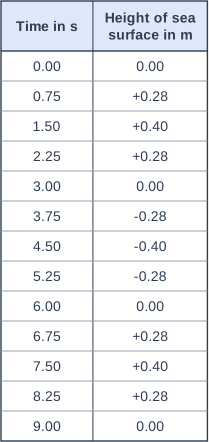
A wave sensor on the end of a pier records the height of the sea surface above or below its rest level (the level of calm water). A negative value means the surface is below the rest level.

The table shows some of the sensor's readings.

Use the table to give the amplitude and the period of the waves. Then calculate the frequency of the waves.

Use the equation

frequency = 1 ÷ period

Table with columns "Time in s", "Height of sea surface in m". Time in s: 0.00; Height of sea surface in m: 0.00 | Time in s: 0.75; Height of sea surface in m: +0.28 | Time in s: 1.50; Height of sea surface in m: +0.40 | Time in s: 2.25; Height of sea surface in m: +0.28 | Time in s: 3.00; Height of sea surface in m: 0.00 | Time in s: 3.75; Height of sea surface in m: -0.28 | Time in s: 4.50; Height of sea surface in m: -0.40 | Time in s: 5.25; Height of sea surface in m: -0.28 | Time in s: 6.00; Height of sea surface in m: 0.00 | Time in s: 6.75; Height of sea surface in m: +0.28 | Time in s: 7.50; Height of sea surface in m: +0.40 | Time in s: 8.25; Height of sea surface in m: +0.28 | Time in s: 9.00; Height of sea surface in m: 0.00.

Model answer

The highest reading is 0.40 m above the rest level, so the amplitude is 0.40 m.
Crests are at 1.5 s and 7.5 s, so the period = 7.5 - 1.5 = 6.0 s
frequency = 1 ÷ 6.0 = 0.17 Hz

Explanation

The amplitude is the greatest height above the rest level, not the height from a trough to a crest (0.80 m). The period is the time for one complete wave: find two crests in the table and subtract their times. A common error is to take 3.0 s, the time between the surface passing the rest level going up and then going down, which is only half a wave.

Mark scheme
  1. 1 mark

    amplitude = 0.40 (m)

    An answer of amplitude 0.40 m, period 6.0 s and frequency 0.17 Hz with no working scores 4 marks. accept 0.4 m. Do not accept 0.80 m (the height from a trough to a crest) or 0.28 m.

  2. 1 mark

    period = 6.0 (s); or a correct final answer of 0.17 Hz with no working

    accept the time between two crests (1.5 s and 7.5 s), or between two times when the surface is at the rest level and moving upwards (0 s and 6.0 s). Do not accept 3.0 s (half a period) or 1.5 s.

  3. 1 mark

    substitution: (frequency =) 1 ÷ 6.0; or a correct final answer of 0.17 Hz with no working

    ecf: allow 1 ÷ their period.

  4. 1 mark

    evaluation: 0.17 (Hz)

    accept 0.167 / 0.1667 / 1/6. ecf: 1 ÷ their period correctly evaluated, e.g. 1 ÷ 3.0 = 0.33 Hz, scores this mark. Ignore units.

Ready to try the rest? Every answer you write is marked against the mark scheme, so you can see exactly where the marks are.

Study Helper Hints first, answers after you try

Stuck on this one? Ask for a hint and I’ll point you in the right direction, without giving the answer away. Once you’ve checked your answer, I’ll show you how the marks are awarded.