
Level:
Correct: 0
Incorrect: 0
Marks: 0/0
Exam Practice
Course:
Topics:
Avg
score:
–
Topics
done:
0/24

Newton's laws of motion and weight

Practise 19 exam-style questions on Newton's laws of motion and weight for Edexcel GCSE Combined Science (Foundation Physics Paper 1). Write your answer as you would in the exam and get it marked in seconds against the mark scheme, point by point, with the Study Helper on hand if you get stuck.

  • 19 questions
  • 1–6 marks each
  • Instant marking
  • No sign-up needed
19 questions, marked as you go

Sample questions with model answers

Here are 4 of the questions in this topic, each with a model answer, an explanation of why it earns the marks and the mark scheme an examiner would use.

Question 1

1 mark

A boy sits still on a chair. The boy pushes down on the chair, and the chair pushes up on the boy.

Which statement about these two forces is correct?

Choose your answer.

  • A the chair's push is bigger, because it holds the boy up
  • B they are equal in size and opposite in direction
  • C the boy's push is bigger, because he is heavier than the chair
  • D they are equal in size and act in the same direction

Model answer

B

The boy's push on the chair and the chair's push on the boy are a Newton's third law pair: equal in size and opposite in direction.

Explanation

Newton's third law says that whenever two objects interact, each exerts a force on the other, and these two forces are equal in size, opposite in direction and of the same type. Here both are contact forces, one acting on the chair and one acting on the boy. It does not matter which object is heavier.

Mark scheme
  1. 1 mark

    B / they are equal in size and opposite in direction

    The only correct answer is B: the two forces are a Newton's third law pair: when two objects interact, they exert forces on each other that are equal in size and opposite in direction. A is not correct because the chair's push on the boy is the same size as the boy's push on the chair; C is not correct because the sizes of the two forces in a third law pair are always equal, whatever the masses of the objects; D is not correct because the boy pushes down and the chair pushes up, so the forces act in opposite directions. Accept the letter or the option. If more than one option is given, do not award the mark.
Question 2

2 marks

To protect baggage handlers from injury, airports do not accept any single checked bag with a mass of more than 32 kg.

Calculate the weight of a bag with a mass of 32 kg.

(gravitational field strength = 10 N/kg)

Model answer

W = m × g
W = 32 × 10
W = 320 N

Explanation

Weight = mass × gravitational field strength, W = m × g. With g = 10 N/kg, every kilogram of mass has a weight of 10 N, so 32 kg has a weight of 320 N. Remember that weight is a force, measured in newtons, while mass is measured in kilograms.

Mark scheme
  1. 1 mark

    substitution: (W =) 32 × 10; or a correct final answer of 320 N with no working

    An answer of 320 N with no working scores 2 marks. 32 ÷ 10 = 3.2 (wrong method) scores 0.

  2. 1 mark

    evaluation: 320 (N)

    Allow 314 or 313.6 (use of g = 9.8 N/kg). Ignore units.

Question 3

2 marks

Rosa uses a newtonmeter to measure the weight of a toy. Before she hangs the toy on it, the newtonmeter reads 0.4 N. With the toy hanging from it, the newtonmeter reads 3.0 N.

Give the weight of the toy, and give one other thing Rosa should do to make sure her reading of the weight is accurate.

Model answer

weight of toy = 3.0 − 0.4 = 2.6 N
She should wait until the toy is hanging still before she reads the scale (and read it at eye level).

Explanation

The newtonmeter read 0.4 N with nothing on it (a zero error), so every reading is 0.4 N too big: subtract it to get the toy's weight. The reading equals the weight only when the toy hangs still, because then the forces on it are balanced. Reading the scale at eye level avoids a parallax error.

Mark scheme
  1. 1 mark

    2.6 (N)

    3.0 − 0.4 = 2.6 N. Do not accept 3.0 N or 3.4 N. Ignore units.

  2. 1 mark

    wait until the toy is hanging still before reading the scale / read the scale at eye level (perpendicular to the scale) / hold the newtonmeter vertically

    Any one. Allow adjust the newtonmeter to read zero before hanging the toy (correct the zero error). Do not accept 'repeat the reading' or 'use a more accurate newtonmeter' on their own.

Question 4

4 marks

A bungee jumper has a mass of 70 kg. At the lowest point of her jump she is not moving for an instant. At this point, the bungee cord pulls upwards on her with a force of 2100 N.

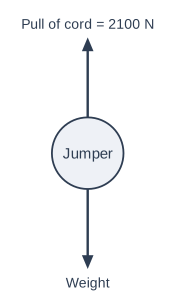
The arrows on the diagram show the forces on the jumper at this point. They are not drawn to scale.

Calculate her acceleration at this point and give its direction.

(gravitational field strength = 10 N/kg)

Use the equations

W = m × g

F = m × a

Free body diagram: a circle labelled "Jumper" with 2 force arrows. An arrow labelled "Pull of cord = 2100 N" starts at the object and points upwards; an arrow labelled "Weight" starts at the object and points downwards.

Model answer

W = m × g = 70 × 10 = 700 N
resultant force = 2100 − 700 = 1400 N upwards
F = m × a, so a = F ÷ m = 1400 ÷ 70
a = 20 m/s² upwards

Explanation

Find her weight first, then the resultant force: the two forces act in opposite directions, so subtract. The resultant force is upwards, so her acceleration is upwards, even though she is not moving at that instant: her velocity is about to change from downwards to upwards. Using 2100 N on its own forgets that her weight also acts on her.

Mark scheme
  1. 1 mark

    weight: (W =) 70 × 10 = 700 (N); or a correct final answer of 20 m/s² with no working

    An answer of 20 m/s² upwards with no working scores 4 marks; an answer of 20 m/s² with no direction and no working scores 3 marks. 2100 ÷ 70 = 30 m/s² (weight ignored) scores the third mark only, plus the fourth mark if the direction is given as upwards. 2800 ÷ 70 = 40 m/s² (forces added) scores the first and third marks if the weight 700 N is shown.

  2. 1 mark

    resultant force = 2100 − 700 = 1400 (N); or a correct final answer of 20 m/s² with no working

    Allow ECF from an incorrect weight.

  3. 1 mark

    acceleration = 1400 ÷ 70 = 20 (m/s²)

    Allow ECF: their resultant force ÷ 70. Ignore units.

  4. 1 mark

    (acceleration is) upwards

    Allow towards the top of the cord / in the direction of the pull of the cord. This mark can be scored even if the value is wrong, as long as the resultant force used is upwards.

Ready to try the rest? Every answer you write is marked against the mark scheme, so you can see exactly where the marks are.

Study Helper Hints first, answers after you try

Stuck on this one? Ask for a hint and I’ll point you in the right direction, without giving the answer away. Once you’ve checked your answer, I’ll show you how the marks are awarded.