
Level:
Correct: 0
Incorrect: 0
Marks: 0/0
Exam Practice
Course:
Topics:
Avg
score:
–
Topics
done:
0/24

Units, prefixes, significant figures and standard form

Practise 16 exam-style questions on Units, prefixes, significant figures and standard form for Edexcel GCSE Combined Science (Foundation Physics Paper 1). Write your answer as you would in the exam and get it marked in seconds against the mark scheme, point by point, with the Study Helper on hand if you get stuck.

  • 16 questions
  • 1–6 marks each
  • Instant marking
  • No sign-up needed
16 questions, marked as you go

Sample questions with model answers

Here are 4 of the questions in this topic, each with a model answer, an explanation of why it earns the marks and the mark scheme an examiner would use.

Question 1

1 mark

The diameter of a human hair is about 0.000 08 m.

Which of these shows this diameter correctly written in standard form?

Choose your answer.

  • A 8 × 10⁵ m
  • B 8 × 10⁻⁵ m
  • C 8 × 10⁻⁴ m
  • D 0.8 × 10⁻⁴ m

Model answer

B - 8 × 10⁻⁵ m

Explanation

In standard form a number is written as A × 10ⁿ, where A is at least 1 and less than 10. For a small number, count how many places the decimal point moves to the right to reach the first digit that is not zero: here it moves 5 places, so n = −5. Students often miscount the zeros or forget that a small number has a negative power of ten.

Mark scheme
  1. 1 mark

    B / 8 × 10⁻⁵ m

    The only correct answer is B: the decimal point moves 5 places to the right to give 8, so the power of ten is −5 (0.000 08 = 8 × 10⁻⁵). A is not correct because a positive power of ten gives a large number (800 000 m); C is not correct because 8 × 10⁻⁴ m is 0.0008 m, which is ten times too big (the places have been miscounted); D is not correct because, although 0.8 × 10⁻⁴ m has the same value, it is not standard form: the first number must be at least 1 and less than 10. Accept the letter or the option. If more than one option is given, do not award the mark.
Question 2

2 marks

A teacher leaves a Geiger-Müller tube and counter in a laboratory overnight to measure background radiation. The counter records for 50 400 s.

Calculate this time in hours.

Model answer

1 hour = 60 × 60 = 3600 s
time = 50 400 ÷ 3600 = 14 hours

Explanation

There are 60 seconds in a minute and 60 minutes in an hour, so 1 hour = 3600 s. To change seconds into hours, divide by 3600 (or divide by 60 twice). Dividing by 60 only once gives the time in minutes (840 minutes), not in hours.

Mark scheme
  1. 1 mark

    (time =) 50 400 ÷ 3600 / 50 400 ÷ 60 ÷ 60; or a correct final answer of 14 hours with no working

    An answer of 14 hours with no working scores 2 marks. 1 hour = 60 × 60 = 3600 s. 50 400 ÷ 60 = 840 on its own (the time in minutes) scores 0; 50 400 ÷ 1000 = 50.4 or 50 400 ÷ 100 = 504 (wrong conversion factor) scores 0.

  2. 1 mark

    evaluation: 14 (hours)

    accept 14 h. Ignore units.

Question 3

3 marks

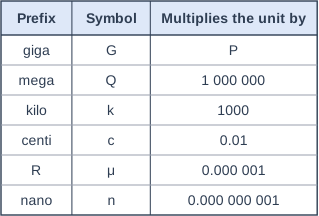
Anwen is making a revision card about the prefixes used in front of SI units. The table shows her card. It has three gaps, labelled P, Q and R.

What should Anwen write in each gap?

Table with columns "Prefix", "Symbol", "Multiplies the unit by". Prefix: giga; Symbol: G; Multiplies the unit by: P | Prefix: mega; Symbol: Q; Multiplies the unit by: 1 000 000 | Prefix: kilo; Symbol: k; Multiplies the unit by: 1000 | Prefix: centi; Symbol: c; Multiplies the unit by: 0.01 | Prefix: R; Symbol: μ; Multiplies the unit by: 0.000 001 | Prefix: nano; Symbol: n; Multiplies the unit by: 0.000 000 001.

Model answer

P: 1 000 000 000 (10⁹)
Q: M
R: micro

Explanation

Each prefix multiplies the unit by a power of ten: giga 10⁹, mega 10⁶, kilo 10³, centi 10⁻², milli 10⁻³, micro 10⁻⁶ and nano 10⁻⁹. Capital and small letters matter: M is mega (a million) but m is milli (a thousandth). Micro has the Greek letter μ as its symbol.

Mark scheme
  1. 1 mark

    P: 1 000 000 000 / 10⁹

    accept 1 × 10⁹ / one thousand million / one billion / 10 to the power 9. Do not accept 1 000 000 (10⁶) or 1 000 000 000 000 (10¹²).

  2. 1 mark

    Q: M

    The capital letter is needed: do not accept m (a lower-case m is the symbol for milli).

  3. 1 mark

    R: micro

    accept any recognisable spelling, e.g. mikro. Do not accept milli or nano.

Question 4

4 marks

A TV programme is sent from a transmitter on the ground to a satellite as a microwave signal. The satellite then sends the signal back down to a satellite dish on a house.

The signal travels 3.6 × 10⁷ m up to the satellite and then 3.6 × 10⁷ m back down to the dish. Microwaves travel at 3.0 × 10⁸ m/s.

Calculate the total time taken for the signal to travel from the transmitter to the dish. Give your answer in milliseconds (ms).

Use the equation

distance travelled = speed × time

Model answer

total distance = 3.6 × 10⁷ + 3.6 × 10⁷ = 7.2 × 10⁷ m
time = distance ÷ speed = 7.2 × 10⁷ ÷ 3.0 × 10⁸ = 0.24 s
0.24 s × 1000 = 240 ms

Explanation

Rearrange distance = speed × time to give time = distance ÷ speed, and remember that the signal makes two trips, up and then down. Enter the standard-form numbers with the EXP key so that the powers of ten are handled correctly. Finally, multiply by 1000 to change seconds into milliseconds.

Mark scheme
  1. 1 mark

    total distance = 2 × 3.6 × 10⁷ = 7.2 × 10⁷ (m); or a correct final answer of 240 ms with no working

    An answer of 240 ms with no working scores 4 marks. An answer of 0.24 s (not changed into ms) scores 3 marks. Using only one distance (3.6 × 10⁷ m) gives 0.12 s and 120 ms and scores 3 marks (marking points 2, 3 and 4 by ecf). Dividing the speed by the distance (3.0 × 10⁸ ÷ 7.2 × 10⁷ = 4.2) scores marking point 1 only.

  2. 1 mark

    rearrangement and substitution: (time =) 7.2 × 10⁷ ÷ 3.0 × 10⁸; or a correct final answer of 240 ms with no working

    allow (3.6 × 10⁷ ÷ 3.0 × 10⁸) × 2, or 3.6 × 10⁷ ÷ 3.0 × 10⁸ (one distance only), for this mark.

  3. 1 mark

    (time =) 0.24 (s) / 2.4 × 10⁻¹ (s); or a correct final answer of 240 ms with no working

    ecf from their distance.

  4. 1 mark

    evaluation: 240 (ms)

    accept 2.4 × 10² (ms). ecf their time in s × 1000.

Ready to try the rest? Every answer you write is marked against the mark scheme, so you can see exactly where the marks are.

Study Helper Hints first, answers after you try

Stuck on this one? Ask for a hint and I’ll point you in the right direction, without giving the answer away. Once you’ve checked your answer, I’ll show you how the marks are awarded.