
Level:
Correct: 0
Incorrect: 0
Marks: 0/0
Exam Practice
Course:
Topics:
Avg
score:
–
Topics
done:
0/24

Energy resources

Practise 15 exam-style questions on Energy resources for Edexcel GCSE Combined Science (Foundation Physics Paper 1). Write your answer as you would in the exam and get it marked in seconds against the mark scheme, point by point, with the Study Helper on hand if you get stuck.

  • 15 questions
  • 1–6 marks each
  • Instant marking
  • No sign-up needed
15 questions, marked as you go

Sample questions with model answers

Here are 4 of the questions in this topic, each with a model answer, an explanation of why it earns the marks and the mark scheme an examiner would use.

Question 1

1 mark

Which of these energy resources releases carbon dioxide when it is used to generate electricity?

Choose your answer.

  • A wind
  • B natural gas
  • C hydro-electricity
  • D nuclear fuel

Model answer

B (natural gas)

Explanation

Fossil fuels (coal, oil and natural gas) release carbon dioxide when they are burned, and bio-fuels do too. Wind, hydro-electricity, tides, the Sun and nuclear fuel release no carbon dioxide while generating electricity. A common error is to think nuclear power stations release carbon dioxide: the clouds from their cooling towers are water vapour.

Mark scheme
  1. 1 mark

    B / natural gas

    The only correct answer is B: natural gas is a fossil fuel, and burning it releases carbon dioxide. A is not correct because wind turbines burn no fuel. C is not correct because hydro-electric power stations use moving water and burn no fuel. D is not correct because nuclear fuel is not burned, so no carbon dioxide is released while it generates electricity. Accept the letter or the option. If more than one option is given, do not award the mark.
Question 2

2 marks

A tidal stream turbine is like an underwater wind turbine. It is turned by the water that flows past it as the tide comes in and goes out.

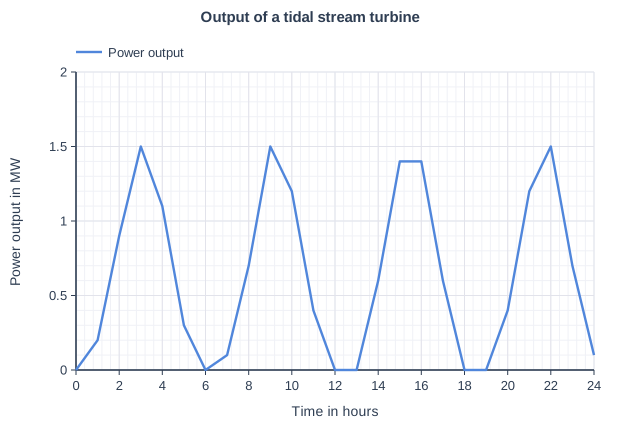
The graph shows an engineer's measurements of the power output of one tidal stream turbine over one day.

Describe the pattern shown by the graph.

Explain why the engineer can predict the output of the turbine for any day weeks in advance.

Output of a tidal stream turbine. Line graph of Power output in MW (y-axis, 0 to 2) against time in hours (x-axis, 0 to 24). "Power output" joins the points (0, 0), (1, 0.2), (2, 0.9), (3, 1.5), (4, 1.1), (5, 0.3), (6, 0), (7, 0.1), (8, 0.7), (9, 1.5), (10, 1.2), (11, 0.4), (12, 0), (13, 0), (14, 0.6), (15, 1.4), (16, 1.4), (17, 0.6), (18, 0), (19, 0), (20, 0.4), (21, 1.2), (22, 1.5), (23, 0.7), (24, 0.1).

Model answer

The output rises to a peak and falls back to zero about four times a day, with a peak about every six hours.

The tides follow a regular pattern, so the times of the tides, and so the times when the water flows fastest, are known weeks in advance.

Explanation

The water flows fastest halfway between high and low tide and stops briefly at high and low tide, so the output peaks twice for each tide coming in and going out. Tides are regular and do not depend on the weather, so the output is predictable, even though it is not constant. Compare this with wind, which cannot be predicted weeks ahead.

Mark scheme
  1. 1 mark

    the output rises and falls (to zero) about four times a day / there are four peaks in a day, about every six hours

    allow 'the output goes up and down regularly / repeats' with a reference to zero output or to the number or spacing of the peaks, e.g. 'peaks at about 3, 9, 15 and 22 hours'. Ignore 'the output varies' on its own.

  2. 1 mark

    the times (and heights) of the tides are known in advance / the tides follow a regular, predictable pattern, so the flow of water can be predicted

    allow 'tides do not depend on the weather'. Do not accept 'the tide is always the same height' or 'the tides are constant'.

Question 3

3 marks

Describe how a hydro-electric power station generates electricity.

Model answer

A dam holds back a large amount of water in a reservoir high up, so the water has energy in its gravitational potential energy store. When the water is released, it flows down through pipes and speeds up. The fast-moving water turns a turbine, and the turbine turns a generator, which generates electricity.

Explanation

Describe the steps in order: water stored high up, water flowing down and speeding up, water turning the turbine, turbine turning the generator. Hydro-electricity is renewable because rain keeps refilling the reservoir. A common error is to leave out the turbine and say the water turns the generator directly.

Mark scheme
  1. 1 mark

    water is stored (behind a dam) in a reservoir high up / at a height (in the gravitational potential energy store of the water)

    Any three from marking points 1 to 4; max 3. allow 'a dam is built across a river to hold back water'.

  2. 1 mark

    the water flows down (through pipes) / falls to a lower level, so it moves fast (its kinetic store increases)

    allow 'the water is released and flows downhill'.

  3. 1 mark

    the moving water turns a turbine

    allow 'water spins the turbines'. Do not accept 'the water turns the generator directly' for this point.

  4. 1 mark

    the turbine turns / drives a generator (which generates the electricity)

    The generator must be linked to the turbine.

Question 4

4 marks

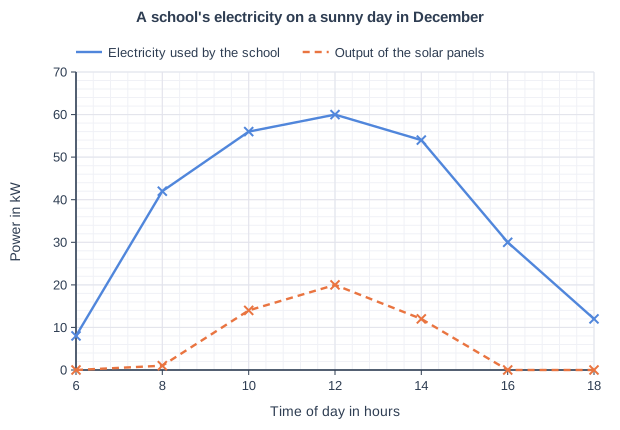
A school has solar panels on its roof. The graph shows the power output of the solar panels and the electrical power used by the school during one sunny day in December.

(Data recorded by the school)

Use the graph to calculate the percentage of the school's electricity supplied by the solar panels at 12:00 (12 hours).

Explain why the school still needs electricity from the National Grid, and suggest how the output of the solar panels would be different on a sunny day in June.

A school's electricity on a sunny day in December. Line graph of power in kW (y-axis, 0 to 70) against time of day in hours (x-axis, 6 to 18). "Electricity used by the school" joins the points (6, 8), (8, 42), (10, 56), (12, 60), (14, 54), (16, 30), (18, 12). "Output of the solar panels" (dashed) joins the points (6, 0), (8, 1), (10, 14), (12, 20), (14, 12), (16, 0), (18, 0).

Model answer

percentage = 20 ÷ 60 × 100
percentage = 33%

The solar panels never supply all the electricity the school uses: even at midday they supply only a third of it, and before 8:00 and after 16:00 they supply none because it is dark. So the rest must come from the National Grid.

On a sunny day in June the output would be greater and would last for more hours, because the days are longer and the Sun is higher in the sky.

Explanation

Read both values at 12 hours (20 kW from the panels and 60 kW used), divide and multiply by 100. The pattern shows that solar output depends on daylight: it is zero in the dark and greatest around midday. In summer the days are longer and the Sun is higher, so the output is greater, but the school would still need the National Grid at night and on dull days.

Mark scheme
  1. 1 mark

    substitution: 20 ÷ 60 × 100; or a correct final answer of 33% with no working

    An answer of 33% (allow 33.3% or one third) with no working scores marking points 1 and 2. 60 ÷ 20 × 100 = 300% scores 0. An answer of 0.33 scores marking point 1 only.

  2. 1 mark

    evaluation: 33 (%)

    accept 33.3 or 33.

  3. 1 mark

    the output of the panels is always less than the power used by the school / the panels produce nothing early in the morning and late in the afternoon (when it is dark), so the rest must come from the National Grid

    allow 'the panels cannot supply all the electricity the school uses'. allow 'no output at night or in cloudy weather'.

  4. 1 mark

    in June the output would be greater / the panels would produce electricity for more hours (because the days are longer and the Sun is higher in the sky)

    allow 'the graph of output would be higher and wider'. Ignore 'it would be sunnier' on its own.

Ready to try the rest? Every answer you write is marked against the mark scheme, so you can see exactly where the marks are.

Study Helper Hints first, answers after you try

Stuck on this one? Ask for a hint and I’ll point you in the right direction, without giving the answer away. Once you’ve checked your answer, I’ll show you how the marks are awarded.