Level:
Correct: 0
Incorrect: 0
Marks: 0/0
Exam Practice
Course:
Topics:
Avg
score:
–
Topics
done:
0/24

The electromagnetic spectrum

Practise 14 exam-style questions on The electromagnetic spectrum for Edexcel GCSE Combined Science (Foundation Physics Paper 1). Write your answer as you would in the exam and get it marked in seconds against the mark scheme, point by point, with the Study Helper on hand if you get stuck.

  • 14 questions
  • 1–6 marks each
  • Instant marking
  • No sign-up needed
14 questions, marked as you go

Sample questions with model answers

Here are 4 of the questions in this topic, each with a model answer, an explanation of why it earns the marks and the mark scheme an examiner would use.

Question 1

1 mark

In the electromagnetic spectrum, ultraviolet is next to visible light.

Which colour of visible light is ultraviolet next to?

Choose your answer.

  • A violet
  • B red
  • C green
  • D yellow

Model answer

A

Explanation

The visible spectrum runs from red (longest wavelength) to violet (shortest wavelength). Infrared lies just beyond the red end and ultraviolet just beyond the violet end, which is how the two groups got their names. A common error is to mix up infrared and ultraviolet.

Mark scheme
  1. 1 mark

    A / violet

    The only correct answer is A: ultraviolet means 'beyond violet'; it has a shorter wavelength and higher frequency than violet light, the last colour at that end of the visible spectrum. B is not correct because red is at the other end of the visible spectrum, next to infrared; C and D are not correct because green and yellow are in the middle of the visible spectrum, not at an end. Accept the letter or the option. If more than one option is given, do not award the mark.

Question 2

2 marks

The diagram shows the electromagnetic spectrum. Three of the groups are labelled P, Q and R.

Which of the labelled groups, P, Q or R:
- has the highest frequency
- can be detected by our eyes?

The electromagnetic spectrum drawn as a row of seven boxes, from left to right: box 1: radio waves; box 2 is labelled P; box 3: infrared; box 4 is labelled Q; box 5: ultraviolet; box 6 is labelled R; box 7: gamma rays.

Model answer

Highest frequency: R
Detected by our eyes: Q

Explanation

The frequency increases from the radio-wave end to the gamma-ray end, so of the three labelled groups R (X-rays) has the highest frequency. Q lies between infrared and ultraviolet, so it is visible light, the only part of the spectrum our eyes can detect. P is microwaves.

Mark scheme
  1. 1 mark

    highest frequency: R

    accept 'R (X-rays)'. Do not accept 'gamma rays' (not one of P, Q and R). If more than one letter is given for this part, do not award the mark.

  2. 1 mark

    detected by our eyes: Q

    accept 'Q (visible light)'. If more than one letter is given for this part, do not award the mark.

Question 3

2 marks

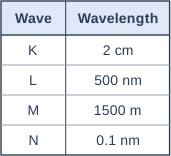
The table shows the wavelengths of four electromagnetic waves, K, L, M and N.

Write the letters of the four waves in order of increasing frequency, starting with the lowest frequency.

Table with columns "Wave", "Wavelength". Wave: K; Wavelength: 2 cm | Wave: L; Wavelength: 500 nm | Wave: M; Wavelength: 1500 m | Wave: N; Wavelength: 0.1 nm.

Model answer

M, K, L, N

Explanation

The lowest frequency goes with the longest wavelength. Put the wavelengths in the same units first: 1500 m (M) is longest, then 2 cm = 0.02 m (K), then 500 nm (L), then 0.1 nm (N). A common error is to compare only the numbers and ignore the units, which would put 1500 m and 500 nm next to each other.

Mark scheme
  1. 2 marks

    M, K, L, N

    2 marks for M, K, L, N. 1 mark for N, L, K, M (correct order but starting with the highest frequency) or for an order with only one pair of neighbouring waves swapped (e.g. K, M, L, N or M, L, K, N). 0 marks otherwise.

Question 4

4 marks

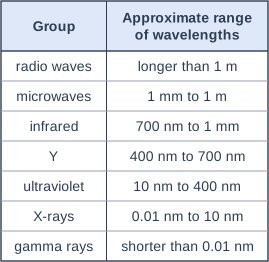
The table shows the approximate range of wavelengths for each group of the electromagnetic spectrum. One group is labelled Y.

1 nm = 0.000 000 001 m

Name group Y and describe how the wavelength changes from radio waves to gamma rays. Use the table to explain why the electromagnetic spectrum is described as continuous. Then suggest why radiation with a wavelength of 10 nm could be called either ultraviolet or X-rays.

Table with columns "Group", "Approximate range of wavelengths". Group: radio waves; Approximate range of wavelengths: longer than 1 m | Group: microwaves; Approximate range of wavelengths: 1 mm to 1 m | Group: infrared; Approximate range of wavelengths: 700 nm to 1 mm | Group: Y; Approximate range of wavelengths: 400 nm to 700 nm | Group: ultraviolet; Approximate range of wavelengths: 10 nm to 400 nm | Group: X-rays; Approximate range of wavelengths: 0.01 nm to 10 nm | Group: gamma rays; Approximate range of wavelengths: shorter than 0.01 nm.

Model answer

Y is visible light.
The wavelength gets shorter from radio waves (longer than 1 m) to gamma rays (shorter than 0.01 nm).
In the table each range of wavelengths starts exactly where the previous one ends, for example infrared ends at 700 nm and visible light starts at 700 nm. There are no gaps, so no wavelengths are missing: the spectrum is continuous.
10 nm is the boundary between ultraviolet and X-rays. The groups merge into each other with no sharp dividing line, so radiation near 10 nm could be given either name.

Explanation

Group Y sits between infrared and ultraviolet, so it is visible light, and the table shows the wavelength falling steadily from radio waves to gamma rays. The seven groups are just names for parts of one continuous spectrum: the ranges join with no gaps. The boundaries are only approximate (different sources give slightly different values), so radiation near a boundary, such as 10 nm, can belong to either group.

Mark scheme
  1. 1 mark

    Y is visible light

    accept 'light' / 'visible'. Do not accept a single colour.

  2. 1 mark

    the wavelength decreases / gets shorter from radio waves to gamma rays

    accept 'radio waves have the longest wavelength and gamma rays the shortest'. Do not accept 'the wavelength gets smaller and the frequency gets lower'.

  3. 1 mark

    there are no gaps between the ranges / each range starts where the one before it ends (e.g. ultraviolet ends at 10 nm and X-rays start at 10 nm), so no wavelengths are missing

    accept 'the ranges join up with no gaps' / 'it covers every wavelength from radio waves to gamma rays'. Do not accept 'it goes on for ever' or 'it never stops'.

  4. 1 mark

    10 nm is at the boundary between ultraviolet and X-rays / is where the ultraviolet range ends and the X-ray range starts / the groups merge into each other / there is no sharp dividing line between groups

    accept 'the groups overlap' / 'the boundaries between groups are not exact / are only approximate' / 'different books or scientists put the boundary at different wavelengths' / '10 nm is in both ranges in the table'. Do not accept 'it is both at the same time' with no reference to a boundary or to the ranges.

Ready to try the rest? Every answer you write is marked against the mark scheme, so you can see exactly where the marks are.

Study Helper Hints first, answers after you try

Stuck on this one? Ask for a hint and I’ll point you in the right direction, without giving the answer away. Once you’ve checked your answer, I’ll show you how the marks are awarded.