Practise 16 exam-style questions on Dangers and uses of electromagnetic radiation for Edexcel GCSE Combined Science (Foundation Physics Paper 1). Write your answer as you would in the exam and get it marked in seconds against the mark scheme, point by point, with the Study Helper on hand if you get stuck.
16 questions
1–6 marks each
Instant marking
No sign-up needed
16 questions, marked as you go
Sample questions with model answers
Here are 4 of the questions in this topic, each with a model answer, an explanation of why it earns the marks and the mark scheme an examiner would use.
Question 1
1 mark
Gamma rays are produced by changes in one part of an atom.
Name this part of the atom.
Model answer
The nucleus.
Explanation
Changes in atoms and in their nuclei can generate electromagnetic radiation over a wide range of frequencies. Gamma rays come from changes in the nucleus of an unstable atom. Light and ultraviolet come from changes involving the electrons around the nucleus.
Mark scheme
1 mark
the nucleus
accept 'nuclei' / 'the centre of the atom (the nucleus)' / 'the protons and neutrons in the nucleus'. Do not accept 'electrons', 'electron shells' or 'the outside of the atom'.
Question 2
2 marks
A television remote control sends signals to the television using infrared.
Explain why X-rays would not be a sensible choice for sending these signals.
Model answer
X-rays have a much higher frequency than infrared. The potential danger of electromagnetic radiation increases with frequency, so X-rays could cause mutations or damage to the cells of people in the room every time the remote control was used. The low-frequency infrared from a remote control does not harm people.
Explanation
Link the danger to the frequency: the higher the frequency, the greater the potential danger. X-rays are near the high-frequency end of the spectrum and can damage or mutate cells inside the body, so they are never used where people would be exposed every day. Answers that say only 'X-rays are dangerous' need to say why or to whom.
Mark scheme
1 mark
X-rays have a (much) higher frequency than infrared
accept 'X-rays have a shorter wavelength (and higher frequency)' / 'infrared has a lower frequency' (ORA).
1 mark
so X-rays have a greater potential danger: they could cause mutation of / damage to cells of people in the room
accept 'X-rays could cause cancer in people using the remote' / 'X-rays are harmful to people, but infrared from a remote is not'. Do not accept 'X-rays are dangerous' with no reference to people or cells.
Question 3
2 marks
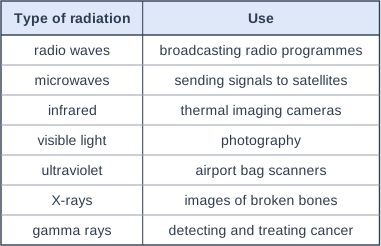
Alfie made a table to show one use of each type of electromagnetic radiation. One of the uses in his table is wrong.
Identify the type of radiation with the wrong use, and give a correct use for that type of radiation.
Model answer
Ultraviolet is wrong: airport bag scanners use X-rays. A correct use of ultraviolet is detecting forged bank notes.
Explanation
Check each row against what you know: all the other uses are correct, but airport bag scanners use X-rays, which pass through the bags. Ultraviolet is used for security marking, fluorescent lamps, detecting forged bank notes and disinfecting water.
Mark scheme
1 mark
ultraviolet
accept 'UV' / 'the ultraviolet row'. If more than one type is given, do not award either mark.
1 mark
a correct use of ultraviolet: security marking / fluorescent lamps / detecting forged bank notes / disinfecting water
One mark for any one correct use. accept 'sunbeds' / 'tanning' / 'checking for invisible ink'. Do not accept 'airport scanners', 'thermal imaging' or 'sterilising food'.
Question 4
4 marks
Leo cooks a large potato in a microwave oven. It is cooked all the way through in 8 minutes.
He cooks a potato of the same size under an infrared grill. It takes about 40 minutes, and the skin becomes brown and crisp long before the middle is cooked.
Explain the difference.
Model answer
Microwaves pass into the potato, below its surface, so the inside of the potato absorbs them and is heated directly. Infrared from the grill is absorbed by the surface of the potato. The outside gets very hot and turns brown, but the middle is heated only slowly, by conduction from the outside, so it takes much longer to cook.
Explanation
This is the same difference as in the harmful effects of the two radiations: microwaves cause internal heating of body cells, while infrared is absorbed at the surface and causes skin burns. A common error is to say that microwaves travel faster than infrared; all electromagnetic waves have the same speed.
Mark scheme
1 mark
microwaves pass into / penetrate (below the surface of) the potato
accept 'microwaves go inside the food' / 'microwaves are not all absorbed at the surface'. Ignore any depth given (e.g. 'about 1 cm' or 'a few centimetres').
1 mark
so the inside of the potato absorbs the microwaves and is heated directly / microwaves cause internal heating
accept 'water inside the potato absorbs the microwaves' / 'the whole potato heats up at once'.
1 mark
infrared is absorbed by the surface / skin of the potato
accept 'infrared only heats the outside' / 'infrared does not penetrate far into the potato'. Do not accept 'infrared does not heat the potato'.
1 mark
so the outside gets very hot (and browns), and the middle is heated only slowly, by conduction from the outside
accept 'energy has to be conducted / transferred slowly to the middle' / 'the potato is a poor (thermal) conductor, so energy reaches the middle slowly'. Do not accept 'infrared is weaker' or 'microwaves are faster' (all electromagnetic waves travel at the same speed).
Ready to try the rest? Every answer you write is marked against the mark scheme, so you can see exactly where the marks are.
Ctrl + Enter to check
Study HelperHints first, answers after you try
Stuck on this one? Ask for a hint and I’ll point you in the right direction, without giving the answer away. Once you’ve checked your answer, I’ll show you how the marks are awarded.