
Level:
Correct: 0
Incorrect: 0
Marks: 0/0
Exam Practice
Course:
Topics:
Avg
score:
–
Topics
done:
0/24

Atoms, isotopes and ions

Practise 16 exam-style questions on Atoms, isotopes and ions for Edexcel GCSE Combined Science (Foundation Physics Paper 1). Write your answer as you would in the exam and get it marked in seconds against the mark scheme, point by point, with the Study Helper on hand if you get stuck.

  • 16 questions
  • 1–6 marks each
  • Instant marking
  • No sign-up needed
16 questions, marked as you go

Sample questions with model answers

Here are 4 of the questions in this topic, each with a model answer, an explanation of why it earns the marks and the mark scheme an examiner would use.

Question 1

1 mark

Very small lengths are often given in nanometres (nm).

1 nm = 1 × 10⁻⁹ m

Which of these is closest to the size of a small molecule, such as a water molecule?

Choose your answer.

  • A 0.0003 nm
  • B 0.3 nm
  • C 30 nm
  • D 3000 nm

Model answer

B - 0.3 nm.

Explanation

Atoms are about 1 × 10⁻¹⁰ m (0.1 nm) across, and small molecules such as water, which contain only a few atoms, have the same order of magnitude: 0.3 nm is 3 × 10⁻¹⁰ m. To change nanometres to metres, multiply by 10⁻⁹. A common mistake is to think a molecule is as big as a bacterium or a virus, which contain many millions of atoms.

Mark scheme
  1. 1 mark

    B / 0.3 nm

    The only correct answer is B: 0.3 nm = 3 × 10⁻¹⁰ m, and atoms and small molecules have sizes with an order of magnitude of 10⁻¹⁰ m. A is not correct because 0.0003 nm = 3 × 10⁻¹³ m, far smaller than an atom (an atom is about 0.1 nm across); C is not correct because 30 nm = 3 × 10⁻⁸ m, about the size of a small virus, 100 times bigger than a small molecule; D is not correct because 3000 nm = 3 × 10⁻⁶ m, about the size of a bacterium. Accept the letter or the option. If more than one option is given, do not award the mark.
Question 2

2 marks

Ellie says: 'A positron is the same as a proton, because they both have a relative charge of +1.'

Explain why Ellie is wrong.

Model answer

A positron has a much smaller mass than a proton. The relative mass of a positron is about 1/1836, the same as an electron, but the relative mass of a proton is 1. So a positron is like a positive electron, not a proton, even though both have a relative charge of +1.

Explanation

Particles are described by their mass as well as their charge. A proton and a positron have the same charge (+1), but a proton is about 1836 times heavier: a positron has the same tiny mass as an electron. Protons are in every nucleus, but positrons are only given out by some unstable nuclei.

Mark scheme
  1. 1 mark

    a positron has a much smaller mass than a proton / the relative mass of a positron is about 1/1836 but the relative mass of a proton is 1

    Any two of the three marking points; max 2. Accept a relative mass for the positron of 1/1836, 1/2000, 0.0005 or 'negligible / almost zero'. Accept 'a proton is about 1836 (about 2000) times heavier than a positron'. Do not accept 'a positron has no mass'.

  2. 1 mark

    a positron has the same mass as an electron / a positron is like a positive electron

    Accept 'a positron has the mass of an electron but a positive charge'.

  3. 1 mark

    protons are found in the nucleus of every atom, but positrons are not found in atoms / positrons are emitted by some unstable nuclei

    Accept 'positrons are a type of nuclear radiation (β+)'. Do not accept 'positrons orbit the nucleus'.

Question 3

3 marks

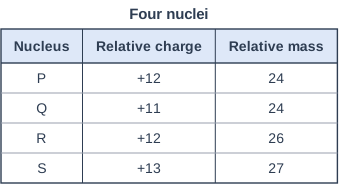
The table shows the relative charge and the relative mass of four different nuclei, P, Q, R and S.

Give the letters of the two nuclei that are isotopes of the same element.

Explain your answer. Use the data in the table.

Four nuclei. Table with columns "Nucleus", "Relative charge", "Relative mass". Nucleus: P; Relative charge: +12; Relative mass: 24 | Nucleus: Q; Relative charge: +11; Relative mass: 24 | Nucleus: R; Relative charge: +12; Relative mass: 26 | Nucleus: S; Relative charge: +13; Relative mass: 27.

Model answer

P and R.
They both have a relative charge of +12, so each nucleus has 12 protons. This means they are nuclei of the same element.
Their relative masses are different (24 and 26). So R has 2 more neutrons than P: P has 24 − 12 = 12 neutrons and R has 26 − 12 = 14 neutrons.
Same number of protons but different numbers of neutrons means they are isotopes.

Explanation

The charge of a nucleus comes only from its protons, and each element has its own number of protons, so nuclei with the same charge belong to the same element. Isotopes of that element differ in mass because they have different numbers of neutrons. Q has the same mass as P but a different charge (+11), so it is a different element: a common mistake is to choose P and Q because their masses match.

Mark scheme
  1. 1 mark

    P and R

    Both letters are needed for this mark. Marking points 2 and 3 can be awarded for correct statements about P and R even if this mark is not awarded.

  2. 1 mark

    (P and R) have the same (relative) charge, +12, so they have the same number of protons (12) / so they are nuclei of the same element

    Accept 'same atomic number' or 'the nucleus of each element has its own charge, and P and R both have +12'. Do not accept 'same number of electrons' (these are nuclei).

  3. 1 mark

    (P and R) have different (relative) masses, 24 and 26, so they have different numbers of neutrons (12 and 14)

    Accept 'R has two more neutrons than P'. Do not accept 'different numbers of protons' or 'different numbers of electrons'.

Question 4

4 marks

A teacher uses a ball on a staircase as a model of how an electron behaves in an atom.

- The ball stands for an electron.
- Each step stands for one of the set distances from the nucleus at which an electron can orbit. The higher the step, the further the orbit is from the nucleus.
- The ball can rest on any step, but never between two steps.

Explain how this model can be used to show what happens to an electron when an atom absorbs electromagnetic radiation and when an atom emits electromagnetic radiation.

Give one way in which the model does not behave like an electron in a real atom.

Model answer

The ball can rest only on a step and never between two steps. This shows that an electron can only orbit at set distances from the nucleus.
When an atom absorbs electromagnetic radiation, the electron moves to an orbit further from the nucleus. In the model, the ball is lifted up to a higher step.
When an atom emits electromagnetic radiation, the electron moves back to an orbit closer to the nucleus. In the model, the ball drops down to a lower step.
The model does not behave like a real atom because the electrons in an atom keep moving around the nucleus, but the ball stays still on its step.

Explanation

In this model, the height of a step stands for the distance of an orbit from the nucleus. When an atom absorbs electromagnetic radiation an electron moves out to an orbit further from the nucleus (up the stairs), and the atom emits electromagnetic radiation when the electron moves back closer to the nucleus (down the stairs). Common mistakes are mixing up absorbing and emitting, saying the electron can stop between orbits, and giving a difference in size rather than in behaviour.

Mark scheme
  1. 1 mark

    the ball resting only on a step (never between steps) shows that an electron can only orbit at set distances from the nucleus / can only be in certain orbits

    Mark each point independently. Accept 'electrons can only be in certain energy levels / shells'. Do not accept 'the steps are the orbits' on its own: the idea that the electron (ball) can only be at these set distances is needed.

  2. 1 mark

    when the atom absorbs electromagnetic radiation, the electron moves to an orbit further from the nucleus / the ball is moved up to a higher step

    The link to absorbing and the direction are both needed. Accept 'the electron moves to a higher (outer) orbit or energy level' or 'the ball goes up the stairs'. Do not accept 'the electron moves to a different orbit' without the direction. Do not accept 'the electron leaves the atom'.

  3. 1 mark

    when the atom emits electromagnetic radiation, the electron moves (back) to an orbit closer to the nucleus / the ball drops down to a lower step

    The link to emitting and the direction are both needed. Accept 'the electron moves to a lower (inner) orbit or energy level' or 'the ball falls down the stairs'. If absorbing and emitting are the wrong way round, award neither marking point 2 nor marking point 3.

  4. 1 mark

    one way the model does not behave like an electron in an atom

    1 mark for any one of: the electrons in a real atom move (orbit) around the nucleus all the time, but the ball stays still on its step; an electron is held by its attraction to the positive nucleus (an electric force), but the ball is held on the step by gravity; when the ball drops it transfers energy by sound or by heating the step, but when an electron moves closer to the nucleus the atom emits electromagnetic radiation; the ball moves only up and down one staircase, but electrons orbit the nucleus in all directions. Credit other valid differences in behaviour. Ignore answers about size or appearance only (for example 'a ball is much bigger than an electron').

Ready to try the rest? Every answer you write is marked against the mark scheme, so you can see exactly where the marks are.

Study Helper Hints first, answers after you try

Stuck on this one? Ask for a hint and I’ll point you in the right direction, without giving the answer away. Once you’ve checked your answer, I’ll show you how the marks are awarded.