
Level:
Correct: 0
Incorrect: 0
Marks: 0/0
Exam Practice
Course:
Topics:
Avg
score:
–
Topics
done:
0/24

Core practical: waves in a solid and a fluid

Practise 15 exam-style questions on Core practical: waves in a solid and a fluid for Edexcel GCSE Combined Science (Foundation Physics Paper 1). Write your answer as you would in the exam and get it marked in seconds against the mark scheme, point by point, with the Study Helper on hand if you get stuck.

  • 15 questions
  • 1–6 marks each
  • Instant marking
  • No sign-up needed
15 questions, marked as you go

Sample questions with model answers

Here are 4 of the questions in this topic, each with a model answer, an explanation of why it earns the marks and the mark scheme an examiner would use.

Question 1

1 mark

A student strikes one end of a metal rod with a small hammer. The rod makes a ringing sound with a frequency of a few thousand hertz.

Which is the most suitable way to measure the frequency of this sound?

Choose your answer.

  • A count the vibrations in 10 s with a stopwatch
  • B measure the length of the rod with a metre rule
  • C use a frequency app on a phone held near the rod
  • D connect a signal generator to the rod

Model answer

C (use a frequency app on a phone held near the rod)

Explanation

The sound from a struck metal rod has a frequency of thousands of hertz, far too high to count. A microphone connected to a frequency meter, an oscilloscope or a phone app is needed. The length of the rod is also measured, but that is used to find the wavelength, not the frequency.

Mark scheme
  1. 1 mark

    C / use a frequency app on a phone held near the rod

    The only correct answer is C: the app picks up the sound with the phone's microphone and shows its frequency directly. A is not correct because thousands of vibrations each second are far too many to count by eye or ear; B is not correct because the length of the rod gives the wavelength, not the frequency; D is not correct because the rod's frequency is set by the rod itself when it is struck, not by a signal generator (a signal generator sets the frequency of a vibrator, as in a ripple tank). Accept the letter or the option. If more than one option is given, do not award the mark.
Question 2

2 marks

The vibrating bar of a ripple tank is connected to a signal generator. The display on the signal generator shows 6.0 Hz. The ripples have a wavelength of 3.5 cm.

Calculate the speed of the ripples. Give your answer in cm/s.

Model answer

wave speed = frequency × wavelength
v = 6.0 × 3.5 = 21 cm/s

Explanation

Use wave speed = frequency × wavelength (v = f × λ), which you need to remember. With the wavelength in cm, the speed comes out in cm/s, which is what the question asks for. The signal generator display gives the frequency directly, which is more precise than counting ripples.

Mark scheme
  1. 1 mark

    substitution: (v =) 6.0 × 3.5; or a correct final answer of 21 cm/s with no working

    An answer of 21 cm/s with no working scores 2 marks. 0.21 (converted to m/s although cm/s was asked for) scores marking point 1 only. 3.5 ÷ 6.0 = 0.58 or 6.0 ÷ 3.5 = 1.7 (wrong methods) score 0.

  2. 1 mark

    evaluation: 21 (cm/s)

    accept 21.0.

Question 3

3 marks

Seb strikes one end of a steel rod with a small hammer five times. Each time, he records the frequency of the sound shown by a frequency app on his phone.

2010 Hz   2035 Hz   2320 Hz   2045 Hz   2020 Hz

Identify the anomalous reading. Then calculate the mean frequency, leaving out the anomalous reading.

Model answer

The anomalous reading is 2320 Hz: it is much higher than the other four readings, which are all between 2010 Hz and 2045 Hz.
mean = (2010 + 2035 + 2045 + 2020) ÷ 4 = 8110 ÷ 4 = 2027.5 Hz (about 2030 Hz)

Explanation

An anomalous reading is one that does not fit the pattern of the others; here 2320 Hz is about 300 Hz higher than the rest, which agree to within 35 Hz. Leave it out, add the other four readings and divide by 4, not by 5. Including the anomaly gives 2086 Hz, which is higher than four of the five readings.

Mark scheme
  1. 1 mark

    2320 (Hz)

    An answer of 2027.5 Hz (or 2028 Hz or 2030 Hz) with no working scores marking points 2 and 3. 2086 Hz (the mean of all five readings, anomaly included) scores 0 for marking points 2 and 3.

  2. 1 mark

    (mean =) (2010 + 2035 + 2045 + 2020) ÷ 4 / 8110 ÷ 4; or a correct final answer of 2027.5 Hz (or 2028 Hz or 2030 Hz) with no working

    ecf: allow the mean of the four readings left after leaving out their anomalous reading.

  3. 1 mark

    evaluation: 2027.5 (Hz) / 2028 (Hz) / 2030 (Hz)

    Ignore units.

Question 4

4 marks

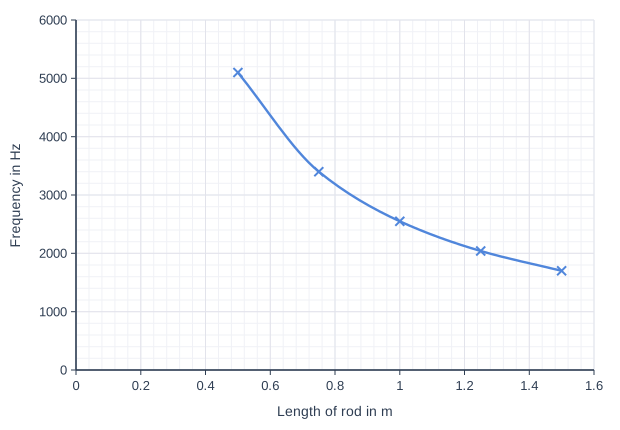
Rhodri investigates how the length of a rod affects the frequency of the sound it makes. He uses five aluminium rods, from 0.50 m to 1.50 m long. His results are plotted on the graph.

For each rod, the wavelength of the sound is twice the length of the rod. The speed of sound is the same in every aluminium rod.

Using the equation v = f × λ, explain why the frequency decreases as the length of the rod increases. Use data from the graph in your answer.

Line graph of Frequency in Hz (y-axis, 0 to 6000) against length of rod in m (x-axis, 0 to 1.6). The line is a smooth curve through (0.5, 5100), (0.75, 3400), (1, 2550), (1.25, 2040), (1.5, 1700).

Model answer

All the rods are aluminium, so the speed of sound is the same in every rod. The wavelength is twice the length, so a longer rod gives a longer wavelength. Since v = f × λ, the frequency = v ÷ λ, so if v stays the same and λ gets bigger, f must get smaller. The graph shows this: the 0.50 m rod gives 5100 Hz and the 1.00 m rod gives 2550 Hz, so doubling the length halves the frequency. For both rods, f × λ = 5100 × 1.00 = 2550 × 2.00 = 5100 m/s.

Explanation

The key idea is that the speed stays the same, so frequency and wavelength are linked: if one doubles the other halves. Good answers quote pairs of readings from the graph, such as 0.75 m and 1.50 m (3400 Hz and 1700 Hz). A common mistake is to say the sound travels more slowly in a longer rod: the speed depends on the metal, not the length.

Mark scheme
  1. 1 mark

    the speed of sound (v) is the same in every rod / is constant

    Max 3 if no data from the graph are used. accept 'all the rods are aluminium, so v does not change'.

  2. 1 mark

    a longer rod gives a longer wavelength (wavelength = 2 × length)

    accept 'the wavelength increases as the length increases'.

  3. 1 mark

    frequency = speed ÷ wavelength, so a longer wavelength gives a lower frequency / frequency and wavelength are inversely proportional (for a constant speed)

    accept 'f × λ stays the same, so if λ goes up, f must go down'.

  4. 1 mark

    use of data, e.g. doubling the length halves the frequency: 0.50 m gives 5100 Hz and 1.00 m gives 2550 Hz / 0.75 m gives 3400 Hz and 1.50 m gives 1700 Hz / f × 2 × length = 5100 m/s for each rod

    accept any correct pair of readings from the graph that shows the frequency falling as the length rises, e.g. 1.00 m: 2550 Hz and 1.50 m: 1700 Hz.

Ready to try the rest? Every answer you write is marked against the mark scheme, so you can see exactly where the marks are.

Study Helper Hints first, answers after you try

Stuck on this one? Ask for a hint and I’ll point you in the right direction, without giving the answer away. Once you’ve checked your answer, I’ll show you how the marks are awarded.