Practise 14 exam-style questions on Development of the atomic model for Edexcel GCSE Combined Science (Foundation Physics Paper 1). Write your answer as you would in the exam and get it marked in seconds against the mark scheme, point by point, with the Study Helper on hand if you get stuck.
14 questions
1–6 marks each
Instant marking
No sign-up needed
14 questions, marked as you go
Sample questions with model answers
Here are 4 of the questions in this topic, each with a model answer, an explanation of why it earns the marks and the mark scheme an examiner would use.
Question 1
1 mark
In 1913, Niels Bohr suggested a change to Rutherford's nuclear model of the atom.
Which idea did Bohr add to the model?
Choose your answer.
A electrons orbit the nucleus only at set distances
B the nucleus contains neutrons
C most of the atom is empty space
D atoms contain negative electrons
Model answer
A
Explanation
Bohr kept Rutherford's tiny positive nucleus but said that the electrons can only move in orbits at set distances from it, which are now called shells or energy levels. His calculations using this model agreed with measurements of the light given out by hydrogen atoms, so the model was accepted. Each wrong option is an idea from a different stage in the development of the model, so check who added which idea.
Mark scheme
1 mark
A / electrons orbit the nucleus only at set distances
The only correct answer is A: Bohr suggested that electrons can only orbit the nucleus at certain set distances (in shells or energy levels), not at any distance. B is not correct because neutrons were discovered later, by James Chadwick in 1932; C is not correct because Rutherford had already concluded from the alpha particle scattering experiment that most of the atom is empty space; D is not correct because electrons were discovered by J J Thomson in 1897 and were already part of the plum pudding model and the nuclear model. Accept the letter or the option. If more than one option is given, do not award the mark.
Question 2
2 marks
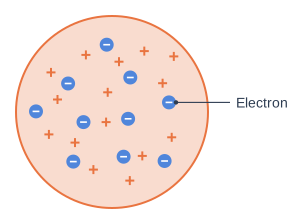
The diagram shows a model of the atom that scientists used in the early 1900s.
Name this model of the atom and the scientist who suggested it.
Model answer
This is the plum pudding model of the atom. It was suggested by J J Thomson.
Explanation
In the plum pudding model the atom is a ball of positive charge with negative electrons spread through it, like plums in a pudding, and there is no nucleus. J J Thomson suggested it in 1904, a few years after he discovered the electron. Do not confuse it with Rutherford's nuclear model, which has a tiny positive nucleus at the centre.
Mark scheme
1 mark
plum pudding (model)
Mark the two points independently. accept recognisable spellings. Do not accept nuclear model, Bohr model, Rutherford model or Dalton's model.
1 mark
(J J) Thomson
accept Thomson / J. J. Thomson / Joseph John Thomson; accept recognisable spellings, e.g. Thompson. Do not accept Rutherford, Bohr, Dalton, Geiger or Marsden.
Question 3
2 marks
When Bohr suggested his model of the atom in 1913, he did not throw away Rutherford's nuclear model. He kept most of its features.
Give two features of Rutherford's nuclear model that are also part of Bohr's model.
Model answer
Bohr kept the tiny nucleus at the centre of the atom, which contains the positive charge and most of the mass. He also kept the electrons outside the nucleus, moving around it, so most of the atom is still empty space.
Explanation
Bohr built on Rutherford's model rather than replacing it: the tiny, dense, positive nucleus and the mostly empty atom came from the alpha particle scattering evidence, so he kept them. What Bohr changed was where the electrons can be - only in orbits at set distances - so that is not a feature he kept. This is a good example of a model being improved step by step as new evidence appears.
Mark scheme
2 marks
Any two from: there is a nucleus at the centre of the atom; the nucleus is very small (compared with the atom); the nucleus is positively charged; the nucleus contains most of the mass of the atom; the electrons are outside the nucleus, moving around (orbiting) it; most of the atom is empty space
1 mark for each different feature, max 2. 'The nucleus is tiny and positive' counts as two features. Do not accept 'the electrons orbit at set distances / in shells' (this is the feature Bohr added, not one he kept from Rutherford's model), 'the nucleus contains neutrons' (neutrons were discovered later), 'positive charge spread through the atom' (plum pudding model), or vague answers such as 'both have electrons'.
Question 4
4 marks
A student writes: 'Rutherford's alpha particle scattering experiment proved that the plum pudding model was wrong. It also proved that his nuclear model was the correct and final model of the atom.'
Evaluate the student's statement.
Model answer
The student is partly right. The plum pudding model predicted that all the alpha particles would pass through the foil with only small deflections, but a few were deflected through large angles and a very few bounced back. The plum pudding model could not explain this, so it was replaced. The results were explained by Rutherford's nuclear model, so they supported it. However, the nuclear model was not final. In 1913, Bohr changed it by putting the electrons in orbits at set distances from the nucleus, and later the neutron was discovered in the nucleus. So the experiment gave strong evidence for the nuclear model, but it did not prove that the model was correct and final: scientific models can change when new evidence is found.
Explanation
In an evaluation, give the evidence on both sides and finish with a judgement. The experiment did show that the plum pudding model could not explain the results, but no experiment can prove that a model is final - Bohr's change in 1913 shows that models are improved when new evidence appears. Answers that only agree, or only disagree, cannot reach full marks.
Mark scheme
1 mark
the results (large deflections / alpha particles bouncing back) could not be explained by the plum pudding model, so it had to be replaced
Max 3 if the answer gives only one side (only reasons to agree or only reasons to disagree). Mark each point independently. accept the plum pudding model predicted that all the alpha particles would pass through with only small deflections, but a few were deflected through large angles / bounced back.
1 mark
the results were explained by / supported the nuclear model (with a tiny, positive nucleus)
accept the evidence fitted the nuclear model.
1 mark
but the nuclear model was changed later (for example by Bohr, who put the electrons in orbits at set distances, or when the neutron was discovered in the nucleus)
accept any later change to the nuclear model, e.g. Bohr's model, electrons in energy levels / shells, or the discovery of neutrons in the nucleus.
1 mark
judgement: the statement is not (fully) correct, because evidence supports a model but does not prove it is correct / final, and a model can change when new evidence is found
A judgement needs a reason (the idea that models can change with new evidence, or that evidence supports rather than proves); a judgement on its own scores 0. allow 'partly correct: the plum pudding model was shown to be wrong, but the nuclear model was not final'.
Ready to try the rest? Every answer you write is marked against the mark scheme, so you can see exactly where the marks are.
Ctrl + Enter to check
Study HelperHints first, answers after you try
Stuck on this one? Ask for a hint and I’ll point you in the right direction, without giving the answer away. Once you’ve checked your answer, I’ll show you how the marks are awarded.