
Level:
Correct: 0
Incorrect: 0
Marks: 0/0
Exam Practice
Course:
Topics:
Avg
score:
–
Topics
done:
0/24

Electromagnetic waves and the refraction core practical

Practise 15 exam-style questions on Electromagnetic waves and the refraction core practical for Edexcel GCSE Combined Science (Foundation Physics Paper 1). Write your answer as you would in the exam and get it marked in seconds against the mark scheme, point by point, with the Study Helper on hand if you get stuck.

  • 15 questions
  • 1–6 marks each
  • Instant marking
  • No sign-up needed
15 questions, marked as you go

Sample questions with model answers

Here are 4 of the questions in this topic, each with a model answer, an explanation of why it earns the marks and the mark scheme an examiner would use.

Question 1

1 mark

A student investigates refraction by shining a ray of light into a rectangular glass block.

The angle of refraction is measured between which two lines?

Choose your answer.

  • A the incident ray and the normal
  • B the refracted ray and the surface of the block
  • C the incident ray and the refracted ray
  • D the refracted ray and the normal

Model answer

D

Explanation

In ray diagrams every angle is measured from the normal, a line at 90° to the surface. The angle of incidence is between the incident ray and the normal; the angle of refraction is between the refracted ray and the normal. Measuring from the surface of the block is a common mistake.

Mark scheme
  1. 1 mark

    D / the refracted ray and the normal

    The only correct answer is D: the angle of refraction is the angle between the ray inside the block (the refracted ray) and the normal, the line drawn at 90° to the surface where the ray enters. A is not correct because that is the angle of incidence; B is not correct because angles are measured from the normal, not from the surface; C is not correct because the angle between the two rays is the change in direction of the ray, not the angle of refraction. Accept the letter or the option. If more than one option is given, do not award the mark.
Question 2

2 marks

The Lovell Telescope at Jodrell Bank in Cheshire is a radio telescope. It detects radio waves given out by distant galaxies.

All electromagnetic waves transfer energy from a source to an observer.

Identify the source and the observer of the radio waves in this example.

Model answer

The source is the distant galaxy, which gives out the radio waves. The observer is the radio telescope (the Lovell Telescope), which detects them.

Explanation

The source is whatever gives out the electromagnetic waves and the observer is whatever detects or absorbs them, so energy is carried from the galaxy across space to the telescope's dish. The radio waves are what carries the energy, so they are neither the source nor the observer.

Mark scheme
  1. 1 mark

    source: a (distant) galaxy / the stars or gas in a galaxy

    Do not accept 'the telescope', 'space' or 'the radio waves' as the source.

  2. 1 mark

    observer: the (radio) telescope / the Lovell Telescope / the dish or receiver of the telescope

    accept 'Jodrell Bank' / 'the scientists using the telescope'. Do not accept 'the Earth' on its own. If the source and observer are given the wrong way round, award 0.

Question 3

2 marks

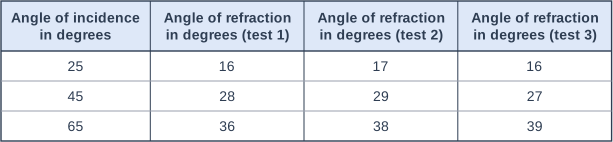
Hana did the refraction practical with a glass block. She took three readings of the angle of refraction for each of three angles of incidence, as shown in the table.

Calculate the mean angle of refraction for an angle of incidence of 65°.

Give your answer to 1 decimal place.

Table with columns "Angle of incidence in degrees", "Angle of refraction in degrees (test 1)", "Angle of refraction in degrees (test 2)", "Angle of refraction in degrees (test 3)". Angle of incidence in degrees: 25; Angle of refraction in degrees (test 1): 16; Angle of refraction in degrees (test 2): 17; Angle of refraction in degrees (test 3): 16 | Angle of incidence in degrees: 45; Angle of refraction in degrees (test 1): 28; Angle of refraction in degrees (test 2): 29; Angle of refraction in degrees (test 3): 27 | Angle of incidence in degrees: 65; Angle of refraction in degrees (test 1): 36; Angle of refraction in degrees (test 2): 38; Angle of refraction in degrees (test 3): 39.

Model answer

mean = (36 + 38 + 39) ÷ 3
mean = 113 ÷ 3 = 37.666...
mean = 37.7°

Explanation

Add the three readings for the 65° row and divide by the number of readings, 3. 113 ÷ 3 = 37.666..., which is 37.7° to 1 decimal place. Check that you use the readings from the correct row of the table, and round only at the end.

Mark scheme
  1. 1 mark

    (36 + 38 + 39) ÷ 3 / 113 ÷ 3; or a correct final answer of 37.7° with no working

    An answer of 37.7° with no working scores 2 marks. An answer of 37.67° or 37.666...° scores this mark only (not to 1 decimal place). An answer of 38° after correct working scores this mark only. 38° with no working (it is also the middle reading) or 113° (the total) scores 0.

  2. 1 mark

    37.7 (°)

    Must be given to 1 decimal place. Ignore units.

Question 4

4 marks

Tomasz has drawn round a glass block on paper. He shone a ray at the block and marked the ray going in and the ray coming out with crosses. He has now removed the block.

Describe how he should use a ruler and a protractor to find the angle of incidence and the angle of refraction.

Model answer

He should use the ruler to draw a straight line through the crosses of the incoming ray up to the outline, which shows where the ray entered the block. He draws a line through the crosses of the ray coming out back to the outline to find where it left. He joins these two points to show the ray inside the block. Then he uses the protractor to draw the normal at 90° to the surface where the ray entered. Finally he measures the angle between the incoming ray and the normal (angle of incidence) and the angle between the ray inside the block and the normal (angle of refraction).

Explanation

The ray inside the glass is found by joining the entry and exit points, so both outside rays must be drawn first. Every angle is then measured from the normal, which must be drawn at 90° to the surface at the entry point. A common error is to measure the angles from the side of the block instead of from the normal.

Mark scheme
  1. 1 mark

    draw a line through the crosses of the incoming ray up to the outline of the block (to show where the ray entered)

    Any four from the six marking points, max 4. accept 'join the crosses with a ruler to show the incident ray'.

  2. 1 mark

    draw a line through the crosses of the ray coming out back to the outline (to show where the ray left the block)

    accept 'draw the emergent ray through its crosses'.

  3. 1 mark

    join the point where the ray entered to the point where it left, to show the (refracted) ray inside the block

    accept 'join the entry and exit points with a straight line'.

  4. 1 mark

    draw the normal at 90° to the surface at the point where the ray entered

    accept 'use the protractor to draw a line at right angles to the side of the block where the ray goes in'. Do not accept 'draw the normal' with no position or angle.

  5. 1 mark

    measure the angle between the incoming ray and the normal (the angle of incidence)

    Do not accept measuring from the surface of the block.

  6. 1 mark

    measure the angle between the ray inside the block and the normal (the angle of refraction)

    Do not accept measuring from the surface of the block or from the ray coming out.

Ready to try the rest? Every answer you write is marked against the mark scheme, so you can see exactly where the marks are.

Study Helper Hints first, answers after you try

Stuck on this one? Ask for a hint and I’ll point you in the right direction, without giving the answer away. Once you’ve checked your answer, I’ll show you how the marks are awarded.