
Level:
Correct: 0
Incorrect: 0
Marks: 0/0
Exam Practice
Course:
Topics:
Avg
score:
–
Topics
done:
0/24

Activity and half-life

Practise 16 exam-style questions on Activity and half-life for Edexcel GCSE Combined Science (Foundation Physics Paper 1). Write your answer as you would in the exam and get it marked in seconds against the mark scheme, point by point, with the Study Helper on hand if you get stuck.

  • 16 questions
  • 1–6 marks each
  • Instant marking
  • No sign-up needed
16 questions, marked as you go

Sample questions with model answers

Here are 4 of the questions in this topic, each with a model answer, an explanation of why it earns the marks and the mark scheme an examiner would use.

Question 1

1 mark

Polonium-210 has a half-life of 138 days.

A sample contains 3 000 000 undecayed polonium-210 nuclei.

How many undecayed polonium-210 nuclei will be left in the sample after 138 days?

Model answer

138 days is one half-life, so half of the undecayed nuclei decay.
3 000 000 ÷ 2 = 1 500 000 nuclei are left.

Explanation

The half-life is the time taken for half of the undecayed nuclei to decay. 138 days is exactly one half-life, so half of the 3 000 000 nuclei (1 500 000) are left. A common mistake is to divide by the half-life (138): the half-life is a time, not a number to divide by.

Mark scheme
  1. 1 mark

    1 500 000

    Accept 1.5 million, 1.5 × 10⁶ or 1.5E6. Do not accept 3 000 000 ÷ 138 (about 21 700) or 0.
Question 2

2 marks

Gold-198 has a half-life of 2.7 days.

A sample of gold-198 has an activity of 4800 Bq.

Calculate the activity of the sample after 5.4 days.

Model answer

Number of half-lives = 5.4 ÷ 2.7 = 2
4800 → 2400 → 1200
Activity after 5.4 days = 1200 Bq

Explanation

First work out how many half-lives fit into the time (5.4 ÷ 2.7 = 2), then halve the activity that many times. A common mistake is to halve the activity only once (2400 Bq), or to divide the activity by the time or by the half-life.

Mark scheme
  1. 1 mark

    5.4 ÷ 2.7 = 2 half-lives / 4800 → 2400 → 1200; or a correct final answer of 1200 Bq with no working

    An answer of 1200 Bq with no working scores 2 marks. If 2 half-lives is shown but the activity is halved only once (2400 Bq), award MP1 only. 4800 ÷ 5.4 = 889 or 4800 ÷ 2.7 = 1778 (wrong methods) score 0.

  2. 1 mark

    1200 (Bq)

    Ignore units.

Question 3

2 marks

Chromium-51 has a half-life of 28 days.

Today the activity of a sample of chromium-51 is 150 Bq.

Calculate what the activity of the sample was 84 days ago.

Model answer

Number of half-lives = 84 ÷ 28 = 3
Going back in time, the activity doubles for each half-life: 150 → 300 → 600 → 1200
Activity 84 days ago = 1200 Bq

Explanation

84 days is 3 half-lives. The activity halves in each half-life going forwards, so going back in time it doubles each half-life: 150 → 300 → 600 → 1200 Bq. The most common error is to halve the activity three times (18.75 Bq), which gives the activity 84 days in the future instead.

Mark scheme
  1. 1 mark

    84 ÷ 28 = 3 half-lives; or a correct final answer of 1200 Bq with no working

    An answer of 1200 Bq with no working scores 2 marks. 150 ÷ 8 = 18.75 Bq (working forwards in time) or 150 × 3 = 450 Bq score MP1 only if 3 half-lives is shown, otherwise 0.

  2. 1 mark

    (150 × 2 × 2 × 2 =) 1200 (Bq)

    Ignore units.

Question 4

4 marks

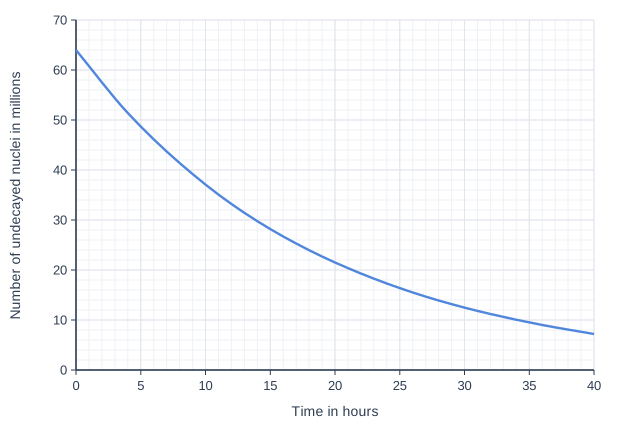
The graph shows how the number of undecayed nuclei in a sample of copper-64 changes with time.

Use the graph to find the half-life of copper-64.

Then calculate the time it will take for the number of undecayed copper-64 nuclei in the sample to fall to 4 million.

Line graph of number of undecayed nuclei in millions (y-axis, 0 to 70) against time in hours (x-axis, 0 to 40). The line is a smooth curve through (0, 64), (4, 51.4), (8, 41.4), (12, 33.2), (16, 26.7), (20, 21.5), (24, 17.3), (28, 13.9), (32, 11.2), (36, 9), (40, 7.2).

Model answer

Half of 64 million is 32 million. The graph reaches 32 million at about 12.7 hours, so the half-life is 12.7 hours.
64 → 32 → 16 → 8 → 4 million is 4 half-lives.
Time = 4 × 12.7 = 50.8 hours

Explanation

Read the half-life from the graph by halving the starting number (64 million → 32 million) and reading the time. The number 4 million is beyond the end of the graph, so count the halvings from 64 million to 4 million (four) and multiply by the half-life. Common errors are dividing 64 by 4 to get the number of half-lives, or reading the time at 32 million as the answer to the second part.

Mark scheme
  1. 1 mark

    half of 64 million is 32 million, and the time is read from the graph where the number is 32 million; or a correct final answer of 50.8 hours (allow 48 to 54 hours) with no working

    An answer of 50.8 hours (allow 48 to 54 hours) with no working scores 4 marks. A half-life of 12.7 hours (allow 12 to 13.5 hours) with no working scores MP1 and MP2. Accept a half-life read from any pair of values where one is half of the other, e.g. 32 million to 16 million.

  2. 1 mark

    half-life = 12.7 hours (allow 12 to 13.5 hours); or a correct final answer of 50.8 hours (allow 48 to 54 hours) with no working

    Ignore units for the half-life if the value is in the range.

  3. 1 mark

    64 → 32 → 16 → 8 → 4 (million) / 4 half-lives; or a correct final answer of 50.8 hours (allow 48 to 54 hours) with no working

    Accept '4 half-lives' stated. 64 ÷ 4 = 16 half-lives scores 0 for this point.

  4. 1 mark

    (time = 4 × 12.7 =) 50.8 (hours)

    Allow 48 to 54 hours. Allow ecf: 4 × the candidate's half-life. A time found by extending the curve beyond the graph without calculation scores 0 for this point. Ignore units.

Ready to try the rest? Every answer you write is marked against the mark scheme, so you can see exactly where the marks are.

Study Helper Hints first, answers after you try

Stuck on this one? Ask for a hint and I’ll point you in the right direction, without giving the answer away. Once you’ve checked your answer, I’ll show you how the marks are awarded.