
Level:
Correct: 0
Incorrect: 0
Marks: 0/0
Exam Practice
Course:
Topics:
Avg
score:
–
Topics
done:
0/24

Speed and distance-time graphs

Practise 16 exam-style questions on Speed and distance-time graphs for Edexcel GCSE Combined Science (Foundation Physics Paper 1). Write your answer as you would in the exam and get it marked in seconds against the mark scheme, point by point, with the Study Helper on hand if you get stuck.

  • 16 questions
  • 1–6 marks each
  • Instant marking
  • No sign-up needed
16 questions, marked as you go

Sample questions with model answers

Here are 4 of the questions in this topic, each with a model answer, an explanation of why it earns the marks and the mark scheme an examiner would use.

Question 1

1 mark

A bus travels along a road at an average speed of 12 m/s for 5.0 minutes.

How far does the bus travel in this time?

Choose your answer.

  • A 2.4 m
  • B 60 m
  • C 3600 m
  • D 216 000 m

Model answer

C - 3600 m

Explanation

Distance travelled = average speed × time, with the time in seconds because the speed is in metres per second. 5.0 minutes is 300 s, so the distance is 12 × 300 = 3600 m. The most common mistake is to multiply by the number of minutes.

Mark scheme
  1. 1 mark

    C / 3600 m

    The only correct answer is C: 5.0 minutes = 5.0 × 60 = 300 s, and distance = average speed × time = 12 × 300 = 3600 m. A is not correct because 2.4 is the speed divided by the time in minutes (12 ÷ 5.0); B is not correct because 60 m uses the time in minutes without changing it into seconds (12 × 5.0); D is not correct because 216 000 m comes from multiplying the minutes by 3600 instead of by 60 (12 × 5.0 × 3600). Accept the letter or the option. If more than one option is given, do not award the mark.
Question 2

2 marks

A narrowboat travels along a canal at an average speed of 6.0 km/h for 40 minutes.

Calculate the distance the narrowboat travels. Give your answer in km.

Use the equation

distance travelled = average speed × time

Model answer

40 minutes = 40 ÷ 60 = 0.667 hours
distance = 6.0 × 0.667 = 4.0 km

Explanation

The speed is in km per hour, so the time must be in hours: 40 minutes is two-thirds of an hour. A common mistake is to write 40 minutes as 0.40 hours, but there are 60 minutes in an hour, not 100. You can also change everything into SI units (1.67 m/s for 2400 s) and then change 4000 m into 4.0 km.

Mark scheme
  1. 1 mark

    time in hours and substitution: (distance =) 6.0 × 40 ÷ 60 / 6.0 × 0.67; or a correct final answer of 4.0 km with no working

    An answer of 4.0 km with no working scores 2 marks. accept working in SI units: 6.0 km/h = 1.67 m/s and 40 minutes = 2400 s, so distance = 1.67 × 2400 = 4000 m. accept 6.0 ÷ 60 = 0.1 km per minute, × 40. 6.0 × 40 = 240 (minutes not changed into hours) scores 0; 6.0 × 0.40 = 2.4 (40 minutes treated as 0.40 hours) scores 0.

  2. 1 mark

    evaluation: 4.0 (km)

    accept 4 km; accept 4000 m only if the unit m is given.

Question 3

3 marks

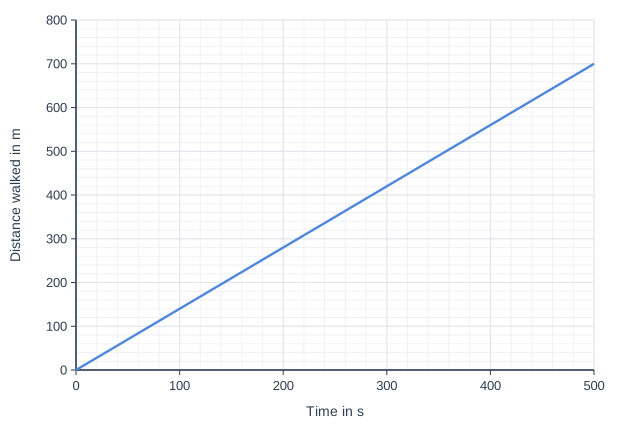
Leila walks at a steady speed along a straight seafront promenade. The graph shows the distance she walks.

Leila keeps walking at the same speed.

Use the graph to calculate the distance Leila walks in the first 20 minutes.

Use the equation

distance travelled = average speed × time

Line graph of distance walked in m (y-axis, 0 to 800) against time in s (x-axis, 0 to 500). The line joins the points (0, 0), (500, 700).

Model answer

speed = gradient = 700 m ÷ 500 s = 1.4 m/s
20 minutes = 20 × 60 = 1200 s
distance = 1.4 × 1200 = 1680 m

Explanation

First find Leila's speed from the gradient of the straight line. Because she keeps walking at the same speed, distance travelled = speed × time can be used for any time, as long as the time is in seconds: 20 minutes is 1200 s. Forgetting to change minutes into seconds gives an answer 60 times too small.

Mark scheme
  1. 1 mark

    speed from the graph = 700 ÷ 500 = 1.4 (m/s); or a correct final answer of 1680 m with no working

    An answer of 1680 m with no working scores 3 marks. accept any correct pair of readings from the line, e.g. 280 ÷ 200. allow 1.3 to 1.5 m/s. An answer of 28 m (1.4 × 20, minutes not changed into seconds) scores marking point 1 only.

  2. 1 mark

    20 minutes = 1200 s and (distance =) 1.4 × 1200; or a correct final answer of 1680 m with no working

    ecf their speed × 1200.

  3. 1 mark

    evaluation: 1680 (m)

    accept 1700 m / 1.68 km / 1.7 km. accept 1560 to 1800 m from a speed of 1.3 to 1.5 m/s read from the graph. ecf their speed × 1200 correctly evaluated.

Question 4

4 marks

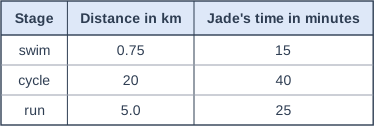
Jade takes part in a sprint triathlon. The race has three stages: a swim, a cycle ride and a run. The table shows the distance of each stage and the time Jade took.

Calculate Jade's average speed for the whole race. Give your answer in m/s.

Use the equation

average speed = distance ÷ time

Table with columns "Stage", "Distance in km", "Jade's time in minutes". Stage: swim; Distance in km: 0.75; Jade's time in minutes: 15 | Stage: cycle; Distance in km: 20; Jade's time in minutes: 40 | Stage: run; Distance in km: 5.0; Jade's time in minutes: 25.

Model answer

total distance = 0.75 + 20 + 5.0 = 25.75 km = 25 750 m
total time = 15 + 40 + 25 = 80 minutes = 80 × 60 = 4800 s
average speed = 25 750 ÷ 4800 = 5.36 m/s

Explanation

The average speed for the whole race is the total distance divided by the total time. You cannot just take the mean of the speeds of the three stages, because Jade spent different amounts of time on each stage. Change kilometres into metres and minutes into seconds to get an answer in m/s.

Mark scheme
  1. 1 mark

    total distance = 0.75 + 20 + 5.0 = 25.75 km / 25 750 m; or a correct final answer of 5.4 m/s with no working

    An answer of 5.4 m/s (or 5.36 m/s) with no working scores 4 marks. An answer of 0.32 km/min or 19 km/h (correct method, not changed into m/s) scores 3 marks. Finding the mean of the three stage speeds (0.83, 8.3 and 3.3 m/s, mean 4.2 m/s) is not a correct method and scores 0, unless the total distance or total time is also found.

  2. 1 mark

    total time = 15 + 40 + 25 = 80 minutes / 4800 s; or a correct final answer of 5.4 m/s with no working

    Each total may be in any unit for this mark and the one before it.

  3. 1 mark

    substitution with consistent units: (average speed =) 25 750 ÷ 4800; or a correct final answer of 5.4 m/s with no working

    accept 25.75 ÷ 80 (km/min) or 25.75 ÷ 1.33 (km/h) for this mark.

  4. 1 mark

    evaluation: 5.4 (m/s) / 5.36 (m/s)

    accept any value that rounds to 5.4, e.g. 5.36 or 5.365. Ignore units.

Ready to try the rest? Every answer you write is marked against the mark scheme, so you can see exactly where the marks are.

Study Helper Hints first, answers after you try

Stuck on this one? Ask for a hint and I’ll point you in the right direction, without giving the answer away. Once you’ve checked your answer, I’ll show you how the marks are awarded.