
Level:
Correct: 0
Incorrect: 0
Marks: 0/0
Exam Practice
Course:
Topics:
Avg
score:
–
Topics
done:
0/24

Nuclear radiation and background radiation

Practise 16 exam-style questions on Nuclear radiation and background radiation for Edexcel GCSE Combined Science (Foundation Physics Paper 1). Write your answer as you would in the exam and get it marked in seconds against the mark scheme, point by point, with the Study Helper on hand if you get stuck.

  • 16 questions
  • 1–6 marks each
  • Instant marking
  • No sign-up needed
16 questions, marked as you go

Sample questions with model answers

Here are 4 of the questions in this topic, each with a model answer, an explanation of why it earns the marks and the mark scheme an examiner would use.

Question 1

1 mark

Which statement describes background radiation?

Choose your answer.

  • A radiation given out only by nuclear power stations and hospitals
  • B low-level ionising radiation that is around us all the time
  • C radiation from a radioactive source used in an experiment
  • D infrared radiation given off by warm objects around us

Model answer

B - low-level ionising radiation that is around us all the time.

Explanation

Background radiation is the ionising radiation we are exposed to all the time, wherever we are. Most of it comes from natural sources, such as radioactive substances in rocks, soil, food and the air (radon gas), and cosmic rays from space. A G-M tube always records a small count, even with no radioactive source nearby, because of background radiation.

Mark scheme
  1. 1 mark

    B / low-level ionising radiation that is around us all the time

    The only correct answer is B: background radiation is the ionising radiation that is present everywhere, all the time, mostly from natural sources on Earth and in space. A is not correct because most background radiation comes from natural sources such as rocks, radon gas and cosmic rays, not only from power stations and hospitals; C is not correct because radiation from a source in an experiment is not background - background radiation is what is measured when the source is taken away; D is not correct because background radiation means ionising radiation, and infrared is not ionising. Accept the letter or the option. If more than one option is given, do not award the mark.
Question 2

2 marks

When ionising radiation from a radioactive source passes through air, some of the atoms in the air are ionised.

Explain what happens to an atom when it is ionised.

Model answer

The radiation knocks one or more electrons out of the atom. The atom now has more protons than electrons, so it becomes a positive ion.

Explanation

Ionising radiation carries enough energy to remove electrons from atoms. An atom that loses an electron has more positive protons than negative electrons, so it becomes a positive ion. A common mistake is to say the atom becomes radioactive: being ionised does not change the nucleus.

Mark scheme
  1. 1 mark

    the radiation removes (knocks out) one or more electrons from the atom

    Accept 'the atom loses an electron'. Do not accept 'the atom loses a proton' or 'the atom becomes radioactive'.

  2. 1 mark

    so the atom becomes a positive ion / has more protons than electrons / becomes positively charged

    Accept 'it becomes charged'. Do not accept 'it becomes an ion' with no idea of charge (this only repeats the question), or 'it becomes a negative ion'.

Question 3

3 marks

A small sealed source that emits gamma radiation has been dropped somewhere on the floor of a hospital storeroom. A technician uses a Geiger-Müller (G-M) tube connected to a counter to find it.

Describe how she should use the G-M tube and counter to find where the source is.

Model answer

First, the technician measures the background count rate somewhere well away from the source, so she knows what the counter reads when no source is nearby. Then she moves the G-M tube slowly across the floor of the storeroom, watching the count rate. As the tube gets closer to the source, the count rate rises well above the background count rate, so the source is where the count rate is highest. Because radioactive emission is random, she keeps the tube still for a few seconds at each place before deciding.

Explanation

A G-M tube detects ionising radiation, and the count rate is higher the closer it is to a source. Knowing the background count rate first lets the technician tell when the reading is caused by the lost source. A common mistake is to expect a count rate of zero away from the source: background radiation is always detected.

Mark scheme
  1. 1 mark

    first measure the background count rate (somewhere away from the source / outside the storeroom), so she knows the reading when no source is nearby

    Any three of the four marking points; max 3. Accept 'find what the counter reads with no source near it'.

  2. 1 mark

    move the G-M tube (slowly) around / across the floor of the storeroom, watching the count rate (or listening to the clicks)

    Accept 'take readings at different places around the room'. Do not accept 'look for the source' with no use of the G-M tube.

  3. 1 mark

    the count rate rises (above background) as the tube gets closer to the source, so the source is where the count rate is highest

    Accept 'follow the direction in which the clicks get faster'. Do not accept 'the counter reads zero when it is far from the source' (there is always background radiation).

  4. 1 mark

    keep the tube in each place for a few seconds (or take more than one reading) before deciding, because the emission of radiation is random

    Accept 'the readings go up and down at random, so wait for the count to settle'.

Question 4

4 marks

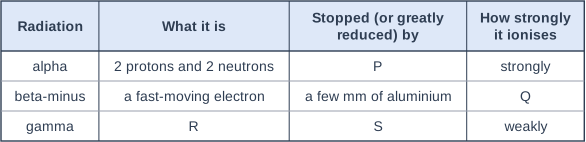
The table gives some information about alpha, beta-minus and gamma radiation. Some of the information is missing.

Give the information that should replace each of the letters P, Q, R and S.

Table with columns "Radiation", "What it is", "Stopped (or greatly reduced) by", "How strongly it ionises". Radiation: alpha; What it is: 2 protons and 2 neutrons; Stopped (or greatly reduced) by: P; How strongly it ionises: strongly | Radiation: beta-minus; What it is: a fast-moving electron; Stopped (or greatly reduced) by: a few mm of aluminium; How strongly it ionises: Q | Radiation: gamma; What it is: R; Stopped (or greatly reduced) by: S; How strongly it ionises: weakly.

Model answer

P: a sheet of paper (or a few centimetres of air)
Q: moderately ionising
R: electromagnetic radiation
S: thick lead (or thick concrete)

Explanation

Alpha particles are the most strongly ionising and the least penetrating: paper or a few centimetres of air stops them. Beta-minus particles are moderately ionising and are stopped by a few millimetres of aluminium. Gamma rays are electromagnetic radiation, weakly ionising and very penetrating: thick lead or concrete reduces them a lot. A common mistake is to think the most penetrating radiation is also the most ionising.

Mark scheme
  1. 1 mark

    P: (a sheet of) paper / a few centimetres of air / skin

    Each letter scores 1 mark independently. Do not accept 'aluminium' or 'lead' for P.

  2. 1 mark

    Q: moderately (ionising) / less than alpha but more than gamma

    Accept 'medium' or 'in between'. Do not accept 'strongly' or 'weakly' on their own.

  3. 1 mark

    R: electromagnetic radiation / an electromagnetic wave

    Accept 'EM radiation' or 'EM wave'. Do not accept 'a wave' or 'a ray' on its own, or 'a particle'.

  4. 1 mark

    S: thick lead / several centimetres of lead / thick concrete

    Accept 'lead'. Ignore 'it is never completely stopped'. Do not accept 'aluminium' or 'paper'.

Ready to try the rest? Every answer you write is marked against the mark scheme, so you can see exactly where the marks are.

Study Helper Hints first, answers after you try

Stuck on this one? Ask for a hint and I’ll point you in the right direction, without giving the answer away. Once you’ve checked your answer, I’ll show you how the marks are awarded.