
Level:
Correct: 0
Incorrect: 0
Marks: 0/0
Exam Practice
Course:
Topics:
Avg
score:
–
Topics
done:
0/24

Energy stores, transfers and conservation

Practise 16 exam-style questions on Energy stores, transfers and conservation for Edexcel GCSE Combined Science (Foundation Physics Paper 1). Write your answer as you would in the exam and get it marked in seconds against the mark scheme, point by point, with the Study Helper on hand if you get stuck.

  • 16 questions
  • 1–6 marks each
  • Instant marking
  • No sign-up needed
16 questions, marked as you go

Sample questions with model answers

Here are 4 of the questions in this topic, each with a model answer, an explanation of why it earns the marks and the mark scheme an examiner would use.

Question 1

1 mark

The Sankey diagram shows the energy transfers in a desk fan in one second.

Calculate the total energy wasted by the fan in one second.
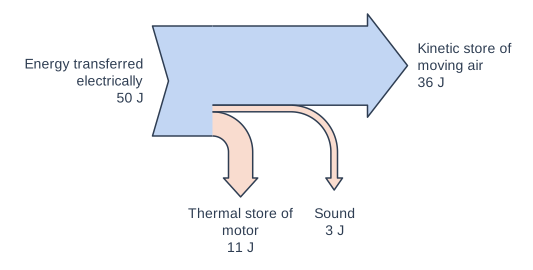
Energy transfer (Sankey) diagram. An arrow on the left labelled "Energy transferred electrically 50 J" splits into an arrow that continues straight on, labelled "Kinetic store of moving air 36 J", and 2 arrows that bend downwards, labelled "Thermal store of motor 11 J" and "Sound 3 J" (from left to right). The width of each arrow is proportional to its value.

Model answer

Energy wasted = 11 + 3
Energy wasted = 14 J

Explanation

The wasted energy is shown by the arrows that bend away from the useful output: the energy transferred to the thermal store of the motor and the energy transferred by sound. Add them (11 J + 3 J), or subtract the useful energy from the input (50 J − 36 J), because energy is conserved. A common mistake is to count only the thermal store and forget that sound is also wasted.

Mark scheme
  1. 1 mark

    14 (J)

    An answer of 14 J with no working scores 1 mark. Working: 11 + 3 = 14, or 50 − 36 = 14. 11 J (sound left out) or 3 J scores 0. 36 J (the useful energy) or 89 J (adding all the outputs) scores 0. Ignore units.
Question 2

2 marks

Seren leaves a torch switched on until its battery is flat.

She says, 'The energy that was stored in the battery has been used up, so it does not exist any more.'

Explain why Seren is wrong.

Model answer

Energy cannot be created or destroyed. The energy has been transferred from the chemical store of the battery, by light and by heating, to the thermal store of the surroundings. It still exists, but it is spread out and is no longer useful.

Explanation

Conservation of energy means that energy is never used up: it is only transferred from one store to another. Here the chemical store of the battery decreases, and the surroundings end up very slightly warmer. 'Used up' is a common everyday phrase, but in physics the energy has been dissipated, not destroyed.

Mark scheme
  1. 1 mark

    energy cannot be created or destroyed / energy is conserved

    allow 'energy cannot be destroyed'. Ignore 'energy cannot be made'. Do not accept 'energy is used up'.

  2. 1 mark

    the energy has been transferred (from the chemical store of the battery) to other stores, e.g. to the thermal store of the surroundings / the energy has been dissipated / spread out in the surroundings (by light and by heating)

    allow the energy is now in the thermal store of the room / air / walls. allow the light is absorbed by the surroundings and warms them. Ignore 'it has turned into light' with no idea of where the energy ends up.

Question 3

3 marks

Eli fills an electric kettle with water and switches it on. After three minutes the water boils and the kettle switches itself off.

Eli forgets about the water. One hour later the water is only warm.

Describe the changes in the way energy is stored from when the kettle is switched on until one hour later.

Model answer

When the kettle is switched on, energy is transferred electrically to the heating element. The element heats the water, so the thermal energy store of the water increases until it boils. Some energy is also transferred to the thermal store of the kettle and the air around it. After the kettle switches off, energy is transferred by heating from the hot water to the surroundings, so the thermal store of the water decreases and the thermal store of the room increases.

Explanation

Split the answer into two stages: heating (the thermal store of the water increases) and cooling (the thermal store of the water decreases and that of the surroundings increases). Energy is not lost when the water cools: it is dissipated into the room, where it is stored in a less useful way. Name the stores (thermal) and the ways of transfer (electrically, by heating).

Mark scheme
  1. 1 mark

    energy is transferred electrically (from the mains) to the heating element / the thermal store of the heating element increases

    Any three from marking points 1 to 4; max 3. allow 'electrical energy is supplied to the element'.

  2. 1 mark

    energy is transferred by heating from the element to the water / the thermal (energy) store of the water increases (while the kettle is on)

    allow 'the water gains thermal energy' / 'the water heats up'.

  3. 1 mark

    while the water is heating, some energy is transferred to the thermal store of the kettle itself / of the surroundings (wasted)

    allow 'the kettle gets warm' / 'some energy is dissipated to the surroundings while it heats'.

  4. 1 mark

    after the kettle switches off, energy is transferred by heating from the water to the surroundings / the thermal store of the water decreases and the thermal store of the surroundings (air / room) increases

    Both the decrease in the water's thermal store and the transfer to the surroundings are needed, e.g. 'the water cools down as energy is transferred to the air'. Ignore 'the energy is lost' with no destination.

Question 4

4 marks

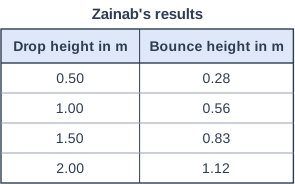
Zainab drops a tennis ball from different heights onto a hard floor. She measures the height of the first bounce each time.

The table shows her results.

Zainab says, 'My results show that energy is not conserved when the ball bounces, because the ball never bounces back to the height it was dropped from.'

Explain why Zainab is wrong. Use data from the table in your answer.

Zainab's results. Table with columns "Drop height in m", "Bounce height in m". Drop height in m: 0.50; Bounce height in m: 0.28 | Drop height in m: 1.00; Bounce height in m: 0.56 | Drop height in m: 1.50; Bounce height in m: 0.83 | Drop height in m: 2.00; Bounce height in m: 1.12.

Model answer

The ball does bounce lower than it was dropped from: for example, dropped from 1.00 m it only bounces to 0.56 m, so its gravitational potential energy store at the top of the bounce is less than at the start. But the energy has not been destroyed. When the ball hits the floor, some energy is transferred to the thermal stores of the ball and the floor, and some is transferred by sound. Air resistance also transfers some energy to the thermal store of the air. The 'missing' energy is in the surroundings, so the total energy is the same and energy is conserved.

Explanation

Energy is always conserved, but not all of it stays in useful stores. Use the data to show the loss in height (and so in gravitational potential energy), then say where that energy went: the thermal stores of the ball, the floor and the air, partly by sound. A good answer ends by saying the total energy is unchanged; just saying 'energy is lost' does not explain why Zainab is wrong.

Mark scheme
  1. 1 mark

    use of data to show that the bounce height is less than the drop height, e.g. dropped from 1.00 m, it bounces to 0.56 m, so the gravitational potential energy store of the ball at the top of the bounce is less than at the start

    Max 3 if no data from the table are used. allow any correct pair of values from the table, or 'the ball bounces to just over half (about 55%) of the drop height' / 'almost half of the gravitational potential energy is not regained'.

  2. 1 mark

    when the ball hits the floor, some energy is transferred to the thermal stores of the ball and the floor / some energy is transferred by sound

    allow 'the ball and floor warm up slightly'. allow 'heat' for thermal.

  3. 1 mark

    air resistance (as the ball falls and rises) transfers some energy to the thermal store of the air / surroundings

    allow 'work is done against air resistance'.

  4. 1 mark

    energy is not destroyed: the 'missing' energy has been dissipated to the surroundings, so the total energy is still the same / energy is still conserved

    allow 'energy cannot be created or destroyed, it has just been transferred to other stores'. Do not accept 'energy is lost' with no idea of where it goes.

Ready to try the rest? Every answer you write is marked against the mark scheme, so you can see exactly where the marks are.

Study Helper Hints first, answers after you try

Stuck on this one? Ask for a hint and I’ll point you in the right direction, without giving the answer away. Once you’ve checked your answer, I’ll show you how the marks are awarded.