
Level:
Correct: 0
Incorrect: 0
Marks: 0/0
Exam Practice
Course:
Topics:
Avg
score:
–
Topics
done:
0/22

Resistance and series circuits

Practise 18 exam-style questions on Resistance and series circuits for Edexcel GCSE Combined Science (Foundation Physics Paper 2). Write your answer as you would in the exam and get it marked in seconds against the mark scheme, point by point, with the Study Helper on hand if you get stuck.

  • 18 questions
  • 1–6 marks each
  • Instant marking
  • No sign-up needed
18 questions, marked as you go

Sample questions with model answers

Here are 4 of the questions in this topic, each with a model answer, an explanation of why it earns the marks and the mark scheme an examiner would use.

Question 1

1 mark

The heater in the rear window of a car is connected to the car's 12 V battery. The resistance of the heater is 1.5 Ω.

What is the current in the heater?

Choose your answer.

  • A 0.125 A
  • B 8.0 A
  • C 10.5 A
  • D 18 A

Model answer

B

V = I × R, so I = V ÷ R = 12 ÷ 1.5 = 8.0 A

Explanation

Recall V = I × R and rearrange it to make the current the subject: I = V ÷ R. Dividing 12 V by 1.5 Ω gives 8.0 A. The wrong options come from dividing the wrong way round, subtracting or multiplying.

Mark scheme
  1. 1 mark

    B / 8.0 A

    The only correct answer is B: from V = I × R, current = potential difference ÷ resistance = 12 ÷ 1.5 = 8.0 A. A is not correct because 1.5 ÷ 12 = 0.125 divides the resistance by the potential difference; C is not correct because 12 − 1.5 = 10.5 subtracts the two values; D is not correct because 12 × 1.5 = 18 multiplies them. Accept the letter or the option. If more than one option is given, do not award the mark.
Question 2

2 marks

A soldering iron in a school electronics room runs from a 24 V supply. The resistance of its heating element is 12 Ω.

Calculate the current in the heating element.

Use the equation

V = I × R

Model answer

V = I × R, so I = V ÷ R
I = 24 ÷ 12
I = 2.0 A

Explanation

Rearrange V = I × R to make the current the subject, I = V ÷ R, then substitute the potential difference and the resistance. Write the substitution down before you work it out. A common mistake is to multiply 24 by 12 instead of dividing.

Mark scheme
  1. 1 mark

    rearrangement and substitution: (I =) 24 ÷ 12; or a correct final answer of 2.0 A with no working

    An answer of 2.0 A with no working scores 2 marks. Allow substitution into V = I × R first: 24 = I × 12. 24 × 12 = 288 and 12 ÷ 24 = 0.5 (wrong rearrangements) score 0.

  2. 1 mark

    evaluation: 2.0 (A)

    Accept 2 (A). Ignore units.

Question 3

3 marks

A technician tests part of the circuit board from a toy keyboard. Three resistors of 5.0 Ω, 8.0 Ω and 12 Ω are connected in series with a battery and an ammeter. The ammeter reads 0.36 A.

Calculate the potential difference across the battery.

Model answer

net resistance = 5.0 + 8.0 + 12 = 25 Ω
V = I × R
V = 0.36 × 25
V = 9.0 V

Explanation

In a series circuit the net resistance is the sum of all the resistances, and the same current passes through each resistor. Multiply the current by the net resistance to find the battery p.d. Using only one of the resistors gives a p.d. that is too small.

Mark scheme
  1. 1 mark

    (net resistance =) 5.0 + 8.0 + 12 = 25 (Ω); or a correct final answer of 9.0 V with no working

    An answer of 9.0 V with no working scores 3 marks. The equation is not given: students must recall V = I × R. 0.36 × 12 = 4.3 V or 0.36 × 5.0 = 1.8 V (using one resistor only) scores 0. 25 ÷ 0.36 = 69 scores marking point 1 only.

  2. 1 mark

    substitution: (V =) 0.36 × 25; or a correct final answer of 9.0 V with no working

    Allow ecf from an incorrect net resistance (for example 0.36 × 24).

  3. 1 mark

    evaluation: 9.0 (V)

    Accept 9 (V). Ignore units.

Question 4

4 marks

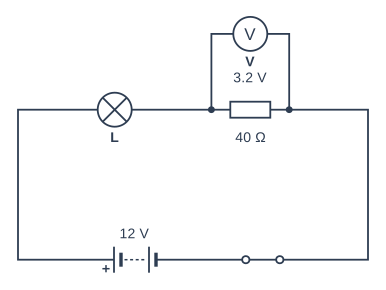
Nia makes an illuminated sign for a school play. She connects a lamp L in series with a 40 Ω resistor, a switch and a 12 V battery. The diagram shows the circuit.

When the switch is closed, voltmeter V reads 3.2 V.

Calculate the resistance of the lamp.

Use the equation

V = I × R

Circuit diagram. Going round the loop from the + terminal of the battery (labelled 12 V): lamp L; then a resistor labelled 40 Ω, with voltmeter V (reading 3.2 V) connected across it; then a closed switch; and back to the − terminal of the battery.

Model answer

current in the resistor = V ÷ R = 3.2 ÷ 40 = 0.080 A (the same current is in the lamp, because they are in series)
p.d. across the lamp = 12 − 3.2 = 8.8 V
resistance of the lamp = V ÷ I = 8.8 ÷ 0.080
resistance of the lamp = 110 Ω

Explanation

Use the voltmeter reading and the 40 Ω to find the current, which is the same in every part of a series circuit. The battery p.d. is shared, so the lamp has 12 − 3.2 = 8.8 V across it. Another route is to find the net resistance, 12 ÷ 0.080 = 150 Ω, and subtract 40 Ω; forgetting to subtract gives 150 Ω.

Mark scheme
  1. 1 mark

    (current =) 3.2 ÷ 40 = 0.080 (A); or a correct final answer of 110 Ω with no working

    An answer of 110 Ω with no working scores 4 marks. Marking points 1 to 3 may be seen in any order. Credit any other correct method in full, e.g. the ratio of the potential differences: (R =) 40 × 8.8 ÷ 3.2 = 110 Ω. An answer of 150 Ω (12 ÷ 0.080, the net resistance of the circuit, with the 40 Ω not subtracted) scores marking points 1 and 2. 12 ÷ 40 = 0.30 A does not score marking point 1.

  2. 1 mark

    (p.d. across the lamp =) 12 − 3.2 = 8.8 (V) / (net resistance =) 12 ÷ 0.080 = 150 (Ω); or a correct final answer of 110 Ω with no working

    Either route scores this mark.

  3. 1 mark

    (R =) 8.8 ÷ 0.080 / 150 − 40; or a correct final answer of 110 Ω with no working

    Allow ecf from an incorrect current or p.d. (for example 8.8 ÷ 0.30).

  4. 1 mark

    evaluation: 110 (Ω)

    Ignore units.

Ready to try the rest? Every answer you write is marked against the mark scheme, so you can see exactly where the marks are.

Study Helper Hints first, answers after you try

Stuck on this one? Ask for a hint and I’ll point you in the right direction, without giving the answer away. Once you’ve checked your answer, I’ll show you how the marks are awarded.