
Level:
Correct: 0
Incorrect: 0
Marks: 0/0
Exam Practice
Course:
Topics:
Avg
score:
–
Topics
done:
0/22

Core practical: extension of a spring

Practise 15 exam-style questions on Core practical: extension of a spring for Edexcel GCSE Combined Science (Foundation Physics Paper 2). Write your answer as you would in the exam and get it marked in seconds against the mark scheme, point by point, with the Study Helper on hand if you get stuck.

  • 15 questions
  • 1–6 marks each
  • Instant marking
  • No sign-up needed
15 questions, marked as you go

Sample questions with model answers

Here are 4 of the questions in this topic, each with a model answer, an explanation of why it earns the marks and the mark scheme an examiner would use.

Question 1

1 mark

Sienna hangs a mass hanger of mass 50 g on a spring. She then puts two 50 g slotted masses on the hanger.

What is the force stretching the spring?

(gravitational field strength, g = 10 N/kg)

Choose your answer.

  • A 1.5 N
  • B 1.0 N
  • C 1500 N
  • D 0.15 N

Model answer

A - 1.5 N.

Explanation

The force on the spring is the weight of everything hanging from it, including the hanger: weight = mass × g, with the mass in kilograms. Forgetting the hanger, or forgetting to convert grams to kilograms, are common errors.

Mark scheme
  1. 1 mark

    A / 1.5 N

    The only correct answer is A: the total mass is 50 + 50 + 50 = 150 g = 0.150 kg, and the force stretching the spring is the weight of the hanger and masses: W = m × g = 0.150 × 10 = 1.5 N. B is not correct because it leaves out the mass of the hanger (0.100 × 10 = 1.0 N); C is not correct because it uses the mass in grams instead of kilograms (150 × 10); D is not correct because 0.15 is the mass in kilograms, not the weight (it has not been multiplied by g). Accept the letter or the option. If more than one option is given, do not award the mark.
Question 2

2 marks

Students doing the spring practical are told to wear eye protection.

Explain why.

Model answer

If the spring is stretched too far, it may snap or slip off the clamp, or the hanger may come off. A stretched spring stores energy, so the spring or a mass could then fly up or spring back very quickly and hit someone in the eye.

Explanation

A stretched spring stores elastic energy. If it breaks or slips, that energy is released suddenly and the spring can whip back fast enough to injure an eye. That is why eye protection is worn, and why the spring should not be overloaded.

Mark scheme
  1. 1 mark

    the spring may snap / slip off the clamp, or the hanger may come off, (especially if the spring is stretched too far)

    An explanation linking two points. Ignore 'for safety' or 'to protect the eyes' on its own.

  2. 1 mark

    (a stretched spring stores energy, so) the spring or a mass could fly up / spring back quickly and hit the eyes

    accept 'the end of the spring could whip back into someone's face'.

Question 3

2 marks

Femi's force-extension graph for a spring is a straight line through the origin up to an extension of 15 cm. Above 15 cm the line curves.

Femi wants to find the work done in stretching the spring to an extension of 25 cm. He plans to use the equation E = ½ × k × x², with the spring constant from the straight part of his graph.

Explain why this would not give the correct value.

Model answer

The equation E = ½ × k × x² only works while the extension is directly proportional to the force, which is up to 15 cm, where the graph is a straight line. Above 15 cm the relationship is non-linear: force ÷ extension is no longer the same, so there is no single spring constant to put into the equation, and the force is no longer k × x. So the value would not be correct.

Explanation

E = ½ × k × x² comes from a straight-line force-extension graph, with one value of k. Beyond the point where the graph stops being straight, k is not constant, so the equation does not give the work done.

Mark scheme
  1. 1 mark

    the equation (E = ½ × k × x²) only applies when the extension is directly proportional to the force / in the straight part of the graph (up to 15 cm)

    An explanation linking two points.

  2. 1 mark

    above 15 cm the relationship is non-linear, so the spring does not have the same spring constant / the force is no longer k × x

    accept 'k changes above 15 cm' or 'there is no single value of k for the curved part'. Ignore 'the spring is inelastic' on its own.

Question 4

4 marks

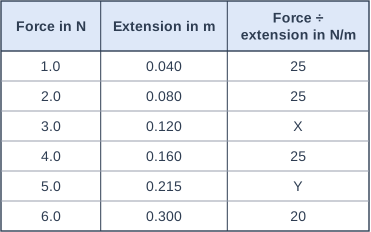
Keira investigates the extension of a spring. For each result she calculates force ÷ extension. The table shows her results. Two values, X and Y, are missing.

Give the values of X and Y.

Use the table to give the largest force for which the extension of the spring is directly proportional to the force. Explain your answer.

Table with columns "Force in N", "Extension in m", "Force ÷ extension in N/m". Force in N: 1.0; Extension in m: 0.040; Force ÷ extension in N/m: 25 | Force in N: 2.0; Extension in m: 0.080; Force ÷ extension in N/m: 25 | Force in N: 3.0; Extension in m: 0.120; Force ÷ extension in N/m: X | Force in N: 4.0; Extension in m: 0.160; Force ÷ extension in N/m: 25 | Force in N: 5.0; Extension in m: 0.215; Force ÷ extension in N/m: Y | Force in N: 6.0; Extension in m: 0.300; Force ÷ extension in N/m: 20.

Model answer

X = 3.0 ÷ 0.120 = 25 N/m
Y = 5.0 ÷ 0.215 = 23 N/m

The largest force is 4.0 N. Up to 4.0 N, force ÷ extension is the same, 25 N/m, so the extension is directly proportional to the force. For 5.0 N and 6.0 N, force ÷ extension is smaller (23 N/m and 20 N/m), so the extension is no longer proportional to the force.

Explanation

If the extension is directly proportional to the force, force ÷ extension (the spring constant) is the same for every result. Here it stays at 25 N/m up to 4.0 N and then falls, which is where a force-extension graph would stop being a straight line.

Mark scheme
  1. 1 mark

    X = 25 (N/m)

    Mark each point separately. (3.0 ÷ 0.120 =) 25.

  2. 1 mark

    Y = 23 (N/m)

    (5.0 ÷ 0.215 = 23.3) accept values that round to 23, e.g. 23.3 or 23.26. Do not accept 0.043 (0.215 ÷ 5.0).

  3. 1 mark

    4.0 N

    Do not accept 5.0 N or 6.0 N.

  4. 1 mark

    force ÷ extension is the same (25 N/m) for every force up to 4.0 N, but it is smaller for 5.0 N and 6.0 N (23 N/m and 20 N/m)

    allow ecf from their value of Y. accept 'up to 4.0 N the extension increases by 0.040 m for each 1.0 N, but by more after that'. Do not accept 'the extension keeps increasing' on its own.

Ready to try the rest? Every answer you write is marked against the mark scheme, so you can see exactly where the marks are.

Study Helper Hints first, answers after you try

Stuck on this one? Ask for a hint and I’ll point you in the right direction, without giving the answer away. Once you’ve checked your answer, I’ll show you how the marks are awarded.