
Level:
Correct: 0
Incorrect: 0
Marks: 0/0
Exam Practice
Course:
Topics:
Avg
score:
–
Topics
done:
0/22

Core practical: specific heat capacity and melting ice

Practise 16 exam-style questions on Core practical: specific heat capacity and melting ice for Edexcel GCSE Combined Science (Foundation Physics Paper 2). Write your answer as you would in the exam and get it marked in seconds against the mark scheme, point by point, with the Study Helper on hand if you get stuck.

  • 16 questions
  • 1–6 marks each
  • Instant marking
  • No sign-up needed
16 questions, marked as you go

Sample questions with model answers

Here are 4 of the questions in this topic, each with a model answer, an explanation of why it earns the marks and the mark scheme an examiner would use.

Question 1

1 mark

In the core practical to find the specific heat capacity of water, the water is stirred before each temperature reading is taken.

Give a reason for stirring the water.

Model answer

So that all of the water is at the same temperature, and the thermometer reading is the temperature of the whole of the water.

Explanation

Water near the heater warms up faster than water further away. Stirring mixes the water so that it is all at the same temperature, so the thermometer measures the true temperature of all the water that the energy has gone into.

Mark scheme
  1. 1 mark

    so that all of the water is at the same temperature / to spread the energy evenly through the water, so the thermometer reads the temperature of the whole of the water

    accept 'so there are no hotter or colder parts in the water'. Do not accept 'to heat the water faster' or 'to make it more accurate' on its own.
Question 2

2 marks

Two thermometers are available for the specific heat capacity of water practical:
- a liquid-in-glass thermometer with a scale marked every 1 °C
- a digital thermometer that reads to 0.1 °C.

The temperature of the water will rise by only about 8 °C.

Explain why the digital thermometer is the better choice.

Model answer

The digital thermometer reads to 0.1 °C, so its readings are much more precise. The temperature rise is only about 8 °C, so with a scale marked every 1 °C a reading error of up to 1 °C would be a big fraction of the rise (about 12%). An error of 0.1 °C is only about 1% of the rise, so the value of c will be more accurate.

Explanation

Choose an instrument whose resolution is small compared with the change being measured. With a small temperature rise, a coarse scale gives a large percentage error in Δθ, and so in the specific heat capacity. 'It is more accurate' on its own is not enough: say why.

Mark scheme
  1. 1 mark

    the digital thermometer has a higher resolution / measures to 0.1 °C, so its readings are more precise

    Max 2. One mark for each of marking points 1 to 3, max 2. Ignore 'it is easier to read' on its own.

  2. 1 mark

    the temperature rise is small, so an error of about 1 °C (or 0.5 °C) would be a large fraction of it (about 1 in 8), but an error of 0.1 °C is only a small fraction / so the value of c is more accurate

    accept 'a reading error of 1 °C would be about 12% of the rise'.

  3. 1 mark

    there is no scale to read, so there are no reading (parallax) errors from looking at the scale from an angle

Question 3

2 marks

In the melting ice core practical, a student keeps taking temperature readings for several minutes after all of the ice has melted.

Explain why she does this.

Model answer

She wants to show that once all of the ice has melted the temperature starts to rise again. This shows clearly where the flat section of the graph ends, so she can see when the melting finished and how long it lasted.

Explanation

The flat section at 0 °C is only clear if there are readings on both sides of it: rising before melting and rising again after it. Stopping as soon as the ice has melted leaves the end of the flat section uncertain.

Mark scheme
  1. 1 mark

    to show that the temperature starts to rise again once all of the ice has melted / once there is only liquid water

  2. 1 mark

    so the end of the flat section can be seen clearly on the graph / so she can find when melting finished and how long the ice took to melt

    Do not accept 'to get more results' or 'to make it more accurate' on its own.

Question 4

4 marks

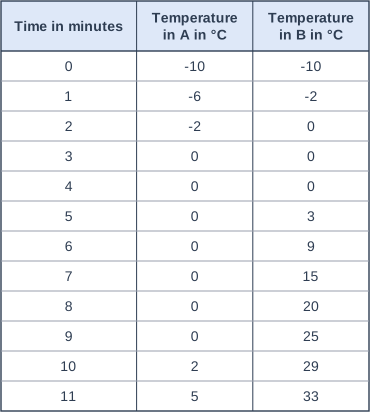
Two students each heat 30 g of crushed ice at -10 °C in a boiling tube. Student A stands the tube in a water bath at 30 °C. Student B uses a water bath at 60 °C. They record the temperature in the tube every minute.

The table shows their results.

Compare the times the ice took to melt in the two experiments, and explain the difference.

Table with columns "Time in minutes", "Temperature in A in °C", "Temperature in B in °C". Time in minutes: 0; Temperature in A in °C: -10; Temperature in B in °C: -10 | Time in minutes: 1; Temperature in A in °C: -6; Temperature in B in °C: -2 | Time in minutes: 2; Temperature in A in °C: -2; Temperature in B in °C: 0 | Time in minutes: 3; Temperature in A in °C: 0; Temperature in B in °C: 0 | Time in minutes: 4; Temperature in A in °C: 0; Temperature in B in °C: 0 | Time in minutes: 5; Temperature in A in °C: 0; Temperature in B in °C: 3 | Time in minutes: 6; Temperature in A in °C: 0; Temperature in B in °C: 9 | Time in minutes: 7; Temperature in A in °C: 0; Temperature in B in °C: 15 | Time in minutes: 8; Temperature in A in °C: 0; Temperature in B in °C: 20 | Time in minutes: 9; Temperature in A in °C: 0; Temperature in B in °C: 25 | Time in minutes: 10; Temperature in A in °C: 2; Temperature in B in °C: 29 | Time in minutes: 11; Temperature in A in °C: 5; Temperature in B in °C: 33.

Model answer

In A the temperature stayed at 0 °C from 3 to 9 minutes, so the ice took about 6 minutes to melt. In B it stayed at 0 °C only from 2 to 4 minutes, about 2 minutes, so the ice melted about three times as fast.
B's water bath was hotter, so there was a bigger temperature difference between the water and the ice, and energy was transferred to the ice at a higher rate. Both tubes held 30 g of ice, which needs the same amount of energy to melt (Q = m × L), so B supplied this energy in a shorter time.

Explanation

The length of the flat section is the time taken to melt the ice. The energy needed depends only on the mass of ice and the specific latent heat, so a faster rate of energy transfer (from a hotter water bath) melts the same ice more quickly. Notice that the temperature during melting is 0 °C in both experiments: the hotter bath changes how fast the ice melts, not the melting point.

Mark scheme
  1. 1 mark

    use of data: in A the temperature stayed at 0 °C for about 6 minutes (from 3 to 9 minutes) but in B for only about 2 minutes (from 2 to 4 minutes) / the ice in B melted about three times as fast

    allow 5 to 7 minutes for A and 2 to 3 minutes for B.

  2. 1 mark

    B's water bath is hotter / there is a bigger temperature difference between the water bath and the ice in B

  3. 1 mark

    so energy is transferred to the ice at a higher rate (faster) in B

  4. 1 mark

    the same mass of ice needs the same amount of energy to melt (Q = m × L), so in B this energy is supplied in a shorter time

    accept 'both need the same energy to melt because they have the same mass'.

Ready to try the rest? Every answer you write is marked against the mark scheme, so you can see exactly where the marks are.

Study Helper Hints first, answers after you try

Stuck on this one? Ask for a hint and I’ll point you in the right direction, without giving the answer away. Once you’ve checked your answer, I’ll show you how the marks are awarded.